What's inside
As an Amazon Associate I earn from qualifying purchases. This post may contain affiliate links at no extra cost to you.
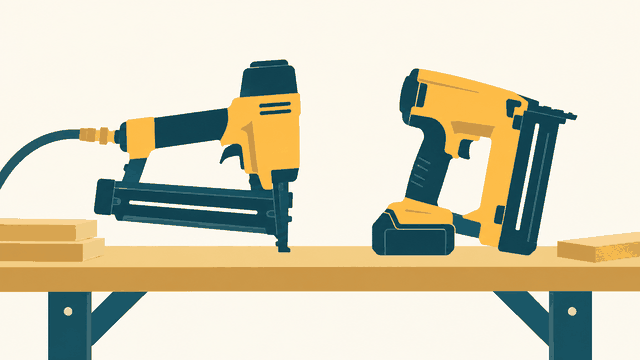
On a remote jobsite, the choice between a cordless framing nailer and a pneumatic nailer is less about raw driving power than about what you can reliably carry, charge, repair, and operate all day. A pneumatic setup is usually cheaper and lighter at the tool, but it needs a compressor, hose, power source, fittings, and maintenance. A cordless framer removes that entire air system, but adds battery weight, charging limits, and more expensive replacement parts.
As an Amazon Associate we earn from qualifying purchases at no extra cost to you.


The basic trade-off
A pneumatic framing nailer is the sensible choice when a compressor and dependable electricity are already available. It delivers consistent performance, supports rapid production, and does not stop because a battery is empty. The drawback is the equipment around it. A framing compressor can weigh 30 to 50 pounds, while a long hose adds drag and creates a trip hazard around walls, ladders, and scaffolding.
A cordless framing nailer is self-contained. It is faster to deploy for a small crew, punch-list work, remote repairs, and sites where the building has no temporary electrical service. The cost is higher up front, and the tool itself often weighs several pounds more than a pneumatic nailer. Batteries also have to be protected from cold, heat, theft, and accidental discharge during transport.
| Factor | Cordless framing nailer | Pneumatic framing nailer |
|---|---|---|
| Extra equipment | Battery and charger | Compressor, hose, fittings, and power source |
| Typical loaded tool weight | About 10 to 12 pounds | About 7 to 9 pounds |
| Remote-site setup | Immediate if batteries are charged | Requires fuel, generator, or utility power |
| Long production runs | Limited by batteries and reloads | Generally unrestricted with a suitable compressor |
| Common failure points | Empty battery, jammed mechanism, cold battery, electronic fault | Low pressure, leaking hose, compressor overload, wet air |
| Best value | Small crews and intermittent work | Frequent framing and multiple users |
When a cordless nailer makes sense
Choose cordless when mobility matters more than maximum output. This is especially true for a cabin site, detached garage, pole barn, roof repair, or house shell where the power service has not been connected. You can move from the lumber stack to the work area without dragging a hose or stopping to relocate a compressor.
It is also useful when one person is working alone. A cordless tool can be carried up a ladder without first staging an air line. That saves setup time and avoids a hose catching on protruding framing. For short jobs, the total system can be lighter than carrying a compressor and generator, even though the nailer itself is heavier.
Battery planning is critical. A modern high-capacity battery may drive several hundred framing nails, but the real number depends on nail length, material, temperature, firing speed, and how much the tool cycles between shots. Do not plan a remote job around the manufacturer’s best-case shot count. For a full day of structural framing, carry at least two high-capacity batteries per active nailer, plus a charging plan. If the job needs several thousand nails, cordless can become inconvenient or uneconomical.
Use a cordless framing nailer bare tool only when it matches batteries you already own. Buying into a new platform for one tool can turn a reasonable purchase into a costly one. The battery family matters as much as the nailer: chargers, impact drivers, saws, lights, and radios can all share the same packs.
Where pneumatic still wins
For production framing, pneumatic remains the practical workhorse. The tool is lighter in the hand, and a compressor can run multiple nailers if it has enough airflow and tank capacity. A typical framing setup needs a compressor that can sustain the nailer’s stated air demand, not merely one that reaches the required pressure. Check the tool’s CFM requirement at 90 PSI and compare it with the compressor’s delivered CFM at the same pressure.
Undersized compressors create recognizable problems: the nailer slows down, nails sit proud, and the compressor runs continuously. Long or narrow hoses make the pressure drop worse. A 50-foot hose can be convenient but may reduce responsiveness compared with a short, adequately sized line. Keep couplers clean, drain the tank daily, and use a filter or separator when moisture is a problem.
Pneumatic is usually cheaper if you already have a compressor. If you need to buy the entire system, calculate the cost of a compressor, generator or extension cord, hose, fittings, oil, and replacement couplers. The “cheap nailer” is not cheap if the supporting equipment is missing.
Battery planning at a remote site
Charging is the main cordless failure mode. A charger connected to a small generator may work, but some chargers draw enough power to overload an undersized inverter or generator when other tools are running. A vehicle inverter can be useful for top-ups, but it is not a substitute for a proper charging station on a long project.
Keep spare batteries in a dry, insulated case. Lithium-ion packs lose output in freezing conditions, and charging a pack while it is very cold can damage it or trigger the charger’s protection circuit. Let cold batteries warm naturally before charging. Do not leave them in direct sun inside a vehicle; excessive heat shortens battery life and can stop charging.
Buy a cordless tool battery and charger kit only after choosing the platform. A faster charger reduces downtime, but it does not create more energy. If multiple tools share one battery system, use a charging rotation: one pack on the charger, one on the tool, and one cooling or ready as a spare.
Nails, jams, and jobsite reliability
Both types of nailer depend on the correct fasteners. Use the required clipped-head or offset-round-head nails, diameter, angle, and length. A nailer designed for one magazine angle may not accept another brand’s collated nails. For framing, common lengths range from 2 to 3-1/2 inches, but the correct length depends on the joint and the material thickness.
Dust, dropped nails, and damaged collation cause jams in either system. Clear jams with the battery removed or air disconnected, and inspect the driver blade before continuing. On cordless tools, a weak battery can resemble a mechanical problem: the motor cycles slowly, depth becomes inconsistent, or the tool refuses to fire. On pneumatic tools, low pressure and a leaking trigger valve can produce similar symptoms.
Which one should you buy?
Buy cordless if the work is spread out, the site lacks dependable power, setup time matters, or you already own several batteries in a suitable platform. A cordless framing nailer with a high-capacity battery is often the simplest solution for a small structure or intermittent framing.
Buy pneumatic if you will frame regularly, need the lightest tool possible, or expect multiple people to nail continuously. It is also the better budget choice when a compressor is already on the truck. For occasional remote work, the cordless premium can be justified by eliminating the compressor and generator. For production work, that premium usually buys convenience rather than higher output.
Before leaving for the site, test-fire both the nailer and every battery or compressor component. Load the actual nails you will use, confirm depth adjustment, charge packs fully, pack spare fittings, and bring eye and hearing protection. Remote-site reliability is mostly preparation; neither power system compensates for arriving with the wrong nails or no way to recharge.
FAQ
Which one should you buy?
Related guides
- Longest Lasting Lawn Mower Battery: AGM vs Lithium vs Flooded Lifespan and Cost per Season
- Duralast Gold Lawn Mower Battery Review: U1 Fit, CCA and When to Pay for AGM
- Greenworks Pro 80V 21-Inch Mower Review: Runtime Math, Push vs Self-Propelled and Yard Fit
- Bosch High Pressure Washer Gun Replacement: Fittings, Adapters and What Fits Your Model