What's inside
As an Amazon Associate I earn from qualifying purchases. This post may contain affiliate links at no extra cost to you.
The DeWalt 20V MAX power cleaner (model DCPW550B) tops out at 550 PSI and 1.0 GPM — roughly a quarter of the pressure of even a budget plug-in electric washer — so it is a portable rinsing and light-cleaning tool for RVs, boats, vehicles, and jobsite equipment, not a pressure washer replacement. Understanding that distinction is the entire buying decision, and everything below breaks down exactly where 550 PSI is enough, where it isn’t, and which batteries and water sources it actually works with.
As an Amazon Associate we earn from qualifying purchases at no extra cost to you.


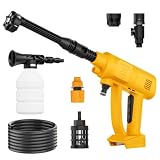

DeWalt DCPW550B Specs vs. Real Pressure Washers
DeWalt deliberately calls this a “power cleaner,” and the spec sheet explains why. Here’s how it stacks up against the plug-in and gas machines it gets confused with:
| Spec | DeWalt DCPW550B (20V MAX) | Typical corded electric washer | Typical gas washer |
|---|---|---|---|
| Max pressure | 550 PSI | 1,800–2,300 PSI | 2,700–3,400 PSI |
| Max flow | 1.0 GPM | 1.1–1.8 GPM | 2.3–2.8 GPM |
| Cleaning units (PSI × GPM) | ~550 | ~2,400–3,000 | ~7,000+ |
| Weight | ~8 lb bare | 20–35 lb | 50–70 lb |
| Water source | Garden hose or self-primes from fresh water (bucket, lake, tank) | Pressurized hose only | Pressurized hose only |
| Power source | Any 20V MAX / FLEXVOLT battery | 120V outlet + hose | Gas engine + hose |
| Street price | ~$120–$180 (bare tool) | ~$120–$250 | ~$300 and up |
The cleaning-units row is the honest number: multiplying pressure by flow gives a rough measure of how fast a machine removes grime, and 550 units is one-fifth to one-twelfth of what “real” pressure washers deliver. For context within the cordless class, that’s still competitive — the Worx Hydroshot line runs in the 320–450 PSI range and Ryobi’s 18V EZClean models span roughly 320–600 PSI depending on version — so the DeWalt sits at the strong end of battery-powered rinsing tools. It just isn’t in the same category as anything with a cord or a pull-start.
What 550 PSI Actually Cleans — and What It Won’t Touch
The two speed settings and four included quick-connect nozzles (15°, 25°, 40°, and turbo) give you usable range within that 550 PSI ceiling. In practical terms:
- It handles well: rinsing cars, trucks, and SUVs without risking paint (use the 40° tip); knocking mud off ATVs, mowers, and jobsite tools; washing boat hulls and decks at the dock; RV and camper exteriors; camping gear, coolers, and muddy boots; lawn furniture; screening and siding rinses where you’d otherwise use a hose nozzle.
- It will disappoint on: stripping deck stain, cleaning concrete driveways, removing embedded mildew from siding, blasting years of grime off a second-story exterior, or anything where you’d normally reach for a turbo nozzle on a 2,000 PSI machine. The turbo tip helps, but physics is physics.
The killer feature isn’t pressure — it’s the self-priming pump. The included suction hose and inlet filter let the DCPW550B draw water from a bucket, a lake, or an onboard tank, which is why it shows up at boat ramps, campgrounds, and off-grid job sites where a corded washer can’t even be turned on. Keep the suction lift modest (a few vertical feet) and the filter submerged, and it primes reliably.
Battery Compatibility and Real-World Runtime
The DCPW550B is sold as a bare tool, and it accepts every battery in DeWalt’s 20V MAX ecosystem — compact packs, XR packs, PowerStack cells, and even FLEXVOLT batteries, which automatically run at 20V on this tool. Estimated trigger time on the high setting scales with capacity:
| Battery (examples) | Energy at 20V | Estimated runtime, high setting | Best use case |
|---|---|---|---|
| 2.0Ah compact (DCB203) | ~40 Wh | ~6–10 min | Quick rinses, one muddy bike |
| 5.0Ah XR (DCB205) | ~100 Wh | ~15–25 min | A car, a boat hull, a patio set |
| 5.0Ah PowerStack (DCBP520) | ~100 Wh | ~15–25 min | Same jobs, cooler-running pack under load |
| FLEXVOLT 9Ah @20V (DCB609) | ~180 Wh | ~35–45+ min | Full RV washdown, multi-vehicle sessions |
Two notes on that table. First, runtime figures are estimates — low speed stretches them considerably, and pulsing the trigger rather than holding it stretches them further. Second, remember the FLEXVOLT quirk: a DCB609 rated “9Ah” delivers that 9Ah at 20V (it’s 3Ah at 60V), so on this tool you get the full capacity.
Run the water math alongside the battery math if you’re working off-grid: at 1.0 GPM, a standard 5-gallon bucket gives you roughly 5 minutes of spray. A 15-gallon tank matches a 5Ah battery nicely; plan your water supply around the job, not just the charge.
Should You Buy It? A Decision Matrix
| Your situation | Verdict |
|---|---|
| Already own 20V MAX batteries and a charger | Strong buy — it’s ~$150 of incremental cost for a genuinely new capability |
| Boat owner, RVer, or overlander cleaning where there’s no outlet | Buy — the self-priming pump is the whole point |
| Want to wash cars at home without dragging out a corded unit | Buy, with realistic expectations — it’s a faster, better hose, not a foam-cannon rig |
| Need to clean concrete, strip a deck, or prep siding for paint | Skip — buy or rent a 2,000+ PSI corded machine instead |
| Starting on a battery platform from zero | Factor $100–$200 more for a pack and charger before comparing prices |
| Woodworker wanting to clean shop equipment, dust-collection drums, or muddy trucks | Buy — this is squarely in its wheelhouse |
Ownership Realities: What Wears and What Kills It
These are the maintenance points that don’t appear on a product listing:
- Never run it dry. More than a few seconds without water overheats the pump seals — the single most common way these units die early. If it loses prime, stop and re-submerge the filter.
- Rinse the inlet filter after every use. A clogged filter causes surging and weak pressure that owners often mistake for a failing pump. It’s a 10-second fix.
- Winterize it. Water left in the pump over a hard freeze can crack the housing. Run the tank dry at season’s end or pump RV antifreeze through it — same procedure as any pressure washer.
- Fresh water only. Salt water and sandy sources chew up the internal valves. If you rinse a boat at the beach, flush the pump with clean fresh water afterward.
- Lose-proof the nozzles. The four tips are small and easy to drop in a lake or leave in the bed of a truck. A zip bag in the kit box saves a reorder.
- The number-one mistake is buying this expecting pressure-washer results. It’s a self-powered, self-priming hose upgrade. Judged on that job description, it’s excellent; judged against a driveway cleaner, it’s hopeless.
FAQ
Will my FLEXVOLT batteries work?
Yes. FLEXVOLT packs are backward-compatible with all 20V MAX tools and deliver their higher amp-hour rating at 20V, making them ideal for longer cleaning sessions.
Is 550 PSI safe on car paint and decals?
Yes — 550 PSI is well below the threshold that damages automotive clear coat, especially with the 40° nozzle held a foot or more out. Keep the 15° and turbo tips away from decals, window seals, and soft RV roofing.
Can it really pull water from a lake or bucket?
Yes — that’s its signature feature. Attach the included suction hose, drop the filtered end into any fresh water source, keep the lift to a few feet, and it self-primes. Salt water is off-limits.
Does it come with a battery?
No — the DCPW550B is a bare tool. If you’re not already on the 20V MAX platform, add the cost of at least a 5.0Ah battery and charger to the purchase price.
The Bottom Line
The DeWalt 20V MAX power cleaner delivers exactly what its honest spec sheet promises: 550 PSI of grab-and-go rinsing power that runs off batteries many tool owners already have, and drinks water from sources corded washers can’t touch. For RVers, boaters, campers, and anyone cleaning vehicles or equipment away from an outlet, it’s one of the most capable cordless cleaners in its class. For anyone whose real need is blasting concrete or stripping a deck, it’s the wrong tool at any price — start with a 2,000 PSI plug-in and keep the DeWalt on the wish list for everything else.
Related guides
- O’Reilly Lawn Mower Battery Guide: U1 vs U1R Sizes, CCA, and Getting the Right Fit
- DeWalt 18V Lithium-Ion Battery Guide: Sizes, Chargers, and 20V MAX Equivalence
- Craftsman 2800 PSI Pressure Washer Review: Engine, Specs, and Jobs It Handles
- Black+Decker Pressure Washer Review: PSI Tiers, Portability, and Best Uses