What's inside
- Top 3 Picks
- Quick Comparison
- How We Chose
- 1. Westinghouse WPX3400 – Best for All-Around Driveway and Siding Work
- 2. Ezasin Gas Powered 3500 PSI – Best for First-Time Buyers on a Tight Budget
- 3. Westinghouse WPX3200 – Best for Balanced Mid-Range Versatility
- 4. Westinghouse ePX3500 – Best for Small Yards and Quiet Neighborhoods
- 5. DeWalt 3300 PSI Gas Pressure Washer – Best for Brand-Supported Residential Reliability
- 6. VEVOR Gas Powered Pressure Washer 3400 PSI – Best for Value Hunters Who Want Big Specs
- 7. Westinghouse WPX3000 – Best for Car Washing and Light-Duty Rinsing
- 8. Simpson Clean Machine 3400 PSI – Best for Mid-Power Cleaning with an Upgraded Engine
- 9. PowerSmart Gas Pressure Washer 3800 PSI – Best for Raw Pressure per Dollar on Large Concrete
- 10. Simpson Clean Machine 3200 PSI – Best for Deck and Fence Stripping
- 11. Simpson PowerShot 3500 PSI – Best for Long-Term Engine Durability
- 12. Simpson PowerShot 4000 PSI (PS60869) – Best for Professional-Grade Large-Area Cleaning
- Related Guides
As an Amazon Associate I earn from qualifying purchases. This post may contain affiliate links at no extra cost to you.
The best gas pressure washer deal for most homeowners in 2026 is the Westinghouse WPX3400: 3400 PSI at 2.6 GPM is the sweet spot for concrete driveways, wood decks and vinyl siding, and the onboard soap tank plus five quick-connect nozzles mean you do not have to buy anything extra to finish the job. If price is the binding constraint, the Ezasin 3500 PSI with its 212cc engine delivers the most pressure per dollar here; if you want the longest service life and will pay for it, the Simpson PowerShot 4000 PSI with a Honda GX270 and an AAA triplex pump outlasts everything else on this page. Everything below compares PSI, GPM, engine displacement, hose length and pump architecture across twelve current machines, then maps them to specific jobs — driveway, deck, siding, vehicles — so you buy the right power rather than the biggest number on the carton.
Our Top Picks
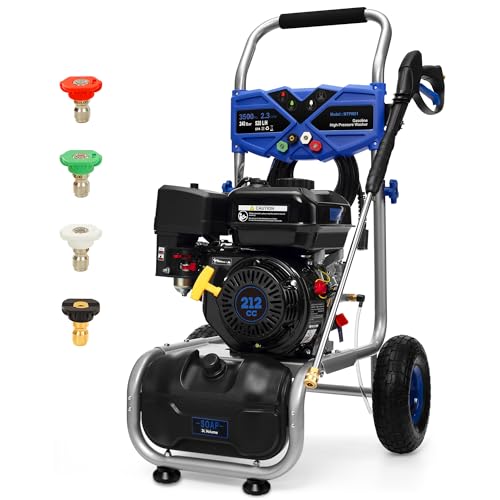 Ezasin Gas Powered Pressure Washer 3500 PSI3500 PSI21.5 x 23.5 x 39.5 inches63 PoundsCheck on Amazon
 Westinghouse ePX3500 Electric Pressure Washer2500 Max PSI13.5 x 14 x 16.5 inches19 PoundsCheck on Amazon


Top 3 Picks
Best Overall: Westinghouse WPX3400
The 3400 PSI / 2.6 GPM combination is high enough to strip algae and old stain from concrete, low enough to be controlled on a cedar deck, and paired with the two features that make a washer pleasant to live with: an onboard soap tank and a five-nozzle quick-connect set. It suits a homeowner with a full-size lot who wants one machine for every surface and does not want to shop again in three years.
Best Budget: Ezasin 3500 PSI
A 212cc, 7 HP engine pushing 3500 PSI through a 25-foot hose is a lot of machine for the entry price band, and the engine displacement is the real story — a 212cc block loafs along at 3500 PSI instead of straining the way a 160cc engine would. It suits first-time buyers and rental-property owners who want maximum cleaning power per dollar and accept a thinner support and parts ecosystem.
Best Premium: Simpson PowerShot 4000 PSI
The combination of a Honda GX270 engine, an AAA triplex pump and 3.5 GPM puts this in a different durability class entirely — roughly 14,000 cleaning units, which is professional-contractor territory. It suits anyone cleaning very large concrete areas, commercial property, or fleet vehicles, and who is willing to trade portability and fuel appetite for a pump that can be rebuilt rather than replaced.
Quick Comparison
Every machine in this guide, sorted by what it is actually good at. Price tiers are relative bands within the gas pressure washer market rather than fixed figures, because listing prices move constantly.
| Product | Best for | Key specs | Price tier |
|---|---|---|---|
| Westinghouse WPX3400 | All-around driveway, deck and siding work | 3400 PSI, 2.6 GPM, onboard soap tank, 5 nozzles, gas | Mid-range |
| Ezasin Gas Powered 3500 PSI | Most power per dollar for first-time buyers | 3500 PSI, 2.3 GPM, 212cc 7 HP engine, 25 ft hose, gas | Budget |
| Westinghouse WPX3200 | Balanced mid-range versatility | 3200 PSI, 2.5 GPM, onboard soap tank, 5 nozzles, gas | Mid-range |
| Westinghouse ePX3500 | Small lots, garages and quiet neighborhoods | 2500 max PSI, 1.76 max GPM, anti-tipping design, electric | Budget |
| DeWalt DXPW3300-S | Buyers who value brand-backed service and support | 3300 PSI, 2.4 GPM, residential model, gas | Premium |
| VEVOR Gas Powered 3400 PSI | Big specs at a mid-range price | 3400 PSI, 2.6 GPM, extension wand, 5 quick-connect nozzles | Mid-range |
| Westinghouse WPX3000 | Cars, fences and light-duty rinsing | 3000 PSI, 2.3 GPM, 4 nozzle set, spray gun and wand | Mid-range |
| Simpson Clean Machine 3400 | Mid-power cleaning with an upgraded engine feel | 3400 PSI, 2.5 GPM, CRX engine, gas | Premium |
| PowerSmart 3800 PSI | Raw pressure per dollar on large concrete | 3800 PSI, 2.5 GPM, house-cleaning focus, gas | Budget |
| Simpson Clean Machine 3200 | Deck and fence stripping with less nozzle work | 3200 PSI, 2.5 GPM, turbo nozzle included, gas | Budget |
| Simpson PowerShot 3500 | Long-term engine durability | 3500 PSI, 2.5 GPM, Honda GX200 engine, gas | Premium |
| Simpson PowerShot 4000 PSI (PS60869) | Professional-grade large-area cleaning | 4000 PSI, 3.5 GPM, AAA triplex pump, Honda GX270 | Premium |
How We Chose
This roundup is a specification and documentation comparison, not a bench report. Selection started with the numbers that actually determine what a pressure washer can do — rated PSI, rated GPM, and the product of the two, which is the cleaning-unit figure that predicts how fast a surface comes clean. From there we weighed engine displacement and type, since a 212cc block running at 3500 PSI is under far less stress than a 160cc block asked to do the same work, and pump architecture, because an axial cam pump and a triplex pump with the same pressure rating have very different service lives.
Category fit came next. A machine has to make sense for a specific property: driveway size, deck material, siding type, whether vehicles are washed at home, and whether the user has a garage for fuel storage. Finally we looked at the upgrade path and ownership cost — nozzle and o-ring availability, whether the pump can be serviced or must be replaced, hose length and whether it can be extended, and how much fuel and maintenance a given engine demands. Machines that only made sense on a spec sheet, with no clear owner profile, were left out.
1. Westinghouse WPX3400 – Best for All-Around Driveway and Siding Work
As an Amazon Associate we earn from qualifying purchases at no extra cost to you.

The WPX3400 sits at the point where pressure stops being a marketing number and starts being genuinely useful. At 3400 PSI and 2.6 GPM it will strip a season of algae off a concrete driveway, pull grey weathering out of a weathered deck when used at a safe distance with the right tip, and rinse vinyl siding without driving water behind the panels. The onboard soap tank is the detail that matters most in daily use — you fill it once, dial detergent in at the nozzle, and never stop to swap a siphon tube in a bucket.
It suits the homeowner with a full-size property: a two-car driveway, a deck, and four sides of siding, all handled by one machine that does not need to be thought about again for years. It is not the cheapest route to 3400 PSI, and it is not aimed at someone who rinses a car twice a season and nothing else.
- Pressure and flow: 3400 PSI at 2.6 GPM (roughly 8,840 cleaning units)
- Engine: Westinghouse overhead-valve gas engine driving an axial-style pump
- Detergent: onboard soap tank with adjustable draw
- Nozzles: five quick-connect tips covering the standard spread from pinpoint to soap
- Included: spray gun, wand and factory hose on a wheeled cart
- Fuel: gasoline, with the usual seasonal storage routine
What makes this the default recommendation is not peak pressure — several budget machines on this page advertise more. It is the balance. A 2.6 GPM flow rate rinses loose dirt away roughly a third faster than the 1.76 GPM an electric unit can manage, which is what turns a two-hour driveway job into a forty-minute one. Add the soap tank, and the workflow becomes spray, foam, dwell, rinse, with no equipment changes mid-job. The five-nozzle set also means you are not buying a $20 tip kit in week one, which is a hidden cost on several budget machines.
The trade-off is weight and footprint. A full-size cart with a gas tank, soap tank and hose reel is a two-hand lift into a truck bed, and it does not enjoy being dragged up a flight of steps. If your property is mostly flat, that is irrelevant; if you are cleaning a second-floor deck, it matters.
Pros
- 3400 PSI and 2.6 GPM cover concrete, deck and siding without a second machine
- Onboard soap tank eliminates the bucket-and-siphon-tube routine
- Five quick-connect nozzles cover everything from stripping to rinsing out of the box
- Mid-range price tier carrying a spec sheet that matches costlier machines
Cons
- Heavier and bulkier than a compact 3000 PSI unit; awkward on stairs
- Factory hose length becomes the limiting factor on long driveways
- Gas ownership means fuel stabilizer, oil checks and winterizing
- More pressure than a beginner needs for soft wood or vehicle paint
Against the Westinghouse WPX3200, this machine buys 200 PSI and 0.1 GPM for a modest step up in price and weight. If your worst job is stained concrete, that extra pressure earns its keep; if your property is mostly deck, fence and vehicles, the WPX3200 does the same work with less risk of surface damage and a little less money spent. Against the VEVOR 3400, the two are near-identical on paper — the difference is brand support and the soap tank, which the Westinghouse includes and the VEVOR listing does not emphasize.
2. Ezasin Gas Powered 3500 PSI – Best for First-Time Buyers on a Tight Budget
Ezasin’s 3500 PSI machine makes its case with one number: 212cc. That is a 7 HP engine, and it is the largest displacement you will find in the budget tier of this roundup. Engine displacement is the most underrated spec in pressure washing, because PSI ratings are cheap to advertise and expensive to deliver. A 212cc block asked to produce 3500 PSI is working comfortably; a 160cc block asked to do the same thing runs hotter, louder and wears faster. This is a machine built around the assumption that you want pressure and you want it to last.
It suits the first-time buyer, the landlord with three rental properties, and anyone whose primary job is a large concrete driveway or a concrete patio that has not been cleaned in five years. It also suits a buyer who is comfortable doing their own maintenance, because the support ecosystem around a smaller brand is thinner than around Westinghouse, DeWalt or Simpson.
- Pressure and flow: 3500 PSI at 2.3 GPM (roughly 8,050 cleaning units)
- Engine: 212cc, 7 HP overhead-valve gas engine
- Hose: 25 ft, stated in the listing
- Build: heavy-duty, high-power frame and cart
- Nozzles: quick-connect set for pressure and detergent work
- Fuel: gasoline, standard seasonal maintenance
The strength here is straightforward value density. For the entry price band you get the highest pressure rating in the budget group and the biggest engine in it, which is a combination that usually costs more. The 25-foot hose is long enough for most single-car driveways and patios, though it will not reach the far corner of a long two-car driveway without being repositioned mid-job.
The 2.3 GPM flow rate is where the compromise shows. Compared to a 2.6 GPM machine, you are moving about 12 percent less water per minute, which means rinsing takes longer and the machine feels slightly less decisive when flushing loosened dirt off concrete. It is not a dealbreaker — pressure does the stripping, flow does the rinsing — but on a big driveway the difference is visible in your total job time.
Pros
- 212cc, 7 HP engine is the largest displacement in the budget tier here
- 3500 PSI gives real stripping power on stained concrete
- 25-foot hose covers most single-car driveways and patios
- Lowest cost of entry to genuinely heavy-duty pressure in this guide
Cons
- 2.3 GPM rinses more slowly than 2.5 or 2.6 GPM alternatives
- No onboard soap tank emphasized; expect a siphon setup for detergent
- Thinner parts and service ecosystem than the major brands
- Budget-tier build means o-rings, seals and nozzles wear sooner
Compared with the PowerSmart 3800 PSI, the Ezasin gives up 300 PSI but keeps the larger engine and a more conservative pressure-to-displacement ratio, which is usually the better long-term bet — a 3800 PSI rating on a budget engine is asking a lot of a pump that is not built for commercial duty. Compared with the Westinghouse WPX3400, the Ezasin is the value play and the Westinghouse is the ownership play: you pay more for the soap tank, the nozzle set and a parts network that will still exist when you need a replacement wand.
3. Westinghouse WPX3200 – Best for Balanced Mid-Range Versatility

The WPX3200 is the sensible middle of this entire list. At 3200 PSI and 2.5 GPM it produces roughly 8,000 cleaning units — barely 10 percent behind the WPX3400 — while being easier to control on surfaces that do not appreciate full pressure. It carries the same onboard soap tank and five-nozzle quick-connect set as its bigger sibling, so nothing about the workflow is compromised.
It suits the homeowner who owns a mix of surfaces: a concrete driveway, a wood deck, vinyl siding, and maybe a fence, without any single job being brutal. It also suits the buyer who has already learned that too much pressure is its own problem, and who would rather have control and a soap tank than another 200 PSI.
- Pressure and flow: 3200 PSI at 2.5 GPM (roughly 8,000 cleaning units)
- Engine: Westinghouse overhead-valve gas engine
- Detergent: onboard soap tank
- Nozzles: five quick-connect tips
- Included: spray gun, wand and factory hose on a wheeled cart
- Fuel: gasoline with standard seasonal maintenance
The case for this machine is that 3200 PSI is the most forgiving pressure that still does serious work. It strips algae from concrete, blasts mud off a truck frame, and cleans a deck without the risk profile of a 4000 PSI machine. The five-nozzle set lets you step down to a wider spray for siding and up to a narrower tip for concrete staining, and the soap tank means detergent jobs do not require a separate siphon tool.
Where it gives ground is on the hardest jobs. Heavily stained concrete that has absorbed years of oil or rust may need a second pass, and a machine with 4000 PSI or 3.5 GPM will simply win the race. If your driveway is the worst thing you own, buy up; if it is one of several surfaces, this is the one to buy.
Pros
- 3200 PSI is the control-versus-power sweet spot for mixed surfaces
- Onboard soap tank and five quick-connect nozzles included
- Roughly 8,000 cleaning units — within striking distance of 3400 PSI machines
- Slightly lighter and easier to move than the WPX3400
Cons
- 200 PSI short of the WPX3400 for stubborn concrete staining
- Same gas-engine ownership chores as every other gas machine here
- Factory hose length still limits very long driveways
- Not a meaningful upgrade if you already own a working 3000 PSI unit
Compared with the WPX3400, this is the value-and-control choice, and the gap between them is small enough that the decision comes down to your worst surface. Compared with the Westinghouse WPX3000, it is a clear step up: 200 PSI and 0.2 GPM more, plus a fifth nozzle, for a small price difference. If you are choosing between the three Westinghouse gas models, the WPX3200 is the one most people should buy.
4. Westinghouse ePX3500 – Best for Small Yards and Quiet Neighborhoods
The ePX3500 is the odd one out on a gas-focused page, and it earns its place by solving the problems gas machines create. It is corded electric, rated at 2500 max PSI and 1.76 max GPM, with anti-tipping technology built into the frame. No fuel to store, no oil to change, no exhaust, no pull cord, and no noise complaint from a neighbor at 8 a.m. on a Saturday.
It suits the townhouse owner, the apartment-dweller with a patio, the person with a one-car driveway and a small deck, and anyone who wants to pressure wash twice a year without maintaining an engine between uses. It also suits buyers in neighborhoods with noise restrictions or HOAs that frown on small-engine equipment.
- Pressure: 2500 max PSI (peak rating, not sustained working pressure)
- Flow: 1.76 max GPM
- Power: corded electric — no fuel, no oil changes, no exhaust
- Stability: anti-tipping design for safer handling on sloped driveways
- Detergent: onboard tank for soap application
- Nozzles: quick-connect set for pressure and rinse work
The single most important thing to understand about this machine is the word “max.” Electric pressure washers are commonly advertised at peak pressure, which is what the pump can hit momentarily, while the sustained working pressure is lower. Practically, that means the ePX3500 cleans like a light-duty machine — excellent on siding, fences, patio furniture, grills, vehicles and concrete that is only mildly soiled, but slow and underpowered on deep-set oil stains or years of black algae on a large driveway.
The anti-tipping frame is a real feature rather than a marketing line. Electric units are lighter and easier to pull over with a taut hose, and a machine that falls mid-job can crack a pump housing or soak its own motor. A stable base removes that failure mode, which matters on sloped driveways and uneven patios.
Pros
- No fuel, no oil changes, no exhaust — the lowest-maintenance machine here
- Quiet enough for early-morning or evening use in close neighborhoods
- Anti-tipping design adds stability on sloped or uneven surfaces
- Light and compact; easy to store on a shelf or in a closet
Cons
- 2500 max PSI is a peak figure; sustained cleaning power is modest
- 1.76 GPM rinses far more slowly than any gas machine on this page
- Cord management replaces hose management as the main annoyance
- Not suitable for large driveways or heavy stripping work
Compared with the Westinghouse WPX3000, the choice is about commitment. The gas WPX3000 gives you 3000 PSI and 2.3 GPM — a genuinely more capable machine — but it asks you to buy fuel, check oil, winterize it and accept the noise. The ePX3500 asks almost nothing of you and does about two-thirds of the work. If your total cleaning area is under roughly 600 square feet, electric wins on convenience. Above that, gas wins on time.
5. DeWalt 3300 PSI Gas Pressure Washer – Best for Brand-Supported Residential Reliability

The DeWalt DXPW3300-S is a 3300 PSI, 2.4 GPM residential machine, and its argument is not the spec sheet — it is what happens in year four. DeWalt maintains one of the deepest service and parts networks in the power-equipment world, with published parts diagrams, widely stocked replacement nozzles, wands, o-rings and hoses, and a support infrastructure that smaller brands simply cannot match.
It suits the homeowner who intends to keep the machine for a decade, who wants to be able to order a replacement part by number rather than search forums, and who values knowing that the brand will still exist and still stock consumables. It also suits the buyer who already owns DeWalt cordless tools and appreciates a coherent equipment ecosystem.
- Pressure and flow: 3300 PSI at 2.4 GPM (roughly 7,920 cleaning units)
- Model class: residential-grade gas pressure washer, DXPW3300-S
- Engine: gas, overhead-valve class
- Frame: wheeled cart with the heavier build typical of this brand
- Support: published parts diagrams and a wide service footprint
- Fuel: gasoline with standard seasonal maintenance
The 3300 PSI / 2.4 GPM pairing is a well-judged residential spec. It is more than enough for concrete driveways and patios, comfortable on siding at the right distance and nozzle, and controllable on decks if you respect the wood. The flow rate sits between the budget 2.3 GPM machines and the 2.6 GPM mid-range leaders, so rinsing is respectable without being the fastest here.
The real value is durability of ownership rather than durability of any single component. Consumables wear on every pressure washer — nozzles erode, o-rings flatten, hoses develop pinholes, detergent tubes clog. On a machine with a deep parts catalog, each of those is a small, cheap, five-minute fix. On a machine with no parts catalog, each of those can end the tool’s life. That is what the premium tier is actually buying.
Pros
- 3300 PSI and 2.4 GPM handle the full range of residential surfaces
- Extensive parts and service network — replacement nozzles, wands, o-rings and hoses are easy to source
- Sturdier cart and frame than typical budget-tier machines
- Strong brand recognition, which helps at resale or when gifting equipment
Cons
- Premium price tier for a spec sheet that mid-range machines match
- 2.4 GPM is not the fastest rinsing rate in this roundup
- Heavier than compact alternatives
- Still a gas engine, so fuel and storage discipline are required
Compared with the Westinghouse WPX3400, you are trading 100 PSI and 0.2 GPM for a stronger service network and a heavier-duty frame. If your decision is driven by “what happens when something breaks,” the DeWalt wins. If it is driven by cleaning speed and features like the onboard soap tank, the Westinghouse wins. Compared with the Simpson PowerShot 3500, the DeWalt is the generalist and the Simpson is the engine specialist — the Simpson’s Honda GX200 is a commercial-grade powerplant with a longer expected service life, while the DeWalt spreads its value across the whole machine.
6. VEVOR Gas Powered Pressure Washer 3400 PSI – Best for Value Hunters Who Want Big Specs

VEVOR’s 3400 PSI, 2.6 GPM gas machine lands on the same headline numbers as the best overall pick on this page, at a mid-range price tier and with an extension wand and five quick-connect nozzles included. On paper, it is the value play of the entire roundup: the same pressure and flow as a machine that costs meaningfully more, plus a wand extension that improves reach on siding and second-story trim.
It suits the buyer who reads specs carefully, understands exactly what 3400 PSI and 2.6 GPM will do, and is comfortable sourcing their own consumables when nozzles and o-rings eventually wear. It also suits the second-property owner who wants capable equipment without a premium outlay.
- Pressure and flow: 3400 PSI at 2.6 GPM (roughly 8,840 cleaning units)
- Nozzles: five quick-connect tips
- Reach: extension wand included for higher and farther cleaning
- Included: spray gun and wand
- Engine: gas, overhead-valve class
- Fuel: gasoline with standard seasonal maintenance
The extension wand is a genuinely useful inclusion rather than filler. It adds reach for siding above shoulder height, gutter faces, and the underside of a deck, and it lets you keep the machine farther from the wall — which keeps overspray off windows and keeps the cart on stable ground. Buying one separately is a small expense that most people forget until they are already on a ladder.
Flow rate is where this machine shines for the price. At 2.6 GPM it rinses loosened dirt off concrete and siding at the same rate as machines in the premium tier, which directly shortens job time. That combination of 3400 PSI and 2.6 GPM is the reason this specification is the most popular in the category.
Pros
- 3400 PSI and 2.6 GPM at a mid-range price tier
- Extension wand included — real reach benefit for siding and decks
- Five quick-connect nozzles cover stripping through rinsing
- Roughly 8,840 cleaning units, matching far costlier machines
Cons
- No onboard soap tank highlighted, so detergent work may need a siphon setup
- Parts and service ecosystem is thinner than the established brands
- Budget-to-mid-tier build quality means seals and o-rings are the first to go
- Fit and finish on carts and fittings can vary between production runs
Compared with the Westinghouse WPX3400, the specs are nearly identical and the difference is ownership infrastructure. Westinghouse gives you an onboard soap tank, a parts catalog and a warranty structure; VEVOR gives you the extension wand and a lower entry point. If you wash with detergent regularly, the soap tank is worth more than the wand. If your work is mostly pressure and rinse, the VEVOR’s included wand makes it the sharper buy.
7. Westinghouse WPX3000 – Best for Car Washing and Light-Duty Rinsing
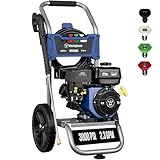
The WPX3000 is the entry point of Westinghouse’s gas line, rated at 3000 PSI and 2.3 GPM with a four-nozzle set, a spray gun and wand, and the manufacturer’s own framing of it as a machine for cars and fences. That framing is honest, and it is the most useful thing about this listing: it tells you exactly what the machine is good at instead of pretending it is a driveway monster.
It suits the car detailer at home, the fence and railing owner, the person with a small patio and a modest driveway, and the buyer who wants gas power without the weight, fuel appetite and pressure of a 3400 PSI machine. It also suits anyone nervous about damaging surfaces, because 3000 PSI with the right nozzle is difficult to misuse on a car’s clear coat.
- Pressure and flow: 3000 PSI at 2.3 GPM (roughly 6,900 cleaning units)
- Nozzles: four-nozzle set
- Included: spray gun and wand
- Intended use: cars, fences and light-duty cleaning per the listing
- Engine: gas, overhead-valve class
- Fuel: gasoline with standard seasonal maintenance
The lower flow rate and pressure make this the most forgiving gas machine in the guide. For vehicles, that is a feature: 3000 PSI at a comfortable distance with a wider nozzle removes road film and bug residue without the risk that comes with 4000 PSI. For fences, the combination of moderate pressure and a fan tip strips grey weathering off cedar and pressure-treated pine without raising the grain as aggressively as higher-pressure machines.
The limit is concrete. On a large driveway with embedded staining, 6,900 cleaning units will require patience and multiple passes, and the 2.3 GPM flow means rinsing takes noticeably longer than on a 2.6 GPM machine. This is a light-to-medium-duty tool being asked to do medium duty well, not heavy duty.
Pros
- 3000 PSI is easy to control on vehicles and painted surfaces
- Four-nozzle set covers car washing through general rinsing
- Lighter and easier to maneuver than the 3200 and 3400 PSI models
- Genuine gas power without premium-tier pricing
Cons
- Roughly 6,900 cleaning units — the lowest gas figure in this guide
- 2.3 GPM rinses slowly on large hard surfaces
- Four nozzles rather than five limits tip flexibility
- Not enough power for heavy concrete restoration
Compared with the Westinghouse ePX3500, this is the “real machine” alternative: more pressure, more flow, more capability, in exchange for fuel, noise and maintenance. Compared with the WPX3200, the WPX3000 saves money and weight but gives up 200 PSI, 0.2 GPM and a nozzle. If your jobs are cars, fences and a small patio, the WPX3000 is enough. If a driveway is in the mix, step up.
8. Simpson Clean Machine 3400 PSI – Best for Mid-Power Cleaning with an Upgraded Engine

The Simpson Clean Machine 3400 pairs 3400 PSI and 2.5 GPM with a CRX engine — Simpson’s own overhead-valve powerplant used across the Clean Machine line. The result is a machine that reads like a mid-range spec sheet with a more serious engine behind it, and it lands in the premium tier on price because of that.
It suits the buyer who has decided that engine quality is the part of a pressure washer worth paying for. Engines determine how easily a machine starts after six months in a garage, how it holds up under repeated long sessions, and how likely it is to need service. The pump and engine are the two components that decide whether a pressure washer lasts five years or fifteen.
- Pressure and flow: 3400 PSI at 2.5 GPM (roughly 8,500 cleaning units)
- Engine: Simpson CRX overhead-valve gas engine
- Line: Simpson Clean Machine series
- Included: spray gun, wand and nozzle set
- Frame: wheeled cart built for residential-to-semi-pro use
- Fuel: gasoline with standard seasonal maintenance
Simpson is one of the few brands in this category that has built its reputation specifically on pressure washing rather than on being a general tool company, and the Clean Machine line is its residential-focused offering. That focus shows in details like nozzle selection, wand ergonomics and the availability of replacement pumps and unloaders — the kind of parts that matter when a machine is five years old and still perfectly good apart from one worn component.
The 2.5 GPM flow rate sits in the middle of this roundup: faster than the 2.3 GPM budget machines, slower than the 2.6 GPM leaders. Practically, that means a driveway job takes a few minutes longer than on the best-flowing machines here, but the cleaning quality is the same.
Pros
- CRX engine is a step up from generic budget powerplants
- 3400 PSI and 2.5 GPM handle concrete, siding and decks
- Simpson focuses on pressure washing, so replacement parts are category-specific
- Roughly 8,500 cleaning units with an engine built for repeated long sessions
Cons
- Premium price tier for a spec sheet mid-range machines match
- 2.5 GPM is not the fastest rinsing rate available here
- No onboard soap tank highlighted in the listing
- Heavier than entry-level carts
Compared with the Simpson Clean Machine 3200, this machine trades 200 PSI for a different nozzle package and a slightly higher price — the 3200 includes a turbo nozzle, which is faster on flat concrete than a standard tip. Compared with the DeWalt DXPW3300-S, the Simpson gives you 100 PSI more and a pressure-washing specialist’s parts catalog, while the DeWalt gives you broader brand infrastructure. Both are premium-tier purchases for buyers who care what happens in year four.
9. PowerSmart Gas Pressure Washer 3800 PSI – Best for Raw Pressure per Dollar on Large Concrete

PowerSmart’s 3800 PSI, 2.5 GPM machine is the highest-pressure unit in the budget tier of this roundup, and its listing is explicit about the target job: house cleaning. That is a fair description of what 3800 PSI does well — it strips heavy biological growth off siding, blasts concrete, and removes paint and stain faster than anything with a lower pressure rating.
It suits the buyer with a genuinely dirty property: a shaded driveway with black algae, siding with green growth on the north face, a concrete patio that has never been cleaned. It also suits the buyer who wants maximum stripping power and is prepared to accept the corresponding limits on softer surfaces and on engine life.
- Pressure and flow: 3800 PSI at 2.5 GPM (roughly 9,500 cleaning units)
- Intended use: house cleaning and heavy exterior surfaces
- Engine: gas, overhead-valve class
- Included: spray gun, wand and nozzle set
- Frame: wheeled cart
- Fuel: gasoline with standard seasonal maintenance
The pressure advantage is real on the right surface. Where a 3200 PSI machine needs two passes over a stained concrete slab, 3800 PSI often does it in one, and the difference is more pronounced on vertical surfaces where you cannot bear down. For siding with heavy organic growth, higher pressure means faster stripping and less dwell time for detergent.
The caution is that 3800 PSI is genuinely aggressive. On wood, it will raise grain and etch soft fibers if you get close, and on a car it can strip wax and damage trim. This is a machine that demands correct nozzle selection and a deliberate standoff distance. It also asks more of a budget-tier engine and pump than a 3200 or 3400 PSI machine does, because pressure is produced by restricting flow, and restriction is what loads a pump. That is the trade you make for the headline number.
Pros
- 3800 PSI is the highest pressure rating in the budget tier here
- Roughly 9,500 cleaning units — competitive with much costlier machines
- Excellent for siding with heavy organic growth and stained concrete
- Budget price tier for heavy-duty pressure capability
Cons
- Aggressive on wood, paint and vehicle finishes if misused
- 2.5 GPM rinses no faster than mid-range machines with less pressure
- High pressure loads a budget-tier pump harder, which can shorten service life
- Thinner parts and service network than the major brands
Compared with the Ezasin 3500 PSI, this machine wins on pressure but loses on engine displacement ratio — 3800 PSI from a budget-class engine is a harder working life than 3500 PSI from a 212cc block. If you want longevity, the Ezasin’s larger engine is the more conservative choice; if you want the fastest possible result on a filthy concrete slab, the PowerSmart’s extra 300 PSI is worth having.
10. Simpson Clean Machine 3200 PSI – Best for Deck and Fence Stripping

The Simpson Clean Machine 3200 runs 3200 PSI at 2.5 GPM and includes a turbo nozzle — a rotating zero-degree tip that concentrates the full pressure into a spinning point, which cleans flat surfaces far faster than a fan tip of the same rating. That single inclusion changes what the machine is best at: flat work, particularly decks, fences and concrete.
It suits the homeowner whose main projects are a wood deck that needs stripping, a fence line that has gone grey, and a concrete patio with surface staining. It also suits the buyer who wants Simpson’s pressure-washing-specific parts availability without paying premium-tier money.
- Pressure and flow: 3200 PSI at 2.5 GPM (roughly 8,000 cleaning units)
- Nozzle highlight: turbo nozzle included for fast flat-surface cleaning
- Line: Simpson Clean Machine series
- Included: spray gun, wand and nozzle set
- Engine: gas, overhead-valve class
- Fuel: gasoline with standard seasonal maintenance
The turbo nozzle is the reason to pick this machine over a cheaper 3200 PSI unit. A standard fan tip spreads pressure across a line and requires overlapping passes; a turbo nozzle concentrates it into a moving point that scrubs as it spins. On a deck or driveway, that typically cuts cleaning time substantially. It is also the tool that lets a 3200 PSI machine keep pace with a 3400 PSI machine using conventional tips.
Used carelessly, a turbo nozzle is also the fastest way to gouge wood. On a deck, you want the turbo nozzle for stripping finish and then a wide fan tip at low pressure for the final pass, and you want to keep the tip moving continuously. Simpson’s inclusion of the turbo nozzle assumes the user will respect that.
Pros
- Turbo nozzle included — noticeably faster on decks, fences and concrete
- 3200 PSI and 2.5 GPM is a safe, capable all-round specification
- Simpson’s pressure-washing-specific parts availability
- Budget price tier despite the brand and the nozzle package
Cons
- Turbo nozzle requires care on wood; it can gouge if held still
- No onboard soap tank highlighted
- 2.5 GPM is mid-pack for rinsing speed
- Not enough pressure for the worst concrete restoration jobs
Compared with the Simpson Clean Machine 3400, you give up 200 PSI and 0.1 GPM but gain a turbo nozzle and a lower price. For flat surfaces and stripping work, the 3200 with the turbo tip is often the faster machine in practice. Compared with the Westinghouse WPX3200, the specs are close, and the decision comes down to the turbo nozzle and Simpson’s parts focus versus Westinghouse’s onboard soap tank.
11. Simpson PowerShot 3500 PSI – Best for Long-Term Engine Durability

The Simpson PowerShot 3500 pairs 3500 PSI and 2.5 GPM with a Honda GX200 engine. That engine is the entire argument. The Honda GX series is a commercial-grade powerplant family — cast-iron cylinder sleeve, low-oil shutdown, and a service reputation built on running for thousands of hours in industrial equipment. In a residential pressure washer, that means an engine that starts reliably after long storage and does not wear out before the pump does.
It suits the buyer who keeps equipment for a decade or more, who runs long cleaning sessions, and who wants to spend money once. It also suits anyone who has owned a cheap gas engine and is tired of hard starting, surging and seasonal carburetor problems.
- Pressure and flow: 3500 PSI at 2.5 GPM (roughly 8,750 cleaning units)
- Engine: Honda GX200, commercial-grade overhead-valve powerplant
- Line: Simpson PowerShot series
- Included: spray gun, wand and nozzle set
- Frame: heavier-duty cart typical of the PowerShot line
- Fuel: gasoline; still benefits from stabilizer and off-season draining
The GX200 brings concrete ownership benefits. Low-oil shutdown protects the engine if you neglect the dipstick, which is the single most common way homeowners destroy a small gas engine. The cast-iron sleeve tolerates far more running hours than an aluminum-bore budget engine. And the service network around Honda small engines is the broadest in the world, which means a replacement air filter, spark plug or carburetor kit is available locally rather than only online.
On the cleaning side, 3500 PSI and 2.5 GPM is a well-rounded specification: enough pressure for concrete, enough control for siding, and a flow rate that rinses at a decent pace. It is not the fastest machine in this guide, and it is not the most powerful. It is built to be the one that still works.
Pros
- Honda GX200 engine is commercial-grade, with a cast-iron sleeve and low-oil shutdown
- Broadest small-engine service network of any machine here
- 3500 PSI and 2.5 GPM cover the full residential range
- Premium-tier build intended for a long service life
Cons
- Premium price tier, driven largely by the engine
- 2.5 GPM is not the fastest rinsing rate in this roundup
- Heavier than most mid-range carts
- No onboard soap tank highlighted in the listing
Compared with the Simpson Clean Machine 3400, this machine costs more and delivers nearly identical cleaning performance — the extra money buys the Honda engine and the durability it implies, not more pressure. Compared with the Simpson PowerShot 4000, the 3500 is the sensible residential choice: the 4000’s 3.5 GPM and AAA triplex pump are aimed at professional volume, and most homeowners will never use that capacity. Buy the 3500 for longevity; buy the 4000 for throughput.
12. Simpson PowerShot 4000 PSI (PS60869) – Best for Professional-Grade Large-Area Cleaning
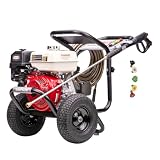
The Simpson PS60869 is the most capable machine in this guide by a wide margin: 4000 PSI, 3.5 GPM, an AAA triplex pump and a Honda GX270 engine. Multiply the numbers and you get roughly 14,000 cleaning units — around 60 percent more cleaning power than the mid-range 3400 PSI machines that dominate