What's inside
- Quick picks by situation
- Makita shop vac comparison
- 18V LXT: the portable, lower-commitment choice
- 18V X2, also sold as 36V: the cordless middle ground
- Corded models: the practical winner for long sessions
- Decision matrix: which Makita shop vac fits?
- HEPA and AWS: two features that are easy to misunderstand
- Setup and maintenance that affect real performance
- Final buying advice
- Quick picks by situation
- Makita shop vac comparison
- 18V LXT: the portable, lower-commitment choice
- 18V X2, also sold as 36V: the cordless middle ground
- Corded models: the practical winner for long sessions
- Decision matrix: which Makita shop vac fits?
- HEPA and AWS: two features that are easy to misunderstand
- Setup and maintenance that affect real performance
- Final buying advice
As an Amazon Associate I earn from qualifying purchases. This post may contain affiliate links at no extra cost to you.
The best Makita shop vac depends on whether you value cordless portability, maximum battery runtime, or uninterrupted corded suction: choose an 18V LXT model for small jobs and tool dust, an 18V X2 model for longer demanding work, and a corded VC-series vacuum for workshop-scale cleanup.
As an Amazon Associate we earn from qualifying purchases at no extra cost to you.

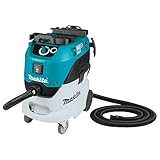


Quick picks by situation
- Best compact cordless choice: Makita XCV11Z 18V LXT for trim work, vehicle interiors, drilling, and occasional cleanup.
- Best cordless tool-connected option: Makita XCV19Z 18V LXT brushless vacuum when automatic tool activation and higher suction matter.
- Best cordless HEPA option: Makita XCV10PTX or a comparable 18V X2 HEPA model for fine woodworking dust and longer sessions.
- Best high-capacity cordless choice: an 18V X2 vacuum such as the XCV23Z when two batteries are preferable to a power cord.
- Best for continuous workshop use: Makita VC4710 or VC4210L corded extractors, particularly when the vacuum will run for hours near a stationary tool.
Makita shop vac comparison
The figures below are representative manufacturer specifications for commonly sold North American versions. Makita can revise equipment, accessories, and regional model numbers, so confirm the specification plate before buying.
| Model or type | Power source | Container capacity | Airflow / suction | Filtration and useful features | Best use |
|---|---|---|---|---|---|
| XCV11Z | One 18V LXT battery | 2.1 gal. dry | 57 CFM; 27 in. water lift | Compact wet/dry design; fleece filter available | Portable cleanup and light tool dust |
| XCV19Z | One 18V LXT battery | 2.1 gal. dry | 57 CFM; about 36 in. water lift | Brushless motor; Bluetooth AWS auto-start; HEPA filter available by configuration | One-tool-at-a-time dust extraction |
| XCV10PTX | Two 18V LXT batteries | 2.1 gal. dry | 74 CFM; about 39 in. water lift | Brushless motor; HEPA filtration; wet/dry operation | Fine dust and longer cordless sessions |
| XCV23Z | Two 18V LXT batteries | about 2.1 gal. dry | High-output cordless extraction; model configuration varies | Brushless motor; AWS-compatible versions; HEPA-rated configurations available | Professional cordless tool extraction |
| VC4210L | 120V corded | 11 gal. | about 148 CFM; about 92 in. water lift | Class L dust extractor; automatic filter cleaning; tool power outlet | Large stationary tools and renovation work |
| VC4710 | 120V corded | 12 gal. | about 135 CFM; about 92 in. water lift | HEPA filtration option; automatic filter cleaning; tool activation | High-volume workshop and jobsite use |
18V LXT: the portable, lower-commitment choice
A one-battery 18V LXT vacuum is the easiest Makita shop vac to carry between rooms, vehicles, and job sites. The XCV11Z is particularly compact and avoids the extension cord, making it practical for short drilling jobs, cabinetry installation, and collecting chips around a workbench.
The limitation is capacity and runtime. A two-gallon container fills quickly when connected to a router or sander, and a single battery can become expensive to operate if used continuously. These vacuums make most sense when the cleanup area is small or when the vacuum is used in short bursts.
The brushless XCV19Z is a better match for power tools. Its AWS capability allows compatible Makita tools and the vacuum to communicate wirelessly, so the extractor starts when the tool runs and stops after a short delay. That reduces unnecessary noise and saves some battery power. AWS is not universal Bluetooth control: both the vacuum and tool must support the AWS system, and the pairing procedure must be completed correctly.
18V X2, also sold as 36V: the cordless middle ground
Makita’s 18V X2 vacuums use two 18V LXT batteries at once. They are often described as 36V tools, but they do not use a separate 36V battery platform. This matters when comparing ownership costs: you need two charged, compatible LXT batteries, plus a dual-port charger or enough charging time between sessions.
The XCV10PTX is a strong choice when fine dust control is more important than minimum weight. Its HEPA filtration and higher airflow are better suited to sanding dust, drywall dust, and repeated tool extraction than a small one-battery unit. HEPA filtration helps capture very small particles, but it does not make unsafe dust automatically safe. Use the correct filter, sealed bags where supported, suitable respiratory protection, and local dust-control procedures.
Choose an 18V X2 model rather than a one-battery vacuum when you regularly sand, cut sheet goods, or work away from outlets for more than a few minutes at a time. It remains quieter and more mobile than a corded extractor, but the batteries add weight and replacement cost.
Corded models: the practical winner for long sessions
A corded VC-series vacuum is usually the better financial decision for a dedicated workshop. It delivers consistent performance without stopping to recharge, and larger containers mean fewer interruptions. The VC4210L and VC4710 also provide features expected from professional dust extractors, including automatic filter cleaning and an electrical outlet or tool-activation system on applicable versions.
For a simple ownership comparison, suppose a cordless vacuum uses two battery sets costing roughly $300 to $500 in total and is used for 300 long sessions. Battery allocation alone works out to approximately $1 to $1.67 per session, before charging losses, filters, and eventual battery replacement. A corded vacuum avoids that battery cost, though it requires a suitable outlet and may cost more initially. For occasional ten-minute cleanup, portability can easily outweigh the calculation; for daily production work, corded power generally wins.
Decision matrix: which Makita shop vac fits?
| Your situation | Recommended direction | Why |
|---|---|---|
| Small budget and occasional use | One-battery 18V LXT | Uses batteries you may already own and has the lowest storage burden. |
| Frequent sanding or cutting without an outlet | 18V X2 HEPA model | Higher output, two-battery runtime, and improved fine-dust filtration. |
| Several compatible Makita tools | AWS-equipped model | Automatic starting avoids repeatedly reaching for the vacuum switch. |
| Small workshop or limited storage | XCV11Z or XCV19Z | Compact enough for a shelf or vehicle and quick to deploy. |
| Daily use with a table saw, planer, or miter saw | VC4210L or VC4710 | Continuous power, larger capacity, and more suitable filter maintenance. |
| Wet spills and general renovation debris | Wet/dry model with float shutoff | Prevents liquid from reaching the motor; empty it promptly after use. |
HEPA and AWS: two features that are easy to misunderstand
HEPA refers to the filtration system, not simply the vacuum’s motor strength. A HEPA-rated configuration is useful for fine particles only when the filter is installed correctly and the housing, hose, and collection system remain reasonably sealed. A clogged filter can reduce airflow dramatically, while a damaged gasket can let dust bypass the filter.
AWS is Makita’s wireless auto-start system. It is worthwhile when you repeatedly switch between a compatible sander, grinder, router, or saw and the extractor. It is less important if you use the vacuum for manual cleanup or connect it to tools from several brands that cannot pair with AWS. Corded models may provide automatic starting through a tool outlet instead.
Setup and maintenance that affect real performance
- Match the hose to the tool. Use a smaller hose for a sander or router port and a larger hose for chips. A reducer that is too restrictive can make a high-CFM vacuum perform poorly.
- Check the filter before every fine-dust job. A loaded filter reduces airflow and can force dust back toward the tool. Use the model’s cleaning cycle or tap and replace the filter according to the manual.
- Do not mix wet and dry debris carelessly. Remove the dry filter or install the wet-collection arrangement specified for the model before vacuuming liquid. Empty and dry the tank afterward to prevent odors and corrosion.
- Inspect the first wear points. Hoses split at cuffs, floor nozzles wear at their edges, fleece bags fill before the tank looks full, and seals lose flexibility. Replacing these parts often restores performance more cheaply than replacing the vacuum.
- Keep battery contacts and vents clean. Fine sawdust around contacts can interrupt communication, while blocked cooling vents increase heat during long extraction sessions.
Final buying advice
Buy the XCV11Z if your priority is a light vacuum for short jobs. Step up to the XCV19Z when AWS and brushless operation will save time. Select an 18V X2 HEPA model for serious cordless fine-dust work, especially when you already own several LXT batteries. If the vacuum will stay in one workshop and run beside tools every day, the corded VC4210L or VC4710 is usually the more capable and economical long-term choice.