What's inside
As an Amazon Associate I earn from qualifying purchases. This post may contain affiliate links at no extra cost to you.
Best Milwaukee Cordless Shop Vacs: M12 and M18 Picks
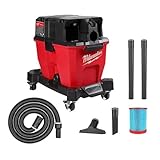
For most mobile woodworkers, the Milwaukee M18 FUEL 6-gallon wet/dry vacuum is the best Milwaukee cordless shop vac: it offers substantially more capacity and is better suited to repeated cleanup, while the compact M12 FUEL wet/dry vacuum is the easier choice for quick jobs, tight spaces, and lighter carry weight.
The right pick depends less on a headline suction figure than on what you clean, how often you stop to empty the tank, and which batteries you already own. Neither vacuum replaces a properly sized dust extractor connected to a sander for sustained fine-dust collection. Think of them as portable cleanup tools for offcuts, chips, vehicle interiors, and occasional spills.
As an Amazon Associate we earn from qualifying purchases at no extra cost to you.


M12 vs. M18 FUEL: the practical differences
| Vacuum | Capacity | Airflow | Sealed suction | Best fit |
|---|---|---|---|---|
| Milwaukee M12 FUEL wet/dry vacuum (0960) | 1.6 gal | 45 CFM | 47 in. water lift | Small spills, benches, vehicles, and light-duty mobile cleanup |
| Milwaukee M18 FUEL 6-gallon wet/dry vacuum (0970) | 6 gal | 75 CFM | 60 in. water lift | More frequent cleanup, larger debris loads, and longer work sessions |
Figures are manufacturer-published specifications; actual runtime and pickup vary with battery, debris, filter condition, and attachments. Airflow describes air volume, while sealed suction describes pull under restricted conditions. Neither number alone predicts how quickly a vacuum will clear a particular pile of sawdust.
Which Milwaukee cordless shop vac should you buy?
Choose the M12 FUEL for compact, occasional cleanup
The M12 is the sensible pick if your vacuum lives in a van, under a bench, or in a cabinet and comes out for short jobs. Its 1.6-gallon tank keeps the unit compact, and the M12 platform makes it appealing when you already own compatible batteries. It is well suited to clearing a workbench, cleaning a tool between tasks, or tidying a vehicle after a project.
The trade-off is capacity. A small tank fills quickly with bulky shavings, and frequent emptying interrupts work. It also has less airflow and sealed suction than the M18 6-gallon model. For piles of chips or repeated cleanup across a full shop session, the smaller footprint may not be worth the extra stops.
Choose the M18 FUEL 6-gallon for more work between interruptions
The 0970 is the stronger all-around option for a woodworker who expects to clean up multiple times during a day. Its larger tank reduces emptying frequency, and its higher published airflow and sealed-suction figures give it more headroom for demanding portable cleanup. The M18 platform is also a natural fit if your cordless tool kit already uses M18 batteries.
That capacity brings bulk. Consider where it will ride in your vehicle and whether you will carry it up stairs or between jobs. It is still a portable vacuum, not a substitute for a high-capacity corded shop vacuum or a dust extractor built for continuous fine-dust collection.
Consider the M18 FUEL PACKOUT wet/dry vacuum for modular transport
If your tools and supplies already travel in PACKOUT storage, Milwaukee’s M18 FUEL PACKOUT wet/dry vacuum offers a stackable, system-oriented format. The design can make a mobile setup easier to load and organize, particularly when a vacuum needs to travel with toolboxes from job to job. Check the exact model’s capacity and accessories before comparing it directly with the 6-gallon 0970; a PACKOUT-compatible footprint and a larger tank serve different priorities.
PACKOUT compatibility is most valuable when it solves a real transport problem. If you usually vacuum in one garage, paying extra for a modular setup may not improve the cleanup itself.
Runtime: plan around the battery, not a promise
Runtime changes with battery capacity, operating mode, filter loading, and the work being done. Fine dust that clogs a filter can reduce effective pickup and make a session feel shorter. Since published runtime claims may use a particular battery and test condition, treat them as comparisons under stated conditions—not as a guarantee for your mix of sawdust and debris.
For a useful planning estimate, divide the cleanup into actual trigger-on minutes rather than the time spent at a job. For example, if your cleanup takes four two-minute passes, budget around eight minutes of vacuum operation, plus interruptions to move hoses or empty the tank. If that workload regularly exceeds the runtime you get from your own battery, carry a charged spare or move to a larger-capacity battery supported by the tool.
Higher-capacity packs generally provide more energy, but they add weight and cost. A compact M12 setup can be a good choice for brief, frequent touch-ups; for longer or heavier sessions, the M18 platform and a spare battery are usually the more practical pairing.
Pick by your workshop situation
| Your situation | Better match | Why |
|---|---|---|
| Occasional cleanup; limited storage | M12 FUEL 0960 | Small 1.6-gallon format is easier to store and carry. |
| Frequent cleanup or larger debris loads | M18 FUEL 0970 | Six-gallon capacity means fewer emptying stops. |
| Tools already travel in PACKOUT cases | M18 FUEL PACKOUT vacuum | Stackable transport can simplify a mobile kit. |
| Primarily sanding, with continuous fine-dust collection needed | A suitable dust extractor | A cordless shop vac is mainly a cleanup tool, not an automatic substitute for source extraction. |
Ownership details that affect day-to-day performance
- Keep the filter suited to the job. Use the manufacturer-recommended filter for the material and wet-or-dry application. A loaded filter restricts airflow; clean or replace it according to the manual.
- Let wet components dry. After wet pickup, empty the tank and clean and dry the tank and filter as directed before storing the vacuum. Leaving moisture and debris inside invites odor and can damage components.
- Check the hose and seals. Fine dust, wood chips, and tight bends can obstruct a hose or nozzle. A leak at a connection can also reduce effective pickup, even when the motor is running normally.
- Expect wear at the working end. Hoses, cuffs, nozzles, and filters take the most routine abuse. Store the hose without sharp kinks, and confirm replacement parts are available for the exact model.
- Choose the right tool for fine dust. Emptying and cleaning a shop vac can release dust back into the workspace. For frequent sanding or cutting, pair the tool with appropriate source collection and follow the dust-control guidance for your materials.
Bottom line
Buy the M12 FUEL 0960 if compact storage and quick cleanup matter more than tank capacity. Choose the M18 FUEL 0970 for a more capable general-purpose cordless vacuum and fewer interruptions during a busy workday. Pick the M18 FUEL PACKOUT version when stackable transport is a meaningful part of your workflow. For all three, battery availability, replacement filters, and the type of dust you need to capture matter as much as the vacuum’s headline suction numbers.