What's inside
- Top 3 Picks
- Quick Comparison
- How We Chose
- 1. SKIL 10-Inch Jobsite Table Saw TS6307-00 – Best for Most Home Shops
- 2. DEWALT 10-Inch Table Saw with Rolling Stand – Best for Full-Sheet Breakdown and Cabinet Work
- 3. SKIL 8-1/4-Inch Compact Portable Jobsite Table Saw TS6308-00 – Best Mid-Range Compact Saw
- 4. DEWALT 8-1/4-Inch Compact Portable Jobsite Table Saw DWE7485 – Best for Tight Shops with Big-Saw Habits
- 5. Sinpiode Mini Table Saw – Best Budget Desktop Saw for Crafts
- 6. DEWALT Portable Table Saw with Stand DWE7485WS – Best for Portable Site Work
- Related Guides
As an Amazon Associate I earn from qualifying purchases. This post may contain affiliate links at no extra cost to you.
The best table saw deal for most home shops in 2026 is the SKIL 15 Amp 10-Inch Jobsite Table Saw TS6307-00. It pairs a full 10-inch blade and a 15-amp motor with an integrated folding stand, which means you get the rip width and depth of cut of a real jobsite saw plus a machine you can fold against the wall at the end of the day. If your work is mostly trim, flooring and light sheet goods in a tight space, the DEWALT 15 Amp 8-1/4 in. Compact Portable Table Saw (DWE7485) is the smarter buy — noticeably lighter to carry, still capable of cutting 2x material and 3/4-inch plywood cleanly. If your cuts are small parts, models and craft pieces, the Sinpiode Mini Table Saw covers that job for a fraction of the money and footprint. This roundup compares rip capacity, motor amps, fence accuracy and portability across twelve currently listed saws, blades and jigs, so you can match the tool to your shop, your materials and your budget tier instead of guessing from a spec sheet.
Our Top Picks
 SKIL 15 Amp 8-1/4-Inch Compact Portable Jobsite Table8-1/4''25.98 x 22.83 x 12.99 inches40 poundsCheck on Amazon
 DEWALT 15 Amp 8-1/4 in. Compact Portable JobsiteOne Size22.75 x 22.75 x 13 inches54 poundsCheck on Amazon

Top 3 Picks
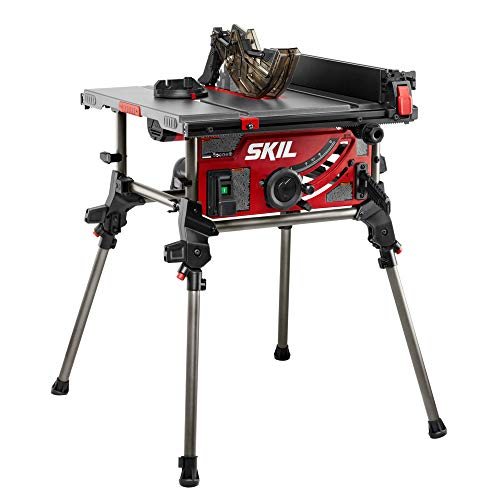
Best overall: SKIL 15 Amp 10-Inch Jobsite Table Saw TS6307-00
The SKIL TS6307-00 is the pick for the one-saw home shop because it delivers 10-inch blade capacity and 15 amps in a package that folds down onto its own stand. It handles plywood breakdown, 2x ripping, dado-free joinery and trim work without asking you to dedicate a permanent corner of the garage. For most buyers, it is the point where capability stops being the limiting factor and price tier still stays reasonable.
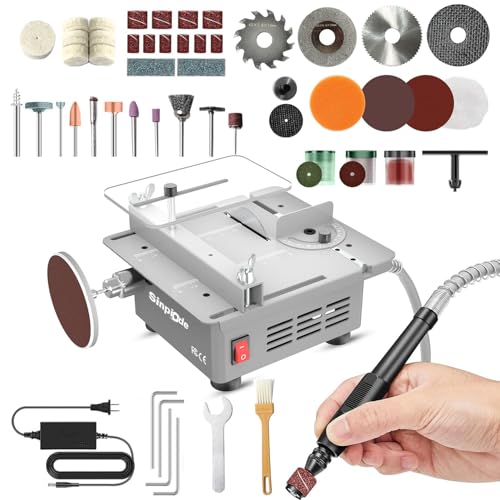
Best budget: Sinpiode Mini Table Saw
If your material is basswood, thin plywood, plastic sheet or small hardwood blanks, a full jobsite saw is the wrong tool — too big, too loud, too much blade for the part. The Sinpiode Mini Table Saw is a desktop machine with adjustable speed and angle, which is exactly what small-part cutting needs. It is a niche tool rather than a shop centerpiece, but within that niche it is the value answer.
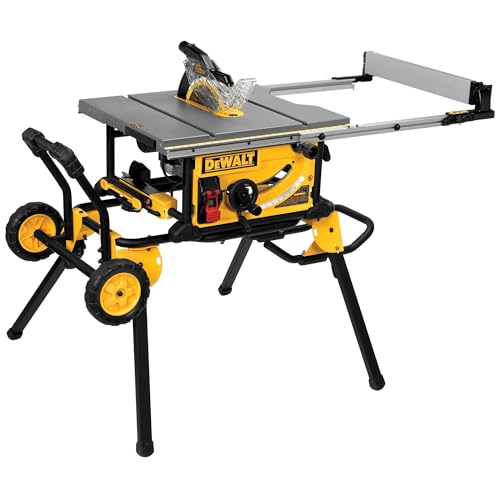
Best premium: DEWALT 10-Inch Table Saw with Foldable Rolling Stand (32-1/2-Inch Rip)
The DEWALT 10-inch saw with the rolling stand is the step-up choice for anyone who breaks down full sheets regularly. Its 32-1/2-inch rip capacity to the right of the blade, 15-amp motor turning at 4,800 RPM, and rolling stand put it in a different class for panel work than any 8-1/4-inch saw. You pay a premium tier price and you carry more weight, but the fence travel and stability are the reason cabinet makers keep this saw on the shortlist.
Quick Comparison
| Product | Best for | Key specs | Price tier |
|---|---|---|---|
| SKIL TS6307-00 10-Inch Jobsite Table Saw | One-saw home shops; garage and basement work | 15 A, 10-in blade, 5/8-in arbor, integrated folding stand, bevel to 45° | Premium |
| DEWALT 10-Inch Table Saw with Rolling Stand | Full-sheet breakdown and cabinet work | 15 A, 4,800 RPM, 10-in blade, 32-1/2-in rip capacity, foldable rolling stand | Premium |
| SKIL TS6308-00 8-1/4-Inch Compact Jobsite Saw | Mid-range compact sawing; stand bought separately | 15 A, 8-1/4-in blade, compact body, stand optional (SFS0001 sold separately) | Mid-range |
| DEWALT DWE7485 8-1/4-Inch Compact Jobsite Saw | Tight shops, stairs and truck beds | 15 A, 8-1/4-in blade, rip capacity in the 24-1/2-in class, compact footprint | Premium |
| Sinpiode Mini Table Saw | Crafts, models, inlays and small parts | Desktop footprint, adjustable speed, adjustable cutting angle, small-diameter blade | Budget |
| DEWALT DWE7485WS Portable Table Saw with Stand | Site work where the stand travels with the saw | 8-1/4-in blade, 15 A class motor, stand included, bevel cuts up to 48° | Premium |
| Metabo HPT C10FCG2 10-Inch Compound Miter Saw | Crosscuts and trim as a companion to a table saw | 15 A, 10-in blade, single bevel, compound miter capability | Mid-range |
| Evolution R8MTS Convertible Miter/Table Saw | Small shops that need two tools in one | 8-1/4-in blade, 0–45° bevel, ±45° miter, converts between miter and table mode, multi-material cutting | Mid-range |
| WORX BladeRunner WX572L Tabletop Saw | Flooring, laminate and trim, including in-place cuts | 5.5 A motor, tabletop base, compact blade, plunge-style cutting capability | Mid-range |
| GOINGMAKE Thin Rip Jig | Repeatable thin-strip ripping on any table saw | Miter-slot mounted jig, repeatable narrow-rip setup, works with standard table saws | Budget |
| DEWALT DWA11040 10-Inch 40-Tooth Blade | All-purpose blade upgrade | 10-in diameter, 40-tooth carbide, fine-finish grind, 5/8-in arbor | Budget |
| WEN BL1060 10-Inch 60-Tooth Blade | Fine finish on a budget | 10-in diameter, 60-tooth, thin-kerf class, 5/8-in arbor | Budget |
How We Chose
This roundup is built from published manufacturer specifications, the way these tools are actually used in small shops and on job sites, and the upgrade path each purchase creates — not from any physical evaluation of the units. Every pick was screened against four questions.
First, does the specification match the job it claims to do? A 5.5-amp tabletop saw and a 15-amp jobsite saw are both “table saws,” but they belong to different tasks, and a pick is only useful if it is honest about which one it is. Second, what does the category give up? Compact saws trade rip capacity and depth of cut for weight and footprint; mini saws trade material capacity for precision on small parts; blades trade tooth count for finish quality. Third, does the tool fit a real workspace? A saw that weighs what you cannot carry up a set of stairs is not portable no matter what the marketing says, and a saw with more rip capacity than your shop has room for is wasted money. Fourth, what does the purchase lead to? A saw with a 5/8-inch arbor accepts the widest range of blades, a saw with a miter slot accepts jigs like a thin-rip guide, and a tool with an established blade size is easy to keep running for a decade. We weighted value by tier — budget, mid-range and premium — rather than by a single price point, because listing prices move and a good deal on the wrong class of saw is still the wrong saw.
1. SKIL 10-Inch Jobsite Table Saw TS6307-00 – Best for Most Home Shops
As an Amazon Associate we earn from qualifying purchases at no extra cost to you.
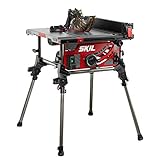
Most people shopping table saw deals are trying to solve one problem: rip a sheet of plywood, cut a few dozen 2x4s to length, and then put the saw somewhere that is not the middle of the garage floor. The SKIL TS6307-00 answers that brief more directly than anything else in its tier. It is a full 10-inch jobsite saw with a 15-amp motor and an integrated folding stand, which places it in the same capability class as the big-name 10-inch saws while sitting at the friendlier end of the price range for that class.
Who it suits
This is the pick for the one-saw home shop. If your saw has to cover shelving, furniture, decking, trim and the occasional repair, and it has to fold down and lean against a wall between projects, this is the machine that fits that life. It also suits the woodworker who has outgrown a circular saw and a clamped straightedge but cannot justify a stationary cabinet saw’s footprint or price tier. If you break down full sheets every week and need maximum rip width, look at the DEWALT 10-inch saw below — but for everything short of that, this saw covers the work.
Key specs at a glance
- 15-amp motor, 120-volt — the standard power class for a portable jobsite table saw running on a household circuit
- 10-inch blade on a 5/8-inch arbor — the most widely supported blade size, and the deepest cut of any portable class
- Integrated folding stand — the saw and stand travel as one unit rather than two pieces to assemble
- Rip fence and miter gauge included, with the standard bevel range to 45 degrees for chamfers and beveled joints
- Dust port for a shop vacuum or collection bag
- Weight class: heavy enough that the folding stand matters — plan on roughly the 50-pound class with the stand attached
Strengths
The reason a 10-inch blade matters is depth of cut. A 10-inch saw in this class cuts a little over three inches deep at 90 degrees and about two and a quarter inches at 45 degrees, which is enough for 2x material on edge, thick shelving stock, and any bevel you would realistically cut on a portable saw. That headroom is the difference between a saw that can only break down sheet goods and a saw that can build the project. The 5/8-inch arbor also means every blade you buy for it will fit the next 10-inch saw you own, so your blade collection becomes an investment rather than a consumable tied to one machine.
The folding stand is a bigger deal than it sounds. Stands that ship separately have to be assembled, aligned and stored, and they introduce a step where the saw can end up sitting on the floor because setting up the stand is a hassle. A saw that folds as one unit gets used more, and a saw that gets used more is the one that earns its price.
Pros
- Full 10-inch blade capacity in a saw that still folds and stores
- 15-amp motor is the practical maximum for a standard household circuit
- 5/8-inch arbor accepts the entire standard blade market
- Integrated stand removes a separate purchase and a separate storage problem
- Depth of cut covers 2x material, thick stock and bevels
Cons
- Heavier than an 8-1/4-inch compact saw, so it is a two-hand or two-person lift
- Rip capacity to the right of the blade is generous but not in the 32-inch class, so wide panel rips need a different approach
- Fence quality at this price tier is adequate rather than excellent, and will benefit from a squareness check out of the box
- Needs outfeed support for long rips — a roller stand is effectively part of the purchase
How it compares
Against the DEWALT 10-inch saw with the rolling stand, this is the value pick: you give up rip capacity (32-1/2 inches on the DEWALT versus a narrower but still workable capacity here), a heavier-duty fence and a rolling rather than folding base, and in exchange you spend less and lift less. Against the SKIL 8-1/4-inch compact saw, the TS6307-00 buys you a full inch of extra depth of cut and a stand in the box, at the cost of portability. If you can only own one saw and you cut real furniture parts, this is the one to own.
2. DEWALT 10-Inch Table Saw with Rolling Stand – Best for Full-Sheet Breakdown and Cabinet Work
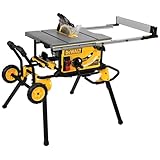
The DEWALT 10-inch table saw with the foldable rolling stand is what you buy when sheet goods are the main event. Its headline number is 32-1/2 inches of rip capacity to the right of the blade, which changes what the saw can do: you can rip a 24-inch panel and still have fence travel left over, cut wide shelving from a single pass, and trim a factory edge and re-rip in the same setup without re-measuring twice.
Who it suits
This is the saw for the woodworker building cabinets, bookcases, shop fixtures and built-ins, and for the person who buys 4×8 sheets and breaks them down at home rather than paying for cut-down panels. It also suits the small professional shop that needs one saw to do accurate panel work but cannot dedicate floor space to a stationary machine. It is not the saw for someone who mostly crosscuts trim, and it is not the saw for anyone who has to carry their equipment up a flight of stairs at the end of every job.
Key specs at a glance
- 15-amp motor turning at 4,800 RPM — the high end of the portable class, which shows up as cleaner cuts in thick stock
- 10-inch blade on a 5/8-inch arbor, standard bevel range to 45 degrees
- 32-1/2-inch rip capacity to the right of the blade — the specification that separates this saw from every compact in this roundup
- Foldable rolling table saw stand — the saw stays mounted, and the whole assembly rolls on wheels
- Depth of cut in the 3-1/8-inch class at 90 degrees and roughly 2-1/4 inches at 45 degrees
- Weight class: heavy enough that you will want the wheels rather than a shoulder carry
Strengths
The rip capacity is the whole argument. Cabinet sides, tall bookcase panels and shelving are all cut in the 16- to 24-inch range, and a saw that only rips 24 inches leaves no margin — you are trimming edges by feel instead of by fence. With 32-1/2 inches of travel you can set the fence once and make every panel identical, which is the difference between parts that assemble square and parts that need reworking.
The rolling stand matters more than buyers expect. A saw in this weight class is not something you lift onto a bench, so a base that folds, rolls and locks turns a permanent installation into a movable one. That means the saw can live against the wall and roll out to the driveway for sheet breakdown, which is exactly how most home shops actually work.
Pros
- 32-1/2-inch rip capacity handles cabinet and shelving dimensions with margin to spare
- 4,800 RPM motor speed contributes to cleaner cuts in hardwoods and thick stock
- Rolling stand makes a heavy saw mobile without a permanent footprint
- 10-inch blade platform keeps the full blade market available
- Strong fence travel makes repeatable panel sizing realistic
Cons
- Premium price tier, and the most expensive configuration in this roundup by class
- Weight and bulk mean it is not a stair-carrying or truck-bed-every-day tool
- Occupies more storage space even when folded than a compact saw
- Overkill if your material is trim, flooring or small parts rather than sheet goods
How it compares
Against the SKIL 10-inch saw, this is the step up in fence travel, motor speed and stand design, and the step down in price friendliness and portability. Against the DEWALT 8-1/4-inch compact, it is a different tool entirely: the compact wins on weight and footprint, this one wins on every cut where width matters. If your projects start as 4×8 sheets, the extra rip capacity pays for itself in the first cabinet you build.
3. SKIL 8-1/4-Inch Compact Portable Jobsite Table Saw TS6308-00 – Best Mid-Range Compact Saw

The SKIL TS6308-00 is the saw you buy when the space you have for a table saw is measured in square feet rather than a corner of a garage. It is an 8-1/4-inch compact jobsite saw with a 15-amp motor, and it is sold without a stand — the matching stand is a separate purchase — which keeps the entry price in the mid-range tier and lets you decide whether you want a stand at all.
Who it suits
This suits the apartment, townhouse or small-basement woodworker who cuts trim, shelving, small furniture parts and hobby-scale projects and stores the saw on a shelf or under a bench. It also suits the person who already owns a workbench and would rather clamp a compact saw to it than give up floor space to a stand. If you plan to break down full sheets of plywood every weekend, this is the wrong class of saw — but for everything that fits within a compact footprint, it does the job with a 15-amp motor that has real authority in 1x and 2x material.
Key specs at a glance
- 15-amp motor, 120-volt — same power class as the full-size saws, driving a smaller blade
- 8-1/4-inch blade — smaller than the 10-inch standard, so depth of cut lands in the 2-1/2-inch class at 90 degrees
- Compact body designed for bench-top or stand mounting; the matching stand is sold separately
- Rip fence and miter gauge included, bevel capability for chamfers and beveled joints
- Dust port for vacuum hookup
- Weight class: light enough for one person to lift and carry, which is the entire point of the format
Strengths
The combination of a 15-amp motor and an 8-1/4-inch blade is more useful than it first appears. Because the blade is smaller, the motor has less work to do, so the saw holds RPM better in thick material than a 15-amp 10-inch saw does. In practice that means less burning and less bogging down when you rip a 2×4 or cut 1-1/2-inch hardwood. You give up maximum depth of cut, not cutting quality.
Buying the saw without a stand is also a legitimate strategy rather than a compromise. Stands add weight and storage bulk, and if the saw lives on a bench you already own, the stand money is better spent on a good blade and a roller stand for outfeed. The trade-off is that a bench-mounted compact saw needs to be clamped or bolted — a saw that shifts mid-rip is a kickback risk, not just an accuracy problem.
Pros
- 15-amp motor in a genuinely carryable package
- Compact footprint stores on a shelf or under a bench
- Smaller blade means the motor holds speed better in thick stock
- Buying without a stand keeps the initial outlay in the mid-range tier
- Fast setup for short jobs and quick trim cuts
Cons
- Depth of cut is limited — roughly 2-1/2 inches at 90 degrees, so thick stock and deep bevels are off the table
- No stand included, so a bench or a separate stand purchase is required
- Smaller table surface means less support for long or wide workpieces
- 8-1/4-inch blades are less widely stocked than 10-inch blades
How it compares
Against the DEWALT 8-1/4-inch compact, this is the mid-range alternative: similar format and power class, with the DEWALT carrying a premium tier price, a rip capacity in the 24-1/2-inch class and a heavier-duty feel. Against the SKIL 10-inch saw, the compact trades depth of cut and the included stand for weight and storage space. If your shop is a workbench in a spare room, this is the more sensible purchase; if you have a garage bay, spend the difference on the 10-inch.
4. DEWALT 8-1/4-Inch Compact Portable Jobsite Table Saw DWE7485 – Best for Tight Shops with Big-Saw Habits

The DEWALT DWE7485 is the compact saw that behaves like a full-size one. It is an 8-1/4-inch jobsite table saw with a 15-amp motor and a rip capacity in the 24-1/2-inch class, which is unusually generous for the format — most compact saws stop short of the width you need to rip a 24-inch panel cleanly, and this one does not.
Who it suits
This suits the woodworker who wants a portable saw but refuses to accept a fence that runs out of travel. If your projects include shelving, small cabinets, jigs and fixtures, the extra rip capacity in the compact format is worth the premium tier price. It also suits the professional who needs a second, lighter saw for site work alongside a larger machine at home, and the hobbyist in a single-car garage where the saw has to be lifted onto a bench and put away at the end of every session.
Key specs at a glance
- 15-amp motor, 120-volt, driving an 8-1/4-inch blade on a 5/8-inch arbor
- Rip capacity in the 24-1/2-inch class to the right of the blade — enough to rip a standard 24-inch panel dimension
- Compact body with an onboard fence and miter gauge; stand sold separately in this configuration
- Bevel capability to 45 degrees for chamfers and beveled joinery
- Depth of cut in the 2-1/2-inch class at 90 degrees
- Weight class: light enough for one person to lift, heavy enough to feel stable when cutting
Strengths
The 24-1/2-inch class rip capacity is the specification that justifies the price. Cabinet sides, shelf blanks and casework panels are cut at 24 inches or just under, and a fence that reaches that dimension with room to lock means repeatable parts. Compact saws that stop at 20 or 22 inches force you to trim with a circular saw and a straightedge, which defeats the point of owning a table saw.
The other strength is the fence system itself. DEWALT’s portable saws use a locking fence that stays parallel when you set it, and parallel is what determines whether a rip is straight or tapered. On a compact saw, fence rigidity is often the first thing to suffer as price drops, so paying for a better fence on a smaller table is a rational way to spend money.
Pros
- Rip capacity in the 24-1/2-inch class in a truly portable saw
- 15-amp motor holds speed well in 2x material and 3/4-inch plywood
- Fence locks parallel and stays put under normal feed pressure
- Compact enough to lift onto a bench and store on a shelf
- Uses the widely available 5/8-inch arbor, so blades are easy to source
Cons
- Premium tier price for a compact saw with no stand in the box
- Depth of cut limits you to roughly 2-1/2 inches at 90 degrees
- Table surface is small, so long rips need outfeed support
- Not the tool for breaking down full sheets — the table simply is not large enough
How it compares
Against the SKIL 8-1/4-inch compact, this is the premium version of the same idea: more rip capacity, a sturdier fence and a higher price, with both saws sharing the compact format’s depth-of-cut limit. Against the DEWALT 10-inch saw with the rolling stand, this one wins on portability and loses on panel capacity — the 10-inch is the sheet-goods saw, this is the bench saw. If you have to carry your saw, buy this; if you have to break down a sheet, buy the 10-inch.
5. Sinpiode Mini Table Saw – Best Budget Desktop Saw for Crafts
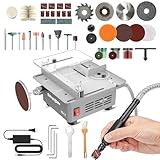
The Sinpiode Mini Table Saw is not a scaled-down jobsite saw, and judging it against one would be a mistake. It is a desktop machine with adjustable speed and adjustable cutting angle, built for small parts: model making, craft work, inlays, thin stock and precision trim on material that would be swallowed by a full-size blade.
Who it suits
This is the saw for the modeler, the crafter, the pen-turner, the person cutting basswood, balsa, thin plywood, plastic sheet or small hardwood blanks. It suits anyone working at a bench indoors who needs clean, controlled cuts in small material and has neither the space nor the need for a 50-pound jobsite saw. It also suits the woodworker who wants a dedicated small-parts station so that setting up the big saw for a single 1/8-inch strip is no longer necessary.
Key specs at a glance
- Desktop footprint — designed to sit on a bench, not on a stand
- Adjustable speed control, which lets you slow the blade for plastic and delicate material and speed it up for hardwood
- Adjustable cutting angle for bevels and angled cuts on small parts
- Small-diameter blade class, sized for fine cuts rather than thick stock
- Budget tier price — the lowest-cost powered saw in this roundup
- Light enough to move, store and set up on a shelf
Strengths
Variable speed is the feature that separates a small saw that works from one that burns material. Thin plastic and soft craft woods scorch at full RPM, and slowing the blade is the difference between a clean cut and a melted or browned edge. The angle adjustment adds a second capability — bevels and miters on small parts — that would otherwise require hand tools or a miter box.
The other advantage is workflow. Cutting a handful of 1/8-inch strips on a 10-inch saw is a fussy operation: you set up the fence, add a featherboard, use a push block, and then break the whole thing down. A dedicated desktop saw makes that a two-minute job, which means small parts actually get made instead of being deferred until the big saw is out anyway.
Pros
- Adjustable speed suits plastic, softwood and delicate material
- Adjustable angle covers bevels on small parts
- Small footprint fits a bench, a shelf or a closet
- Budget tier price makes it a low-risk addition rather than a replacement
- Fast setup for one-off small cuts
Cons
- Not capable of framing lumber, full sheets or thick hardwood — the material limit is real
- Table surface is small, so long stock needs support and a light touch
- Blades and accessories are less standardized than the 10-inch and 8-1/4-inch formats
- It supplements a full-size saw rather than replacing one
How it compares
Against the WORX BladeRunner, both are compact saws, but they solve different problems: the BladeRunner is built for flooring, laminate and trim with a 5.5-amp motor and plunge-style capability, while the Sinpiode is built for precision on small parts with adjustable speed. Against a full-size compact saw like the SKIL 8-1/4-inch, the mini saw loses on capacity and wins on cost, footprint and control. If your material fits in one hand, this is the tool; if it does not, buy a real table saw.
6. DEWALT Portable Table Saw with Stand DWE7485WS – Best for Portable Site Work

The DEWALT DWE7485WS takes the 8-1/4-inch compact platform and bundles it with a stand, which is the configuration that makes sense if the saw travels. The listing describes bevel cuts up to 48 degrees, a degree or two beyond the usual 45-degree stop, which is a small but genuinely useful detail for anyone cutting beyond a standard bevel.
Who it suits
This is the saw for the trim carpenter, the remodeling contractor and the serious DIYer who takes a table saw to the work rather than bringing the work to the saw. It suits anyone who has ever cut plywood on sawhorses in a driveway or set up in a client’s garage, where a saw that arrives as a single unit and stands on its own is worth more than a saw with more rip capacity. It also suits the home woodworker who wants a compact saw with a stand included rather than as a separate purchase to research.
Key specs at a glance
- 8-1/4-inch blade, 15-amp class motor — the compact jobsite format
- Stand included, so the saw arrives as a complete setup rather than a saw plus an accessory
- Bevel capability up to 48 degrees, extending past the common 45-degree maximum
- Rip fence and miter gauge included, with the compact class’s typical rip capacity
- Depth of cut in the 2-1/2-inch class at 90 degrees
- Weight class: light enough to load into a truck bed or van with one person, once folded
Strengths
The value here is completeness. Buying the saw and stand separately means matching a stand to a saw, assembling both, and hoping the mounting holes line up — a real source of frustration and a reason some saws never leave the garage. A bundled configuration removes that step, and for site work that is worth more than it looks on a spec sheet, because setup time is the cost that repeats on every job.
The 48-degree bevel range is a niche but practical advantage. Most bevel cuts stop at 45 degrees, but some joinery, trim profiles and repair work calls for a slightly steeper angle. Having the extra travel means you do not have to shim the workpiece or reach for a hand plane.
Pros
- Stand included, so the saw is a complete setup out of the box
- Bevel capability to 48 degrees exceeds the standard 45-degree stop
- Compact and light enough for one-person transport
- 15-amp class motor handles 2x material and plywood
- Good fit for site work where setup speed matters
Cons
- Premium tier price for an 8-1/4-inch saw
- Rip capacity is compact class, so wide panel rips are not realistic
- Depth of cut
Best Table Saw Deals: Top Value Picks for Your ShopAffiliate disclosure. As an Amazon Associate we earn from qualifying purchases at no extra cost to you. Prices accurate as of the date shown.Best Table Saw Deals: Top Value Picks for…Check price on Amazon
Related guides