What's inside
As an Amazon Associate I earn from qualifying purchases. This post may contain affiliate links at no extra cost to you.
Start with the tool, not the battery label
A battery fits only when its electrical connection, physical interface, and control system are compatible with the tool. Matching the brand name or voltage alone is not enough. Before buying, find the tool’s full model number, usually printed on a label on the housing, battery bay, or handle. Check the manufacturer’s manual or compatibility chart for batteries approved for that exact tool.
Look at the battery currently in the tool, if you have it. Note its voltage, product family, part number, and the shape and position of its rails and contacts. A battery from the same brand can still belong to a different platform or generation. For example, a manufacturer may sell several 18-volt or 20-volt product lines whose packs do not share a mounting interface.
Check voltage and platform
Voltage is a necessary check, not a compatibility guarantee. A tool designed for an 18-volt platform should not be fitted with a pack from a different-voltage platform just because the battery slides into the bay. Some brands use a nominal voltage on one label and a higher “maximum” voltage on another; compare the actual platform and approved battery list, rather than treating those marketing numbers as interchangeable.
Within a platform, newer packs may work with older tools, but exceptions are common. A high-capacity battery might physically attach yet be too bulky for a compact drill’s handle or a tool designed for a slim pack. Conversely, an older tool may not support a newer battery’s electronics or features. Confirm compatibility for the tool model, especially before buying a high-output or unusually large battery.
Compare the fit and contacts
If you can inspect both parts, compare the battery rails, latch positions, and contact layout with the tool’s battery bay. Do not force a pack that stops partway or needs unusual pressure. A correct pack should slide in smoothly and latch securely; the release button should work without prying. A loose fit can interrupt power under load, while forced insertion can damage the rails, latch, or electrical contacts.
Never file, bend, tape, or otherwise modify a battery or tool to make it fit. The contacts may carry substantial current, and an improvised connection can overheat, short, or fail while the tool is running. Do not test fit a pack with damaged, swollen, cracked, or corroded parts.
Read the labels and documentation
Search the tool’s model number together with the battery part number on the manufacturer’s website. A manual or official compatibility chart is more reliable than a retailer listing that says only “fits Brand X.” If the tool is old or discontinued, contact the manufacturer or a service center with the model number and a clear photo of the battery bay.
Check the charger separately. A battery that works in a tool may not be safe to charge in every charger from the same brand, particularly across generations or voltage platforms. Use only a charger listed for that battery family. A charger that accepts the pack physically is not proof of electrical compatibility.
Fit is different from runtime and performance
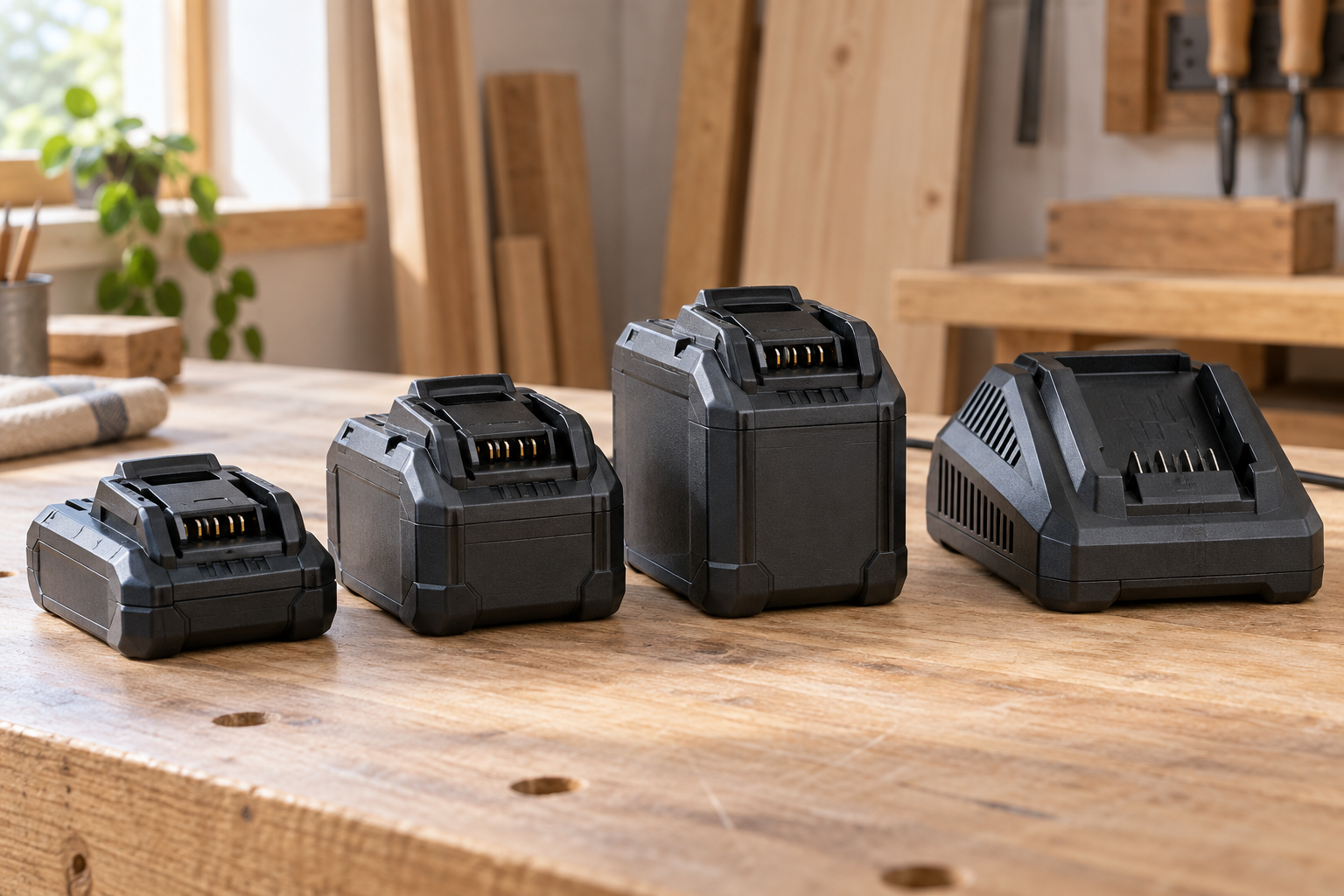
Amp-hours (Ah) describe capacity, not whether a battery fits. Within a compatible platform, a 5 Ah pack generally stores more energy than a 2 Ah pack, but it also tends to cost more, weigh more, and take longer to recharge. For a drill used occasionally for light assembly, a smaller pack may be the better choice. For repeated cutting or grinding, a larger pack can reduce battery changes, though it adds weight and may still run down quickly under heavy load.
| What to compare | What it tells you | What it does not prove |
|---|---|---|
| Voltage and platform | Whether the battery belongs to the tool’s electrical family | That the rails, contacts, or electronics match |
| Battery part number | Whether the manufacturer lists that pack for the tool | That it fits a different tool model in the same brand |
| Amp-hours (Ah) | Approximate battery capacity and likely runtime | Physical or electrical compatibility |
| Charger model | Whether the charger is approved for the pack | That the battery is approved for the tool |
Decide carefully about third-party batteries
Aftermarket packs can cost less, and a reputable replacement may be reasonable for an older tool when the manufacturer’s pack is hard to find. The trade-off is uncertainty: listings may claim broad compatibility without documenting protection circuitry, cell quality, or charger support. Poorly matched electronics can cause shutdowns, inaccurate charge indicators, excess heat, or failure to charge.
If you consider one, verify the exact tool and charger compatibility in writing, check the seller’s return policy and warranty, and avoid packs with vague specifications or no traceable manufacturer. Do not use an adapter to bridge unrelated battery platforms unless the tool and adapter makers explicitly approve that combination. Adapters can leave protections or controls mismatched. For a replacement in a common platform, compare the price of a manufacturer replacement battery with an aftermarket compatible battery, then confirm each candidate against the tool maker’s documentation.
A quick check before you buy
Use this order to avoid buying on a misleading headline: record the tool model; identify its voltage platform; find the battery part numbers the manufacturer approves; confirm the charger separately; then compare capacity, size, weight, price, and warranty. If the listing does not name your tool model or battery family, ask the seller before ordering. Keep the packaging until you have confirmed the pack fits without force and the manufacturer-approved charger recognizes it.
If a correctly identified battery will not latch, or a compatible pack repeatedly cuts out, stop using it. Check for dirt or damage at the contacts, but do not scrape them with metal. A worn tool latch, damaged battery, or failed contact can mimic a compatibility problem. Have the tool or pack inspected rather than trying another adapter or forcing the connection.
Related guides
- Longest Lasting Lawn Mower Battery: AGM vs Lithium vs Flooded Lifespan and Cost per Season
- Duralast Gold Lawn Mower Battery Review: U1 Fit, CCA and When to Pay for AGM
- Greenworks Pro 80V 21-Inch Mower Review: Runtime Math, Push vs Self-Propelled and Yard Fit
- Bosch High Pressure Washer Gun Replacement: Fittings, Adapters and What Fits Your Model