What's inside
As an Amazon Associate I earn from qualifying purchases. This post may contain affiliate links at no extra cost to you.
Two battery platforms with different priorities
Skil PWRCore 20 and Ryobi ONE+ are 20-volt-class cordless tool systems aimed at homeowners, DIY users, and light trade work. Their batteries are not interchangeable, and neither platform is compatible with the other brand’s tools. The useful question is not simply which battery is cheaper. It is whether the system has the tools, battery sizes, chargers, and replacement options you will need several years from now.
Skil generally offers the lower entry price and a focused selection of common cordless tools. Ryobi costs more in some kits, but ONE+ has a much broader range, including outdoor equipment, specialty tools, and several higher-performance 18V HP brushless models. For a homeowner building a small collection, Skil can be the better bargain. For someone planning to replace many corded tools, Ryobi is usually the safer long-term platform.
Battery compatibility and charging
Both systems use slide-on lithium-ion batteries and advertise roughly 20 volts maximum, although the nominal operating voltage is closer to 18 volts. The voltage label does not make the batteries interchangeable. The physical rails, terminals, electronics, and battery-management systems are different.
Within each brand, compatibility still requires attention. Skil PWRCore 20 batteries are intended for PWRCore 20 tools, while Ryobi ONE+ batteries fit the broad ONE+ tool family. Ryobi’s newer ONE+ HP brushless tools still use the same basic battery interface, but they can deliver better results with HP high-performance packs. A small older Ryobi pack will run an HP tool, but it may limit runtime and peak output.
Skil’s PWRCORE technology places some cooling and charging electronics in the battery design, depending on the pack. Ryobi batteries use their own battery-management and monitoring systems. In either case, use the manufacturer’s charger. Third-party batteries and chargers can be unreliable, may reduce tool performance, and create a genuine overheating or fire risk if their protection circuitry is poor.
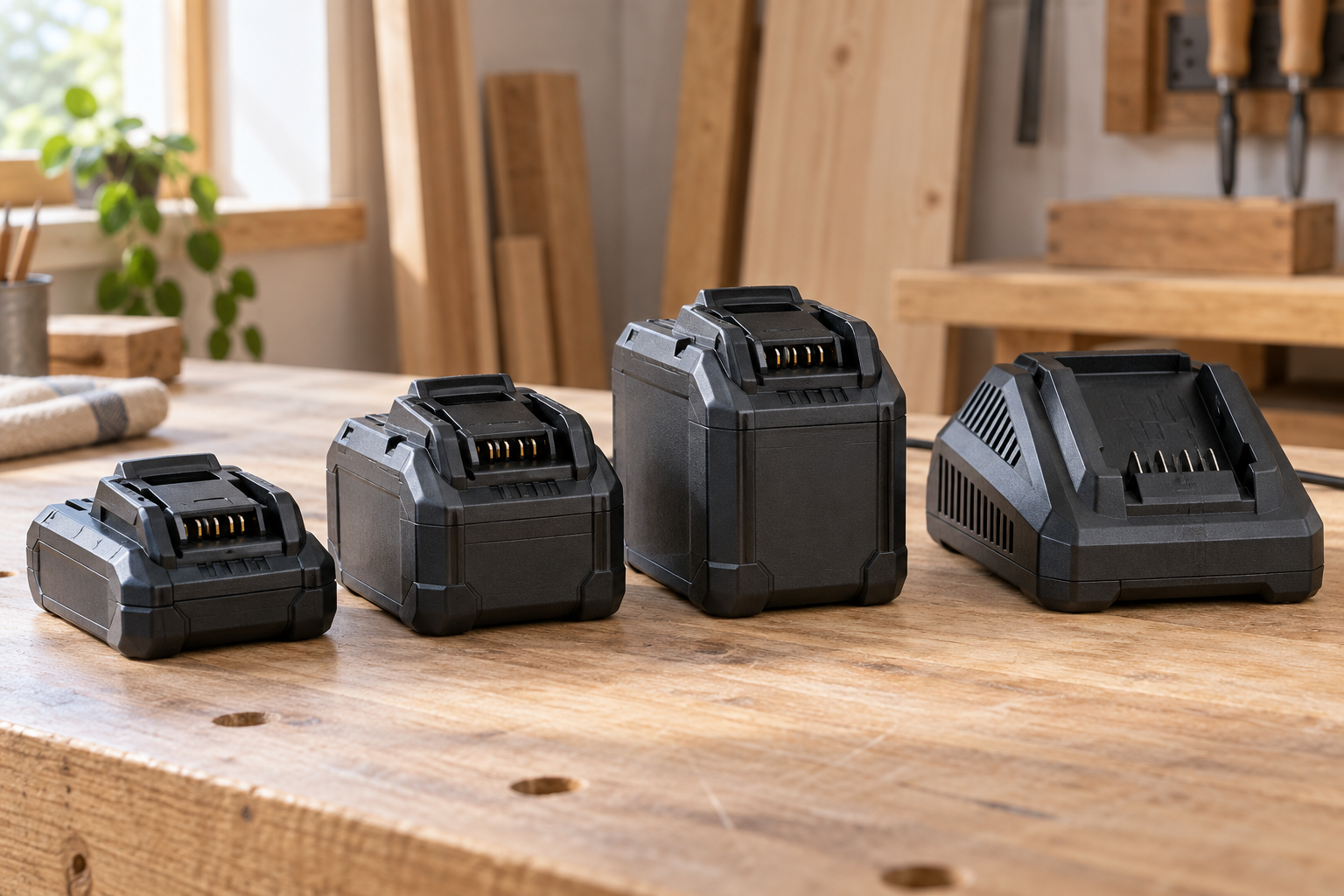
Charging time varies by pack capacity and charger output. A 2.0Ah battery contains roughly half the energy of a 4.0Ah battery, so it normally charges faster but also runs down sooner. A practical rotation is one battery on the tool and one on the charger. If you are using a leaf blower, string trimmer, circular saw, or reciprocating saw, two medium or large batteries are more useful than one oversized pack.
Tool range and intended users
Ryobi ONE+ has the clear advantage in tool range. The family covers drills, impact drivers, saws, sanders, inflators, fans, lights, glue guns, wet/dry vacuums, staplers, and many other workshop tools. It also reaches well into outdoor equipment, including lawn mowers, trimmers, blowers, chainsaws, and sprayers. Some ONE+ accessories are more specialized than most buyers will ever need, but that range reduces the need to maintain multiple battery systems.
Skil’s range is smaller but includes the tools most homeowners buy first: drills, impact drivers, circular saws, reciprocating saws, angle grinders, sanders, oscillating tools, lights, and selected outdoor products. Availability can be less consistent by retailer and region. Before choosing Skil, check that the exact bare tools you expect to buy are currently sold where you live.
| Factor | Skil PWRCore 20 | Ryobi ONE+ |
|---|---|---|
| Best fit | Budget-conscious DIY and homeowner projects | Large homeowner ecosystem and broad tool coverage |
| Core tools | Drills, drivers, saws, sanders, grinders, and common hand tools | Core tools plus a much wider selection of specialty and outdoor tools |
| Battery choice | Common compact and larger-capacity PWRCore 20 packs | Several ONE+ pack sizes, including higher-performance HP batteries |
| Entry cost | Often lower, especially in kits and sales | Can cost more, though frequent promotions narrow the gap |
| Long-term flexibility | Limited by the smaller catalog | Strong, particularly if you add outdoor or specialty equipment |
Runtime, power, and battery sizing
Battery capacity is measured in amp-hours, not tool power. A 4.0Ah battery can theoretically supply twice the energy of a 2.0Ah pack under similar conditions, but actual runtime depends on load, material, blade sharpness, and the tool’s motor efficiency. A circular saw cutting wet lumber can empty a battery dramatically faster than a drill driving small screws.
For occasional drilling and assembly, a 2.0Ah or 2.5Ah battery keeps the tool light. That matters when working overhead or on a ladder. For a reciprocating saw, grinder, mower, or blower, a 4.0Ah or larger pack is generally more practical. Large batteries add weight and can make a compact drill tiring, so buying the biggest battery for every tool is not an efficient solution.
Brushless tools usually offer better efficiency, longer motor life, and stronger sustained performance than brushed versions. Ryobi’s HP brushless range gives the brand a performance tier that is useful for demanding cutting and outdoor work. Skil also sells brushless PWRCore 20 tools, but the platform has fewer high-output choices overall. For occasional repairs, the cheaper brushed tool may be perfectly adequate; for weekly use, brushless is easier to justify.
Upfront price versus ownership cost
The first kit should be judged by what it includes. A drill kit with two batteries and a charger can be a better deal than a cheaper bare tool if you have no batteries yet. After that, bare tools are where a platform saves money. A household with four or five compatible tools can avoid buying four separate chargers and battery sets.
Skil is often the sensible choice when the shopping list ends at a drill, impact driver, saw, and sander. Look for a Skil PWRCore 20 tool kit with two batteries if the price is close to buying the starter kit and bare tools separately.
Ryobi makes more sense if you expect to add lawn equipment, lighting, fans, inflators, or workshop tools. A Ryobi ONE+ tool kit can establish the battery base, after which bare tools are often discounted. Compare included battery capacities, not just the number of tools in the box.
Which one should you buy?
Choose Skil PWRCore 20 when the priority is low cost, ordinary DIY work, and a compact set of core tools. The cheaper option is fine for assembling furniture, installing shelving, repairing a deck, drilling masonry occasionally, and handling seasonal maintenance. Buy two batteries if you will switch between tools during a project.
Choose Ryobi ONE+ when the battery ecosystem itself is the priority. It is the stronger choice for a homeowner who may later want a mower, trimmer, blower, vacuum, inflator, or specialty tool without starting over. If you do demanding cutting or outdoor work, consider Ryobi ONE+ HP brushless batteries and tools, while remembering that they cost more and add weight.
Before committing, inventory the next three tools you are likely to buy, then check current availability and battery prices. A platform that is slightly cheaper today becomes expensive if the replacement battery is unavailable or the required tool does not exist.
FAQ
Which one should you buy?
Related guides
- Longest Lasting Lawn Mower Battery: AGM vs Lithium vs Flooded Lifespan and Cost per Season
- Duralast Gold Lawn Mower Battery Review: U1 Fit, CCA and When to Pay for AGM
- Greenworks Pro 80V 21-Inch Mower Review: Runtime Math, Push vs Self-Propelled and Yard Fit
- Bosch High Pressure Washer Gun Replacement: Fittings, Adapters and What Fits Your Model