What's inside
As an Amazon Associate I earn from qualifying purchases. This post may contain affiliate links at no extra cost to you.
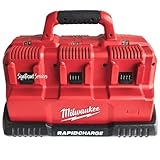
Milwaukee’s M18 Rapid Charger and M18 Super Charger both charge M18 batteries faster than a basic M18 charger, but they suit different workloads. The Rapid Charger is a practical upgrade for one-battery-at-a-time use. The Super Charger can cut charging time further for compatible high-output packs, which matters when a crew is cycling batteries through a full shift.
As an Amazon Associate we earn from qualifying purchases at no extra cost to you.


Charging speed at a glance
Milwaukee’s published estimates are useful for comparing chargers, but they are not guarantees for every battery or jobsite. Pack size, temperature, battery condition and charger generation all affect actual results. The figures below are approximate times to charge a depleted battery; check the labels and current Milwaukee specifications for the exact charger and pack you are buying.
| Battery | M18 Rapid Charger | M18 Super Charger |
|---|---|---|
| 2.0Ah compact pack | About 30 minutes | About 15 minutes |
| 5.0Ah XC pack | About 60 minutes | About 35 minutes |
| 12.0Ah High Output pack | About 130 minutes | About 60 minutes |
These comparisons show where the Super Charger’s advantage is most useful: large packs, particularly High Output batteries. A small battery may already be ready before a worker has used the next one, so the shorter time can make little practical difference. On a 12.0Ah pack, saving roughly an hour can change how many batteries a crew needs to keep tools running.
What the difference means on the job
The Rapid Charger is a good fit for a homeowner, service technician or small crew who charges one battery while using another. It can reduce downtime without requiring the fastest charger Milwaukee sells. If you use compact packs in drills and impact drivers, the tool may be the limiting factor rather than the charger: a battery can recharge while you are measuring, installing or packing up.
The Super Charger is aimed at faster turnaround, especially with larger packs and demanding tools. If a saw, grinder or high-draw outdoor tool is consuming a 12.0Ah battery faster than your work cycle allows, a quicker charger can keep fewer packs in rotation. The benefit depends on having compatible batteries and enough electrical supply; it does not make a depleted pack instantly available, and it does not increase the tool’s runtime.
Neither charger eliminates heat-related delays. A battery that has just been worked hard may be too hot to charge at full speed. The charger’s electronics manage charging and may pause or slow the process while the pack cools. In cold conditions, charging can also take longer. Avoid putting a hot battery straight into a closed vehicle or trying to bypass the charger’s temperature protection.
Compatibility and trade-offs
Both chargers are for Milwaukee M18 batteries, but charging performance varies by pack. A faster charger does not make every M18 battery charge at the same rate, and older, damaged or heavily worn packs may not reach published times. Check that the charger is an M18 model, not an M12-only charger, and confirm the product listing covers the battery sizes you use.
Fast charging is most valuable when batteries are the bottleneck. If your workday already has idle periods, or you own several packs, the Rapid Charger may be enough. The Super Charger costs more and may be unnecessary for a homeowner who charges overnight. Conversely, a crew relying on a small number of expensive large-capacity packs may recoup the extra cost through less waiting and fewer spare batteries.
For buyers comparing the two, start with the batteries already in your kit. If most are 2.0Ah or 5.0Ah packs and you can rotate them, the M18 Rapid Charger is the sensible value choice. If you routinely charge large High Output packs between demanding tasks, compare current pricing on the M18 Super Charger.
Which one should you buy?
Choose the Rapid Charger if you want faster charging than a basic charger, mostly use compact or mid-size packs, and can keep a second battery working while the first charges. It is also the better choice when the Super Charger’s premium would buy another useful battery instead. A spare pack often gives more flexibility than a faster charger, particularly if your tools are spread across different tasks.
Choose the Super Charger when high-capacity batteries are central to your work and turnaround time is expensive. Before paying extra, check whether your batteries are actually the slow point: track how long a pack lasts, how long it sits before the next task, and whether heat or cold is already extending charging. If a battery regularly finishes charging before you need it, a faster charger will not improve the day.
Charge safely and get reliable results
Use the charger on a stable, ventilated surface and keep its vents clear. Do not cover it with clothing, leave it buried in sawdust, or use a damaged cord or cracked battery case. If the charger repeatedly reports a fault, the pack gets unusually hot, or charging times have increased sharply, stop using that battery and have it checked rather than assuming a faster charger will fix it.
In short, the Rapid Charger is the better everyday upgrade for most M18 users; the Super Charger earns its place when large packs and tight turnaround make charging time a real production constraint. Compare the charger’s price with the cost of an additional battery, then choose the setup that keeps your particular tools working without paying for speed you will rarely use.
FAQ
Which one should you buy?
Related guides
- Longest Lasting Lawn Mower Battery: AGM vs Lithium vs Flooded Lifespan and Cost per Season
- Duralast Gold Lawn Mower Battery Review: U1 Fit, CCA and When to Pay for AGM
- Greenworks Pro 80V 21-Inch Mower Review: Runtime Math, Push vs Self-Propelled and Yard Fit
- Bosch High Pressure Washer Gun Replacement: Fittings, Adapters and What Fits Your Model