
What's inside
- Is a 3,000 PSI Electric Pressure Washer Worth It?
- What Does 3,000 PSI Mean on an Electric Pressure Washer?
- How to Choose an Electric Pressure Washer Rated at 3,000 PSI
- Which Nozzle Should You Use?
- How to Use a 3,000 PSI Electric Pressure Washer Safely
- Common Mistakes to Avoid
- Frequently Asked Questions
- Final Verdict
As an Amazon Associate I earn from qualifying purchases. This post may contain affiliate links at no extra cost to you.
An electric pressure washer rated at 3,000 PSI can handle demanding outdoor cleaning, but the advertised pressure alone does not tell you how quickly or effectively a machine will clean. Water flow, nozzle selection, motor capacity, and the surface being cleaned all affect the result.
For homeowners, the most important distinction is between maximum advertised PSI and rated operating PSI. For example, the Westinghouse WPX3000e is listed at 3,000 maximum PSI but 2,600 rated PSI, with a rated flow of 1.1 gallons per minute (GPM). Its specifications illustrate why shoppers should examine pressure and flow together rather than choosing a washer by its largest number.
This guide explains what a 3,000 PSI electric pressure washer can do, which specifications matter, how to select the correct accessories, and how to clean common outdoor surfaces without causing avoidable damage.
Is a 3,000 PSI Electric Pressure Washer Worth It?
A 3,000 PSI electric pressure washer can be worth considering when you regularly clean concrete, exterior hardscapes, outdoor equipment, and other surfaces that benefit from concentrated water pressure. However, suitability depends on the machine’s rated pressure and flow, its power requirements, and the manufacturer’s guidance for the surface.
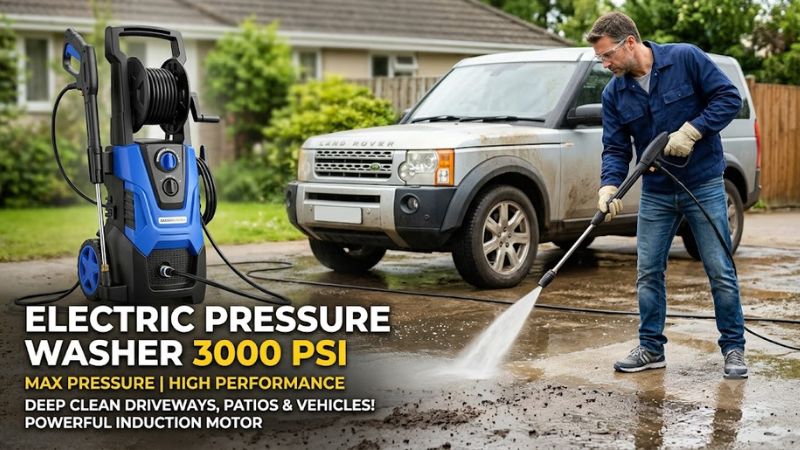
Before buying, consider these typical applications:
| Cleaning task | Suitability | Important consideration |
| Concrete walkways and patios | Often suitable | Use a compatible surface cleaner or an appropriate fan nozzle; avoid damaging weak concrete or mortar |
| Driveways | Often suitable | Surface condition, stains, flow rate, and cleaning-head compatibility affect results |
| Brick and masonry | Conditional | Check mortar condition and use a conservative nozzle and distance |
| Wood decks and fences | Conditional | High pressure can strip fibers, damage coatings, or leave marks |
| Cars and motorcycles | Requires care | Use a vehicle-safe nozzle, appropriate distance, and suitable detergent |
| Outdoor furniture | Often suitable at reduced intensity | Follow the material manufacturer’s cleaning guidance |
| Painted siding | Conditional | Excessive pressure can damage paint or force water behind siding |
| Delicate surfaces | Often unsuitable at full pressure | Use a lower-pressure cleaning method where appropriate |
A pressure washer does not need to operate at maximum pressure for every job. The safest effective setting is the lowest combination of pressure, nozzle intensity, and proximity that removes the dirt without damaging the surface.
What Does 3,000 PSI Mean on an Electric Pressure Washer?
PSI means pounds per square inch. It describes water pressure, not the amount of water the machine moves or the total cleaning performance.
Three specifications deserve particular attention.
1. Maximum PSI versus rated PSI
- Maximum PSI: The manufacturer’s stated peak pressure under its specified conditions.
- Rated PSI: The manufacturer’s stated operating-pressure rating, where provided.
- GPM: Gallons per minute, or the volume of water delivered over time.
Do not assume that maximum PSI represents continuous operating performance. Compare rated figures from manufacturer documentation whenever possible.
For example, the Westinghouse WPX3000e lists 3,000 maximum PSI, 2,600 rated PSI, 1.76 maximum GPM, and 1.1 rated GPM. The maximum-flow and rated-flow figures are not interchangeable, and the manufacturer’s stated operating conditions matter when interpreting them.
2. Why GPM matters
Water flow influences how much loosened dirt the washer can carry away. Two machines with similar pressure ratings may produce different cleaning results if their water flow differs.
For practical shopping, compare pressure and flow as a pair:
- For occasional cleaning of outdoor furniture and small patios, ease of use and nozzle control may matter more than maximum PSI.
- For larger concrete areas, consider flow rate, surface-cleaner compatibility, hose length, and how comfortably you can move the machine.
- For frequent commercial cleaning, compare the machine’s rated output, electrical requirements, duty limitations, serviceability, and warranty rather than relying on a residential product’s maximum-pressure claim.
3. Understanding cleaning power
PSI and GPM describe different aspects of performance. Some manufacturers and retailers also use a calculated cleaning-power figure based on pressure multiplied by flow.
Such a figure can help with initial comparisons, but it is not a standardized guarantee of real-world cleaning speed. Nozzle design, spray pattern, surface condition, detergent, and cleaning technique also matter.
A machine advertised as 3,000 PSI should therefore not automatically be assumed to outperform every lower-pressure washer.
How to Choose an Electric Pressure Washer Rated at 3,000 PSI
The right model depends on your cleaning workload, available electrical supply, and the accessories you expect to use. Check these features before purchasing.
Check the rated pressure and water flow
Look for both rated PSI and rated GPM on the manufacturer’s specification sheet. If the manufacturer publishes only maximum figures, do not assume those numbers represent sustained output.
For larger areas, water flow and a compatible surface cleaner can matter as much as the peak pressure rating. For delicate materials, controllability is more important than maximum output.
Verify voltage, amperage, and outlet requirements
For example, the Westinghouse WPX3000e is specified for 120-volt AC power and a 13-amp motor. That specification applies to this particular model, not every electric washer marketed at 3,000 PSI.
Before buying, confirm:
- The machine’s required supply voltage and frequency match your electrical supply.
- The circuit and outlet meet the manufacturer’s requirements.
- The unit has the specified ground-fault protection.
- The supplied power cord reaches the work area without creating a trip hazard.
- Any extension cord is permitted by the manual and has the required rating and wire gauge.
Do not assume that a high-pressure electric washer can safely operate from any household outlet or extension cord. Never use an undersized cord or an improvised electrical connection around water.
Inspect the hose, wand, and nozzle system
The hose must be rated for the washer’s operating pressure and use compatible fittings. A connection that physically fits is not necessarily rated for the application.
Check whether the package includes:
- A high-pressure hose and spray gun.
- A wand and interchangeable nozzles.
- A detergent tank or compatible detergent applicator.
- A surface cleaner, if you plan to clean large paved areas.
- Replacement parts and accessories that are actually supported by the exact model.
For example, the WPX3000e has a 25-foot high-pressure hose, a 35-foot GFCI power cord, and five nozzle options: 0°, 15°, 25°, turbo, and soap. These are model-specific details, not universal features of 3,000 PSI washers.
Consider warranty and long-term ownership
A low purchase price is less useful if replacement fittings, hoses, or service are difficult to obtain.
Check the warranty terms for the exact model and region. Look for exclusions covering commercial use, pump damage, freezing, improper electrical connections, and unauthorized repairs. Do not assume that a residential warranty covers daily professional use.
Also compare storage requirements, hose replacement cost, detergent compatibility, and access to manufacturer support.
Which Nozzle Should You Use?
The nozzle determines the spray pattern and helps control how concentrated the water stream is. The correct choice depends on the surface and the washer’s manual.
| Nozzle type | Typical purpose | Main caution |
| 0° red nozzle, where supplied | Very concentrated cleaning on limited, suitable applications | High risk of surface damage and injection injury; avoid routine use on household surfaces |
| 15° yellow nozzle, where supplied | More concentrated cleaning on suitable hard surfaces | Can etch masonry, strip coatings, and damage wood |
| 25° green nozzle, where supplied | General cleaning on compatible outdoor surfaces | Begin at a safe distance and check for damage |
| 40° white nozzle, where supplied | Wider, less concentrated spray for more delicate surfaces | Still capable of causing injury or damage |
| Soap nozzle, where supplied | Applying compatible detergent at the machine’s intended low-pressure setting | Confirm the correct detergent and application procedure |
| Turbo nozzle, where supplied | Rotating concentrated spray for suitable hard surfaces | Can damage fragile materials; verify compatibility |
Color conventions are common but not universal. Confirm nozzle identification in the manufacturer’s documentation rather than relying on color alone.
Important: A wider nozzle generally spreads the spray over a larger area, but it does not make every surface safe to pressure-wash. Keep the nozzle moving, begin at a conservative distance, and test an inconspicuous area before cleaning the entire surface.
How to Use a 3,000 PSI Electric Pressure Washer Safely
Follow the exact manual supplied with your machine. The sequence below is a general residential procedure, not a substitute for model-specific instructions.
Step 1: Prepare the work area
Remove loose objects, protect nearby electrical equipment, and keep children and pets away. Check for fragile trim, loose mortar, damaged coatings, and openings where water could enter a building.
Wear safety glasses or suitable eye protection, closed-toe footwear with good traction, and any additional protective equipment specified by the manufacturer. Avoid loose clothing that could interfere with equipment handling.
Step 2: Inspect the equipment
With the machine disconnected from power, inspect the hose, gun, wand, fittings, plug, cord, and housing.
Do not operate equipment with a damaged cord, leaking high-pressure hose, cracked fitting, or defective trigger mechanism. Verify that the nozzle and hose are compatible with the model and pressure rating.
Step 3: Connect the water supply
Connect the inlet hose and turn on the water supply according to the manual. Check the required water flow and inlet conditions.
Follow the manufacturer’s priming and air-purging procedure before energizing the pump. Never run a pump dry unless its documentation expressly permits the relevant operation.
Step 4: Establish electrical protection
Keep electrical connections away from standing water and wet ground where practical. Connect the washer only to a suitable supply using the specified protective devices.
Use the built-in GFCI or other required ground-fault protection according to the manual. Test it as directed. If protection trips repeatedly, stop and identify the problem rather than bypassing it.
Step 5: Start with a conservative spray setting
Fit an appropriate nozzle while following the manufacturer’s shutdown and depressurization procedure. Point the wand away from people, animals, windows, and fragile materials.
Begin at a greater distance than you think necessary, then adjust gradually while keeping the spray moving. Stop if the surface becomes marked, fibers lift, paint flakes, or water appears to penetrate gaps.
Step 6: Apply detergent only when appropriate
Use a detergent approved for the washer and intended surface. Follow the machine’s instructions for detergent application, dilution, dwell time, and rinsing.
Do not use a high-pressure nozzle to apply detergent unless the manufacturer explicitly supports that method. Never mix cleaning chemicals unless their labels specifically permit it.
Step 7: Shut down and release pressure
Turn off the washer and disconnect the supply according to the manual. Close the water supply, then operate the trigger as instructed to release residual pressure before disconnecting the hose or changing accessories.
Allow the equipment to cool if required. Drain and store hoses, inspect for leaks, and protect the pump from freezing using the manufacturer’s approved procedure.
Common Mistakes to Avoid
A pressure washer can damage surfaces or cause serious injury when used incorrectly. Avoid these common errors:
- Choosing by maximum PSI alone: Compare rated pressure, rated flow, and the intended workload.
- Using a 0° nozzle for general cleaning: Its concentrated stream can cause severe surface damage and injury.
- Holding the spray too close: Start farther away and adjust cautiously rather than immediately increasing cleaning intensity.
- Using incompatible accessories: Check pressure ratings, fitting types, and the exact manufacturer’s compatibility guidance.
- Ignoring electrical protection: The U.S. Consumer Product Safety Commission (CPSC) has issued multiple pressure-washer safety warnings and recalls involving missing GFCI protection and electrical shock hazards. Check current recall notices before purchasing or using a unit.
- Using the wrong detergent: Some chemicals can damage equipment, finishes, plants, or nearby surfaces.
- Leaving water in the pump during freezing conditions: Follow the manufacturer’s winterization instructions to reduce the risk of freeze damage.
If a high-pressure stream penetrates the skin, seek emergency medical evaluation immediately, even if the wound looks small. High-pressure injection injuries can cause severe internal damage.
Frequently Asked Questions
Is 3,000 PSI enough to clean a concrete driveway?
Yes, a properly selected 3,000 PSI pressure washer can be suitable for many concrete driveways. Results depend on rated water flow, the concrete’s condition, the type of contamination, and the accessory used. A compatible surface cleaner can help produce more uniform results over broad areas. Use lower intensity on damaged, weak, or previously repaired concrete.
Is an electric pressure washer with 3,000 PSI as powerful as a gas model?
Not necessarily. Compare rated PSI and GPM under comparable operating conditions rather than relying on maximum advertised pressure. Some electric machines are designed for residential cleaning, while gas-powered models may provide different combinations of pressure and flow. Heavy-duty commercial electric machines also exist, but they can require specialized electrical supplies.
Can I use a 3,000 PSI electric pressure washer on my car?
You can use a suitable pressure washer to clean a vehicle, but 3,000 PSI is not a recommended target pressure for car paint. Use a vehicle-appropriate nozzle and detergent, maintain a safe distance, and follow the vehicle and washer manufacturers’ instructions. Avoid directing concentrated spray at paint chips, seals, sensors, electrical connectors, or other vulnerable areas.
Does a 3,000 PSI pressure washer need a special outlet?
It depends on the exact model. A residential unit specified for 120-volt AC power has different requirements from a commercial machine designed for 208-, 230-, 460-, or 575-volt service. Check the nameplate and manual for voltage, frequency, amperage, circuit requirements, and ground-fault protection. Never connect a machine to an incompatible supply or bypass electrical protection.
Final Verdict
An electric pressure washer rated at 3,000 PSI can be a useful choice for homeowners who need to clean concrete, patios, outdoor equipment, and other compatible surfaces without using a gasoline engine.
The best purchasing decision starts with rated PSI, rated GPM, electrical requirements, nozzle control, and accessory compatibility. Confirm those details for the exact model, then choose a machine that matches your actual workload instead of paying extra for a maximum-pressure figure you may rarely use.
For occasional household cleaning, controllability and convenient storage may be more valuable than maximum pressure. For large paved areas or frequent demanding work, prioritize water flow, suitable surface-cleaning accessories, serviceability, and the manufacturer’s stated operating limits.
Before making a purchase, review the model’s specifications, operating manual, warranty, and applicable safety or recall notices. That final check helps ensure the washer is suitable for both your cleaning tasks and your electrical setup.
Related guides
- Ryobi 2300 PSI Pressure Washer Review: Price, Specs, Performance, and Is It Worth Buying?
- How to Use a Husqvarna 3200 PSI Pressure Washer: Setup, Cleaning, and Troubleshooting
- DEWALT 4000 PSI Pressure Washer Review: Price, Specs, and Is It Worth Buying?
- Briggs and Stratton Pressure Washer: How to Use, Maintain, and Troubleshoot It
Write Your Review
No reviews yet. Be the first to share your experience!