
What's inside
- What Is a Briggs and Stratton Pressure Washer?
- How to Set Up and Start a Briggs and Stratton Pressure Washer
- How to Troubleshoot a Briggs and Stratton Pressure Washer
- How to Maintain a Briggs and Stratton Pressure Washer
- How to Identify the Correct Replacement Parts
- When to Repair It Yourself and When to Call a Technician
- Frequently Asked Questions
- Final Verdict
As an Amazon Associate I earn from qualifying purchases. This post may contain affiliate links at no extra cost to you.
A Briggs and Stratton pressure washer can help clean driveways, patios, siding, outdoor furniture, and other exterior surfaces, but correct setup and maintenance are essential for reliable operation. If your pressure washer will not start, produces weak water pressure, or fails to draw detergent, the problem may involve the water supply, spray nozzle, hose connections, engine, or pump.
This guide explains how to set up a Briggs and Stratton pressure washer, use it safely, identify common problems, and perform basic maintenance. Because the brand has produced multiple pressure washer models, always follow the operator’s manual for your specific machine rather than assuming every model uses the same engine, pump, oil, nozzle, or starting procedure.
What Is a Briggs and Stratton Pressure Washer?
A Briggs and Stratton pressure washer is an outdoor cleaning machine that uses a pump to pressurize incoming water and deliver it through a spray gun and nozzle. Many traditional models use a gasoline engine, although the exact configuration depends on the product.
Briggs and Stratton is also an engine manufacturer, so the name on an engine does not necessarily identify the manufacturer of the complete pressure washer. When ordering replacement parts or troubleshooting a machine, identify the pressure washer’s model number and serial number, as well as the engine model where relevant.
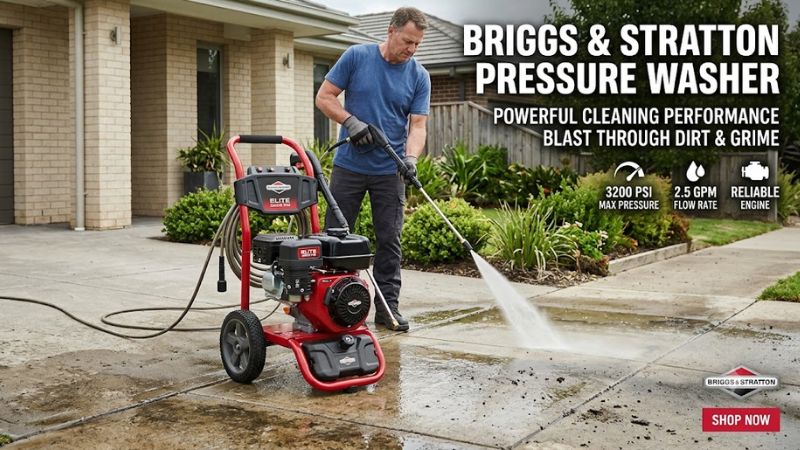
What can you clean with one?
Typical applications include:
- Concrete and paved surfaces: Driveways, walkways, and some patio surfaces, using an appropriate nozzle and technique.
- Outdoor furniture: Suitable weather-resistant furniture, provided the surface can tolerate the pressure.
- Outdoor equipment: Certain tools, bins, and hard-wearing exterior items.
- Vehicle exteriors: Only with an appropriate nozzle, sufficient distance, and a pressure level suitable for the vehicle’s finish.
- Exterior siding: Compatible siding materials, using a conservative cleaning approach that avoids forcing water behind panels.
High pressure is not suitable for every surface. Wood can splinter, painted finishes can peel, and concentrated spray can damage seals, electrical components, and delicate materials. Always start with a less aggressive cleaning method and follow the surface manufacturer’s recommendations.
How to Set Up and Start a Briggs and Stratton Pressure Washer
The correct starting procedure depends on the engine and pressure washer model. The following checklist covers common preparation steps for gasoline-powered units; use your operator’s manual for the exact controls and sequence.
Before starting
Prepare the machine and work area:
- Place the washer on a stable, level surface outdoors.
- Check engine oil and fuel levels according to the engine manual.
- Inspect the high-pressure hose, garden hose, spray gun, fittings, and nozzle for damage.
- Check that the water inlet screen is clean.
- Connect the garden hose to the water inlet and the high-pressure hose to the correct pump and spray-gun connections.
- Turn on the water supply and make sure the hose is not kinked.
- Put on suitable eye protection, sturdy footwear, and other PPE appropriate to the cleaning task.
Never run a gasoline engine in a garage, shed, or other enclosed or partially enclosed area. Exhaust contains carbon monoxide, which can cause serious injury or death. Keep the washer away from ignition sources when handling gasoline.
Starting procedure
- Connect the water supply. Turn on the faucet fully, subject to the requirements in the operator’s manual.
- Purge trapped air. With the engine off, point the spray gun toward a safe area and squeeze the trigger until water flows steadily.
- Prepare the engine. Set the fuel valve, choke, ignition switch, and throttle as specified in the manual. Not every model has the same controls.
- Start the engine. Follow the manufacturer’s recoil-starting or electric-start procedure.
- Check the spray. Release the trigger, secure your footing, point the gun toward the intended cleaning surface, and squeeze the trigger carefully.
- Adjust the cleaning method. Begin at a greater distance from the surface and move closer only if needed and safe for the material.
Do not start or operate a water-cooled pump without an adequate water supply. Some pumps can overheat or suffer damage if operated dry.
How to Troubleshoot a Briggs and Stratton Pressure Washer
If the machine is not working properly, begin with external checks before assuming the engine or pump has failed. The official troubleshooting guidance identifies water-supply problems, blocked nozzles, leaking connections, and inadequate engine speed among possible causes of low pressure.
| Symptom | Possible cause | First action |
| Engine will not start | Fuel, ignition, oil-level, or starting-control issue | Check the manual’s starting checklist |
| Engine runs but pressure is weak | Restricted water supply or incorrect nozzle | Check the water flow, inlet screen, and nozzle |
| Pressure surges or pulses | Restricted water flow, trapped air, or a blockage | Check the supply and purge air |
| Water leaks from a connection | Damaged O-ring, loose fitting, or damaged hose | Shut down and inspect the connection |
| Detergent will not draw | Incorrect nozzle setting, blocked tube, or injector issue | Check the detergent system and specified low-pressure setting |
| Engine slows under load | Incorrect throttle setting or an engine problem | Check the prescribed operating setting; seek service if it persists |
These are possible causes, not confirmed diagnoses. Exact troubleshooting steps vary by model.
1. Briggs and Stratton pressure washer has low or no pressure
Work through these checks in order.
Step 1: Check the water supply.
Confirm that the faucet is open, the garden hose is not kinked, and the hose can provide adequate flow. A restricted supply can prevent the pump from operating correctly even when the engine runs normally.
Briggs & Stratton’s general troubleshooting guidance specifies minimum incoming supply conditions of 20 PSI and 4 GPM for certain standard models, with 25 PSI and 7 GPM for POWERflow+ models. These figures are not universal specifications for every pressure washer. Check the requirements for your exact model before using them as a diagnostic threshold.
Step 2: Inspect the inlet screen.
Turn off the engine and water supply, release trapped pressure, and disconnect the garden hose. Inspect the inlet screen for dirt or debris. Clean it with water if appropriate, and replace it if damaged.
Step 3: Check the spray nozzle.
A low-pressure soap nozzle will not deliver the same cleaning force as the appropriate high-pressure nozzle. Confirm that the installed tip is intended for the task.
If the spray pattern is obstructed, shut off the engine and relieve pressure before removing the tip. Clean it using the method and tool specified in the manual. Never clear a blocked nozzle with your fingers while the machine is pressurized.
Step 4: Inspect hoses and connections.
Look for leaks, cuts, bulges, damaged couplings, and worn O-rings. A damaged high-pressure hose must be replaced rather than patched with tape or a general-purpose sealant.
Replacement hoses must meet or exceed the pressure rating required by the washer and be compatible with its connections. Never attempt to locate a high-pressure leak by running your hand over a suspected leak area; pressurized water can penetrate skin.
Step 5: Check the engine operating setting and pump.
If your model has a throttle control, verify the specified operating position. If pressure remains weak after the water supply, nozzle, and external connections have been checked, the pump or an internal component may require service.
Do not disassemble a pressurized pump or attempt internal repairs while the engine is running.
2. Briggs and Stratton pressure washer will not start
A no-start condition can originate in the engine, fuel system, ignition system, or starting controls.
- Confirm that the engine switch is in the correct position.
- Check the fuel level and use the fuel type specified by the engine manual.
- Check engine oil according to the manufacturer’s instructions; some engines have low-oil protection.
- Confirm that the choke and other starting controls are set correctly for the engine’s temperature and design.
- Inspect the air filter for excessive dirt or obstruction.
- If the engine has been stored for a long time, consider stale or contaminated fuel as a possible cause.
Do not continue repeated starting attempts if fuel is leaking, the engine makes abnormal mechanical noises, or you suspect water contamination.
Before inspecting ignition components, stop the engine and follow the manual’s precautions. If the engine still will not start, a qualified service technician can test the spark plug, ignition system, fuel delivery, and compression as appropriate.
3. Briggs and Stratton pressure washer keeps surging
Surging describes pressure that rises and falls repeatedly while spraying. It can result from restricted incoming water, trapped air, an obstructed nozzle, or a pump-related fault.
Try the following sequence:
- Shut down the machine safely.
- Check the garden hose for kinks, leaks, or restrictions.
- Check the inlet screen for debris.
- With the engine off, restore the water supply and purge air through the spray gun until the flow is steady.
- Check the spray tip for blockage and confirm that it is suitable for the intended operation.
- Restart according to the manual and observe whether the pressure stabilizes.
If the machine continues surging with a confirmed adequate water supply and a clean nozzle, stop using it until the cause is identified. Persistent pressure fluctuations may require pump or valve inspection by a service professional.
4. Briggs and Stratton pressure washer will not draw detergent
Many pressure washers use a detergent siphoning system that requires a particular low-pressure setting. The correct method depends on the model.
Briggs & Stratton identifies several possible causes of failed detergent siphoning, including an incorrectly positioned chemical hose, an unsuitable nozzle or pressure setting, a high-pressure hose extension, and a blocked chemical injector.
Use this checklist:
- Check that the detergent tube is connected to the correct port and that its pickup end is submerged in the appropriate detergent.
- Inspect the tube and filter for cracks, leaks, or blockages.
- Use the detergent nozzle or soap setting specified in the manual.
- Check whether the manufacturer permits the hose configuration and extensions being used.
- If the injector appears blocked, follow the model-specific cleaning procedure or contact an authorized service dealer.
Use only detergents approved for the pressure washer and intended surface. Never put gasoline, solvents, or other flammable liquids into the detergent system.
5. Briggs and Stratton pressure washer leaks water
Water leaking from the machine can be harmless residual drainage in some circumstances, but a persistent leak requires investigation.
| Leak location | Possible issue | Recommended response |
| Garden hose connection | Loose fitting, damaged washer, or damaged inlet connection | Shut off the water and inspect the connection |
| High-pressure hose | Cut, bulge, worn coupling, or damaged seal | Stop using the machine and replace the damaged hose |
| Spray gun or wand connection | Worn O-ring or damaged connector | Depressurize and inspect; replace damaged parts |
| Pump body | Seal, fitting, or internal pump problem | Stop using the machine and arrange service |
| Engine area | Oil or fuel leak rather than water | Shut down and identify the fluid before restarting |
Never tighten, disconnect, or repair a high-pressure connection while the system is pressurized. If fuel is leaking, shut down the engine if safe, keep away from ignition sources, and do not restart until the problem has been corrected.
How to Maintain a Briggs and Stratton Pressure Washer
Regular inspection helps identify restrictions and worn components before they cause more serious problems. Briggs & Stratton recommends checking the machine and accessories before and after use, while referring to the applicable operator’s manual for model-specific maintenance.
Before each use
- Check engine oil and fuel as directed by the engine manual.
- Inspect the garden hose and high-pressure hose.
- Check the inlet screen and any accessible in-line screen.
- Inspect nozzle tips and spray-gun connections.
- Look for damaged O-rings, loose fittings, and signs of leakage.
- Confirm that the detergent tube and filter are intact if detergent will be used.
Replace damaged high-pressure hoses. Do not operate the machine with a leaking hose or a damaged spray gun.
After each use
- If detergent was used, flush the detergent system with clean water according to the manual. Briggs & Stratton’s general maintenance guidance specifies a two-minute flush for the systems covered by its instructions; confirm that this procedure applies to your model.
- Shut off the engine and allow hot components to cool.
- Turn off the water supply.
- Point the spray gun safely and squeeze the trigger to release remaining pressure.
- Disconnect the hoses according to the manual.
- Clean accessible screens and nozzle tips as necessary.
- Wipe down the machine and inspect it for new damage or leaks.
Never disconnect a pressurized hose. Residual pressure can cause the hose or fitting to move unexpectedly.
Pump and engine oil maintenance
Do not assume every Briggs and Stratton pressure washer has the same pump lubrication system. Some pumps have different service requirements, and some designs do not have a conventional user-serviceable oil reservoir.
Check the exact pump and engine documentation for:
- Whether the pump requires separate oil maintenance.
- The specified oil type and quantity.
- The correct checking and changing procedure.
- Any service intervals or conditions that affect those intervals.
Do not add oil to a sealed pump or use oil additives unless the manufacturer specifically instructs you to do so. Engine oil specifications and pump oil specifications are not necessarily interchangeable.
Storage and winterization
Before storing the pressure washer for an extended period:
- Drain or stabilize fuel as directed by the engine manual.
- Follow the manufacturer’s instructions for protecting the pump from freezing.
- Store hoses and accessories without sharp bends or crushing loads.
- Keep the machine in a dry, secure location.
- Use only manufacturer-approved pump-protection products and procedures.
Water left inside a pump can freeze and cause damage. Do not assume that simply draining the garden hose will remove all water from the pump.
How to Identify the Correct Replacement Parts
Finding compatible parts starts with identifying the machine rather than searching only for “Briggs and Stratton pressure washer parts.”
Record the following information before ordering anything:
| Information | Why it matters |
| Pressure washer model number | Identifies the complete machine configuration |
| Pressure washer serial number | Helps distinguish production versions and service parts |
| Engine model and type information | Helps identify engine-specific components |
| Pump identification, where available | Helps match seals, fittings, and pump components |
| Part number from the illustrated parts list | Reduces the risk of ordering a visually similar but incompatible part |
Nozzle tips, hose connections, spray guns, O-rings, pumps, and engine parts can vary between models. Check the specified thread, connection type, pressure rating, and part number rather than relying on appearance alone.
The official Briggs & Stratton support resources provide access to manuals, illustrated parts lists, troubleshooting information, and dealer assistance. If the model identification is unclear, use the product’s identification information before purchasing replacement parts.
When to Repair It Yourself and When to Call a Technician
Basic external checks are reasonable for many owners, but not every fault is a DIY repair.
| Situation | Appropriate next step |
| Dirty inlet screen or blocked nozzle | Clean according to the manual |
| Kinked garden hose or inadequate water supply | Correct the external supply problem |
| Damaged high-pressure hose or spray gun | Replace with a compatible, pressure-rated component |
| Engine will not start after basic checks | Arrange engine diagnosis if the cause remains unclear |
| Persistent low pressure despite external checks | Seek pump and system diagnosis |
| Pump body damage, persistent internal leakage, or abnormal mechanical noise | Stop using the machine and arrange professional service |
| Fuel leak, damaged electrical starting equipment, or suspected carbon monoxide exposure | Stop and address the hazard before any further operation |
For additional help, Briggs & Stratton lists 800-743-4115 for pressure washer and portable generator customer support in the United States, with published hours of Monday through Friday, 8 a.m. to 5 p.m. Central Time. Confirm current contact information and service availability through the manufacturer’s support resources.
Frequently Asked Questions
How many PSI is a Briggs and Stratton pressure washer?
The pressure rating depends on the exact model. Briggs & Stratton pressure washers have been offered in different pressure classes, so there is no single PSI rating that applies to every machine. Check the model’s identification label and operator’s manual rather than estimating pressure from the engine brand or appearance.
Why does my Briggs and Stratton pressure washer run but have no pressure?
Common possibilities include inadequate water flow, a blocked inlet screen, an incorrect nozzle, a clogged spray tip, leaking connections, or a pump fault. Check the water supply and external components first. If those checks do not resolve the problem, the pump may need professional diagnosis.
Can I use any detergent in a Briggs and Stratton pressure washer?
No. Use a detergent compatible with your model and the surface being cleaned. Many machines require a designated low-pressure nozzle or soap setting to draw detergent. Follow the operator’s manual and the detergent label, and flush the system after use as instructed.
How do I find the manual for my Briggs and Stratton pressure washer?
Identify the pressure washer’s model and serial number, then consult the manufacturer’s support resources for the appropriate operator’s manual and parts list. If the machine is powered by a Briggs and Stratton engine but was assembled by another manufacturer, you may also need documentation from the pressure washer’s original manufacturer.
Final Verdict
A Briggs and Stratton pressure washer is easier to maintain when you identify the exact model, follow its operating instructions, and check the water supply, nozzle, hoses, and connections before assuming a major component has failed.
For weak pressure, start with water flow, inlet restrictions, and nozzle condition. For starting problems, follow the engine’s fuel, oil, and ignition checks. For detergent issues, verify the correct siphoning setup. Regular inspections and correct storage can help prevent avoidable problems, while persistent pump faults, fuel leaks, and damaged pressure components call for appropriate professional service.
Related guides
- Ryobi 2300 PSI Pressure Washer Review: Price, Specs, Performance, and Is It Worth Buying?
- How to Use a Husqvarna 3200 PSI Pressure Washer: Setup, Cleaning, and Troubleshooting
- DEWALT 4000 PSI Pressure Washer Review: Price, Specs, and Is It Worth Buying?
- Electric Pressure Washer 3000 PSI: How to Choose and Use One
Write Your Review
No reviews yet. Be the first to share your experience!