
What's inside
- What Are Hand and Power Tools?
- Types of Hand Tools and Their Uses
- Types of Power Tools and Their Uses
- Hand Tools vs. Power Tools: Key Differences
- How to Choose the Right Hand and Power Tools
- Hand and Power Tool Safety Practices
- Common Mistakes When Using Hand and Power Tools
- Frequently Asked Questions
- Conclusion
As an Amazon Associate I earn from qualifying purchases. This post may contain affiliate links at no extra cost to you.
Hand and power tools are essential for DIY projects, woodworking, home repairs, construction, and workshop maintenance. Although both help users cut, drill, fasten, shape, and assemble materials, they differ in how they operate and the amount of physical effort required.
Hand tools use human force, while power tools rely on electricity, batteries, compressed air, fuel, or hydraulic power. Understanding their differences helps you select appropriate equipment, improve work efficiency, and avoid common safety risks.
This guide covers the main types of hand and power tools, their applications, how to choose the right equipment, and essential safety practices for home and professional workshops.
What Are Hand and Power Tools?
Hand and power tools are equipment designed to perform construction, repair, installation, and material-processing tasks. Their primary difference is the energy source used to generate working force.
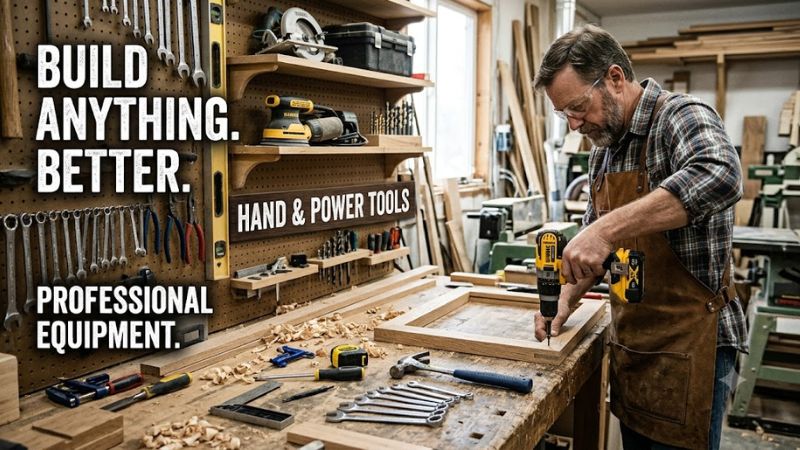
What Are Hand Tools?
Hand tools operate through physical effort rather than an external power source. Users control their movement and force through pushing, pulling, turning, striking, or squeezing.
Common examples include:
- Hammers for driving and removing nails.
- Screwdrivers for tightening and loosening screws.
- Pliers for gripping, bending, and cutting wire.
- Wrenches for turning nuts and bolts.
- Hand saws for cutting suitable materials.
- Chisels for shaping and removing material.
- Tape measures and levels for measuring and alignment.
Hand tools are particularly useful for small repairs, detailed adjustments, and jobs requiring controlled manual force. They are generally portable, straightforward to maintain, and do not require batteries or electrical connections.
Their main limitation is that repetitive or demanding tasks can require considerable physical effort and take longer to complete.
What Are Power Tools?
Power tools use an external energy source to operate a motor or mechanical mechanism. They are commonly used for repetitive work, demanding applications, and material processing.
The main power sources include:
| Power source | Common examples |
| Corded electricity | Electric drills, circular saws, bench grinders |
| Rechargeable batteries | Cordless drills, impact drivers, sanders |
| Compressed air | Pneumatic nailers, impact wrenches |
| Fuel | Chainsaws, concrete saws |
| Hydraulic power | Specialized construction and industrial equipment |
Power tools can improve productivity and reduce repetitive manual effort. However, they introduce additional hazards involving electricity, rotating components, kickback, vibration, noise, and stored energy.
Types of Hand Tools and Their Uses
Hand tools are commonly classified according to their primary function.
1. Fastening and Driving Tools
These tools install, tighten, loosen, and remove fasteners.
Examples include screwdrivers, socket wrenches, adjustable wrenches, ratchets, and hex keys.
A screwdriver should match the screw head in both type and size. Using an incorrectly sized tip can damage the fastener or cause the tool to slip.
2. Striking Tools
Striking tools transfer force through impact.
- Claw hammers drive and remove nails.
- Ball-peen hammers support metalworking tasks.
- Rubber mallets deliver controlled impacts on suitable materials.
- Sledgehammers provide heavier impact force for appropriate demolition work.
Choose the hammer according to its weight, head material, and intended application. Inspect handles and heads for cracks, looseness, or damage before use.
3. Cutting and Shaping Tools
These tools remove material or change its shape.
Common examples include hand saws, hacksaws, utility knives, chisels, and files.
Different cutting tools are designed for different materials. Always secure the workpiece, maintain suitable cutting edges, and direct cutting tools away from your body.
4. Gripping and Measuring Tools
Pliers, clamps, bench vises, tape measures, spirit levels, and combination squares help users hold, measure, and position materials.
Accurate measuring and secure workholding are important for reducing material waste and preventing mistakes during assembly or cutting.
Types of Power Tools and Their Uses
Power tools are available in several categories for drilling, fastening, cutting, grinding, sanding, and construction work.
1. Drilling and Fastening Tools
Common examples include:
- Cordless drill/driver: Drills holes and drives screws using compatible accessories.
- Corded drill: Provides continuous electrical power for suitable drilling applications.
- Hammer drill: Combines rotation with a hammering action for compatible masonry drilling.
- Rotary hammer: Uses an electro-pneumatic mechanism for demanding concrete and masonry applications.
- Impact driver: Delivers rotational impacts for driving compatible fasteners.
- Impact wrench: Tightens and loosens compatible nuts and bolts.
An impact driver and impact wrench are not interchangeable for every application. They use different drive interfaces and are designed for different fastening tasks.
When choosing a drill, consider chuck capacity, speed range, torque control, drilling material, and accessory compatibility.
2. Cutting Tools
Power cutting tools make repeated cutting operations more manageable.
| Tool | Primary application |
| Circular saw | Straight cuts in compatible materials |
| Jigsaw | Curved and irregular cuts |
| Reciprocating saw | Demolition and rough cutting |
| Miter saw | Crosscuts and angled cuts |
| Band saw | Continuous cutting |
| Track saw | Guided straight cuts in panels |
Blade selection matters. Check blade diameter, arbor size, material compatibility, cutting capacity, and maximum rated speed before installation.
3. Grinding and Sanding Tools
Angle grinders, bench grinders, random orbital sanders, belt sanders, and detail sanders are used for material removal and surface preparation.
An angle grinder can perform compatible grinding and cutting operations when fitted with the correct accessory. A random orbital sander is more suitable for many woodworking surface-finishing tasks.
Always check accessory dimensions, mounting requirements, rated speed, and required guards. Never use an abrasive disc simply because it physically fits the tool.
4. Other Specialized Power Tools
Woodworking and construction applications may require routers, planers, table saws, nailers, pneumatic sanders, chainsaws, or concrete breakers.
Each tool has specific operating limits, accessory requirements, and guarding procedures. Read its operating manual before use, especially when working with unfamiliar equipment.
Hand Tools vs. Power Tools: Key Differences
Both categories perform useful workshop tasks, but they differ in operating methods, productivity, maintenance, and hazards.
| Feature | Hand tools | Power tools |
| Energy source | Human effort | Electricity, batteries, air, fuel, or hydraulics |
| Operating speed | Generally slower | Often faster |
| Physical effort | Can be higher | Often reduces repetitive effort |
| Precision | Useful for controlled manual work | Depends on setup and tool design |
| Portability | Usually lightweight | Varies by power source and size |
| Maintenance | Cleaning and component inspection | Mechanical, electrical, and battery maintenance |
| Noise | Generally low | Can be substantial |
| Initial cost | Often lower | Often higher |
| Main hazards | Slipping, cuts, and impacts | Rotating parts, electricity, kickback, noise, and flying debris |
Neither category is universally better. The correct choice depends on the material, workload, working environment, required accuracy, and operator experience.
How to Choose the Right Hand and Power Tools
Choosing tools requires more than comparing purchase prices. Consider the following factors before building your workshop collection.
1. Identify the Job and Material
Start by identifying the task and material you need to work with.
| Project | Suitable tools |
| Furniture assembly | Screwdrivers, hex keys, drill/driver |
| Woodworking | Hand saw, chisels, circular saw, sander |
| Metalworking | Files, hacksaw, bench grinder |
| Masonry drilling | Suitable hammer drill or rotary hammer |
| Home renovation | Drill/driver, circular saw, angle grinder |
| Automotive maintenance | Socket set, torque wrench, impact wrench |
Material compatibility is essential. A wood-cutting blade should not automatically be used for metal, and a standard drill bit is not necessarily suitable for concrete.
2. Consider Usage Frequency
For occasional household repairs, a basic hand-tool collection may cover most requirements.
For frequent construction, woodworking, or renovation projects, power tools can reduce repetitive effort and improve productivity.
Choose equipment according to your actual workload instead of paying for specifications you are unlikely to use.
3. Check the Power Source
Corded tools provide continuous power while connected to a suitable electrical supply. Cordless tools offer greater mobility but require compatible batteries and chargers.
Pneumatic tools need an appropriate compressor and air supply, while fuel-powered equipment requires suitable fuel handling, ventilation, and maintenance.
For cordless equipment, verify the exact battery platform and voltage family. Physical battery fit alone does not establish electrical compatibility.
4. Check Specifications and Accessories
Important specifications vary by tool.
For drills, check chuck capacity, speed range, torque information, and supported accessories.
For saws, check blade diameter, arbor size, cutting depth, and material compatibility.
For grinders, verify disc diameter, spindle mounting, maximum operating speed, and guard requirements.
For every power tool, use accessories that meet the manufacturer’s specifications.
5. Consider Total Ownership Cost
The purchase price is only part of the overall cost.
Consider replacement blades, drill bits, batteries, chargers, abrasive accessories, maintenance, repairs, and storage.
A cordless bare tool may cost less initially than a complete kit, but purchasing batteries and a charger separately can increase the total investment.
Hand and Power Tool Safety Practices
Both hand and power tools can cause serious injuries when used incorrectly. Safe operation begins with inspecting equipment and understanding the specific hazards associated with each task.
1. Inspect Tools Before Use
Check hand tools for loose handles, damaged heads, worn cutting edges, and deformed components.
For power tools, inspect electrical cords, plugs, batteries, switches, guards, handles, and accessories.
Remove damaged equipment from service. Never operate a tool with defective safety guards or damaged electrical insulation.
2. Wear Appropriate Protective Equipment
Depending on the task, protective equipment may include:
- Safety glasses for flying particles.
- Face shields for suitable face-protection applications.
- Hearing protection for hazardous noise exposure.
- Appropriate respiratory protection for airborne hazards.
- Safety footwear for impact and falling-object risks.
- Task-appropriate work clothing.
Gloves are not suitable for every operation because they can become caught in rotating machinery. Follow the tool manufacturer’s instructions and the task-specific risk assessment.
3. Maintain a Safe Work Area
Keep the workspace clean, well-lit, and free of unnecessary obstacles.
Secure materials using suitable clamps or a vise. Keep cords and hoses away from moving parts, sharp edges, and hot surfaces.
Provide suitable ventilation and dust collection when necessary. Keep bystanders away from operating equipment.
4. Follow Proper Operating Procedures
Before starting:
- Confirm that the tool and accessory match the task.
- Check that required guards are installed.
- Secure the workpiece.
- Maintain stable footing and a firm grip.
- Keep hands away from blades and moving components.
- Avoid forcing the tool beyond its rated capabilities.
- Stop if unusual vibration, noise, or heat develops.
Understand kickback risks when using circular saws, angle grinders, chainsaws, and other equipment that can move unexpectedly during operation.
5. Disconnect Power Before Maintenance
Switch off the tool before changing accessories, cleaning, or making adjustments.
Disconnect corded equipment from its power supply, remove batteries where applicable, and release pneumatic or hydraulic pressure according to the manufacturer’s instructions.
Allow moving components to stop completely before handling attachments.
6. Clean and Store Tools Correctly
Clean hand tools after use and inspect handles, joints, and cutting edges.
For power tools, clean ventilation openings as instructed, inspect cords and guards, and maintain accessories according to the manual.
Store batteries in accordance with manufacturer recommendations. Do not apply universal maintenance intervals or lubrication procedures to tools with different service requirements.
Common Mistakes When Using Hand and Power Tools
Avoid these common mistakes to protect both equipment and users.
| Mistake | Better practice |
| Using the wrong tool | Match equipment to the material and task |
| Forcing a drill or saw | Use appropriate accessories and operating conditions |
| Removing safety guards | Keep required guards installed |
| Using incompatible batteries | Verify the exact battery platform |
| Installing incorrectly rated discs | Check dimensions and speed ratings |
| Ignoring dust and noise | Use suitable controls and protective equipment |
| Working with damaged tools | Remove defective equipment from service |
| Leaving tools unsecured | Store equipment properly after use |
A tool that physically fits a particular application is not necessarily suitable for it. Always check manufacturer instructions and operating limits.
Frequently Asked Questions
1. What is the main difference between hand tools and power tools?
Hand tools operate through human effort, while power tools use electricity, batteries, compressed air, fuel, or hydraulic power.
2. What are five common examples of hand tools?
Five common hand tools are hammers, screwdrivers, pliers, wrenches, and hand saws. They are used for striking, fastening, gripping, turning, and cutting.
3. What are the most commonly used power tools for home improvement?
Common home improvement power tools include cordless drill/drivers, circular saws, jigsaws, random orbital sanders, and angle grinders. The right selection depends on the project and material.
4. What safety equipment should you wear when using power tools?
Common protective equipment includes safety glasses, appropriate hearing protection, safety footwear, and task-specific respiratory protection. Additional PPE may be necessary depending on the hazards and operating instructions.
Conclusion
Hand and power tools are essential for DIY, woodworking, construction, home improvement, and maintenance. Hand tools provide portability and controlled manual operation, while power tools help handle repetitive work and demanding applications.
The best workshop collection combines both categories according to actual project requirements. Before purchasing equipment, check its intended application, specifications, accessory compatibility, and ownership costs.
Most importantly, inspect tools before use, maintain required safety guards, wear appropriate protective equipment, and follow manufacturer instructions. Choosing the correct tool and operating it safely are fundamental to successful workshop projects.
Related guides
More from Amazon
Programs that pair well with the guide above. Offers and eligibility are set by Amazon and may change.
A free business account with business pricing and bulk-buying tools for work, shop or home office.
Create a business accountFree shipping on eligible items, Prime Video and more. Eligible new members can start with a free trial.
Start a Prime free trialAudiobooks and podcasts to listen to on the go. Eligible new members can start with a free trial.
Try Audible freeAd-free music streaming. Eligible new subscribers can start with a free trial.
Try Music Unlimited freeAs an Amazon Associate we earn from qualifying purchases.
Write Your Review
No reviews yet. Be the first to share your experience!