
What's inside
- What Is a Wire Brush for an Angle Grinder?
- Types of Wire Brushes for Angle Grinders
- Crimped vs. Knotted Wire Brush: Which Is Better?
- How to Choose the Right Wire Brush for an Angle Grinder
- How to Use an Angle Grinder Wire Brush Safely
- How Much Pressure Should You Apply?
- Common Wire Brush Mistakes to Avoid
- Wire Brush vs. Flap Disc vs. Sanding Disc
- Frequently Asked Questions
- Final Verdict
As an Amazon Associate I earn from qualifying purchases. This post may contain affiliate links at no extra cost to you.
A wire brush for angle grinder applications removes rust, corrosion, loose paint residue, and surface contaminants from suitable metal surfaces. The right brush depends on the material, the shape of the workpiece, the amount of buildup, and the finish you need. Cup brushes work well on larger accessible surfaces, while wire wheel brushes are useful for edges, weld seams, and narrower areas.
Before buying a brush, check its wire material, diameter, mounting interface, and maximum rated speed. A brush that physically fits your grinder is not necessarily safe or suitable for the job. Incorrect accessories, excessive pressure, and inadequate protection can lead to damaged workpieces, broken wires, and serious injuries.
This guide explains the main types of angle grinder wire brushes, how to select the right attachment, how to use one safely, and when another cleaning accessory may be a better choice.
What Is a Wire Brush for an Angle Grinder?
An angle grinder wire brush is a rotating accessory made from metal wires attached to a cup, wheel, or other mounting structure. When fitted to a compatible grinder, the wires contact the workpiece to loosen unwanted material.
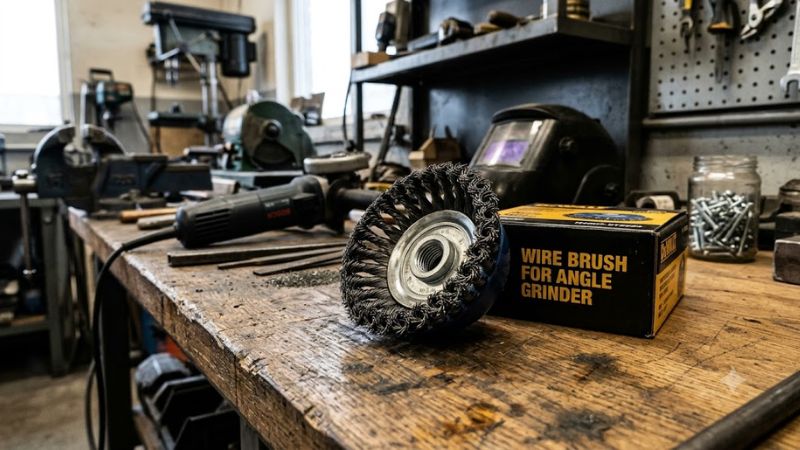
Unlike a grinding disc, which removes material through abrasive particles, a wire brush primarily cleans by scraping and flexing its wire bristles against the surface.
Common applications include:
- Removing loose rust and corrosion from steel.
- Cleaning welds before inspection or further finishing.
- Removing some types of paint residue and surface contamination.
- Cleaning metal fabrication parts and workshop equipment.
- Preparing suitable metal surfaces for subsequent coating.
- Cleaning edges, corners, and irregular metal shapes.
A wire brush is not suitable for every coating or surface. Thick paint, heavy scale, delicate finishes, and hazardous contaminants may require a different removal method. Older paint should be assessed for lead or other hazardous substances before disturbing it.
Types of Wire Brushes for Angle Grinders
The brush’s shape and wire construction determine how it contacts the workpiece, how aggressively it cleans, and where it can reach.
1. Crimped Wire Cup Brush
A crimped wire cup brush has a cup-shaped body with wavy, flexible wire bristles. It is commonly used for general metal cleaning and lighter rust removal.
Best for:
- Cleaning relatively large metal surfaces.
- Removing loose rust and light corrosion.
- Removing certain surface contaminants.
- Preparing suitable steel surfaces for additional work.
Advantages:
- Flexible bristles adapt to some surface variations.
- Useful for broad, accessible workpieces.
- Available in different wire materials and levels of aggressiveness.
Limitations:
- May remove stubborn scale more slowly than a suitable knotted brush.
- Can damage delicate finishes if the wrong wire or pressure is used.
For general-purpose cleaning, a compatible crimped wire cup brush is a reasonable starting point when the surface does not require aggressive material removal.
2. Knotted Wire Cup Brush
A knotted wire cup brush uses twisted wire bundles that are generally more rigid than the loose bristles of a comparable crimped brush.
Best for:
- More aggressive cleaning of suitable steel surfaces.
- Removing stubborn corrosion and certain types of scale.
- Cleaning appropriate weld areas and metal fabrication components.
Advantages:
- Often better suited to heavy-duty cleaning.
- Stiffer wire bundles can help remove stubborn deposits.
- Available in configurations designed for specific industrial applications.
Limitations:
- Can leave a rougher surface.
- May remove material or damage the workpiece if used incorrectly.
- Requires careful control and strict compliance with accessory speed ratings.
Knotted brushes are not automatically better than crimped brushes. Choose one only when its construction and application rating match the workpiece.
3. Wire Wheel Brush
A wire wheel brush has a flat, circular profile. Depending on its design, it can clean edges, narrow surfaces, weld seams, and some areas that are difficult to reach with a cup brush.
Best for:
- Cleaning metal edges.
- Removing contamination along suitable weld seams.
- Working on narrow profiles.
- Cleaning selected corners and joints.
Advantages:
- Useful for edge-oriented cleaning.
- Available in crimped and knotted configurations.
- Can access some areas that a cup brush cannot reach conveniently.
Limitations:
- The working edge can be aggressive.
- Wires may catch on openings, corners, or irregular features.
- Brush orientation and tool control are important.
Choose the wheel’s diameter and wire construction according to the workpiece geometry and grinder manufacturer’s specifications.
4. Bevel Wire Brush
A bevel wire brush has an angled profile that can help reach certain edges, corners, and restricted areas.
Best for:
- Cleaning around joints.
- Reaching selected edges and narrow sections.
- Working on metal profiles where a cup brush is difficult to position.
Advantages:
- Offers a different contact angle from flat wire wheels.
- Can improve access to some restricted areas.
Limitations:
- Access depends on the grinder body, guard, brush dimensions, and workpiece geometry.
- The angled profile does not eliminate the risk of wire breakage or kickback-like tool movement.
Never remove a required grinder guard to accommodate a brush that does not fit properly.
Crimped vs. Knotted Wire Brush: Which Is Better?
The best choice depends on the contamination, material, and finish you want.
| Feature | Crimped Wire Brush | Knotted Wire Brush |
| Wire construction | Wavy, flexible bristles | Twisted wire bundles |
| Typical application | General and lighter cleaning | More aggressive cleaning |
| Flexibility | Generally higher | Generally lower |
| Rust removal | Suitable for loose rust and lighter corrosion | Often suitable for more stubborn deposits |
| Surface finish | May produce a less aggressive finish | Can leave a rougher finish |
| Main limitation | May clean heavy scale more slowly | Greater potential to damage the workpiece |
These are general tendencies rather than guarantees. Wire diameter, brush size, construction, grinder speed, and contact pressure all affect performance.
Practical recommendation: Start with a compatible crimped brush for light contamination or a surface that needs a less aggressive approach. Consider a suitable knotted brush for stubborn deposits on robust metal. Test the chosen accessory on an inconspicuous area before proceeding.
How to Choose the Right Wire Brush for an Angle Grinder
Before purchasing, evaluate the material, brush shape, wire construction, diameter, mounting system, and maximum rated speed.
1. Match the Wire Material to the Workpiece
Different wire materials suit different cleaning applications.
| Wire Material | Typical Application | Important Consideration |
| Carbon steel | Cleaning ordinary carbon-steel parts and removing rust | Can leave iron contamination on stainless steel |
| Stainless steel | Cleaning suitable stainless-steel surfaces | Use a brush intended for the relevant application and control contamination |
| Brass or brass-coated wire | Certain lighter cleaning tasks | May be unsuitable for heavy scale or aggressive removal |
| Nylon or abrasive-impregnated filaments | Specific cleaning and finishing applications | Confirm that the accessory is rated for the grinder and intended task |
When cleaning stainless steel, use an appropriate brush and keep it separate from carbon-steel brushes when contamination is a concern. A stainless-steel brush is not automatically suitable for every alloy or regulated application.
For aluminum and other softer metals, choose an accessory specifically recommended for the material. Steel wire can scratch or damage soft surfaces, and the brush may become loaded with removed material.
2. Choose the Correct Brush Shape
The shape should match the workpiece rather than simply the size of the grinder.
- Large, accessible surfaces: Consider a compatible cup brush.
- Weld seams and edges: Consider a wire wheel designed for the application.
- Corners and restricted spaces: Consider a suitable bevel brush.
- Small parts and delicate surfaces: A hand wire brush or another controlled cleaning method may be more appropriate.
A brush that is too large can obstruct access, interfere with the guard, or force you to hold the grinder in an awkward position. Never remove a required guard to fit a larger brush.
3. Check Diameter and Mounting Compatibility
Angle grinder accessories are not interchangeable simply because they have similar dimensions.
Check the following against the grinder manual and accessory packaging:
- Brush diameter: Must be approved for the grinder and provide the required clearance.
- Spindle thread or arbor: Confirm the exact mounting interface and thread specification.
- Mounting hardware: Use the correct nut, flange, adaptor, or locking system.
- Guard clearance: Ensure the accessory fits with the required guard installed.
- Maximum speed: The brush’s rated maximum RPM must meet or exceed the grinder’s maximum no-load speed, subject to the manufacturers’ instructions.
For example, a brush with an M14 × 2 thread is not automatically compatible with a grinder using a 5/8-11 spindle. Use an adaptor only if the grinder and accessory manufacturers permit that configuration.
Some grinders use dedicated quick-change systems. Do not assume that a conventional threaded brush will fit these systems.
4. Understand Brush Diameter and Wire Thickness
A larger brush may cover more surface area, but it also requires adequate clearance and an appropriate speed rating.
Wire thickness also affects performance. Thicker wire is often stiffer and more aggressive, while finer wire may offer greater flexibility for lighter cleaning.
Do not assume that a larger brush always removes rust faster. Results depend on the brush construction, wire condition, tool speed, material, and operator technique.
5. Check the Maximum RPM Rating
The maximum rated speed is one of the most important specifications to verify.
Suppose your angle grinder has a maximum no-load speed of 11,000 RPM. A brush rated for 8,500 RPM is unsuitable for operation at that speed. Choose a brush with an adequate rating and a compatible mounting system.
Do not assume that operating gently or applying less pressure makes an incorrectly rated accessory safe. Use an approved tool-and-accessory combination and follow the manufacturer’s instructions for any variable-speed settings.
6. Consider Frequency of Use and Total Cost
For occasional rust removal, a suitable general-purpose brush may be sufficient. Frequent fabrication or weld-cleaning work may justify a specialized accessory matched to the material and workload.
Consider more than the initial purchase price. Evaluate cleaning consistency, expected wear, replacement frequency, surface quality, and whether the brush requires a specific mounting system.
How to Use an Angle Grinder Wire Brush Safely
A rotating wire brush can eject broken bristles and metal debris at high speed. Safe operation requires the correct accessory, an intact guard, a securely held workpiece, appropriate protective equipment, and continuous control of the grinder.
Before You Start
Prepare the work area and equipment before connecting the grinder to its power source.
- Eye and face protection: Wear appropriate impact-rated safety glasses or goggles and a face shield. A face shield supplements rather than replaces primary eye protection.
- Hearing protection: Use suitable protection when required by the noise exposure.
- Respiratory protection: Assess the material and contamination. Use suitable dust controls and respiratory protection where necessary.
- Clothing: Wear close-fitting clothing, secure long hair, and remove jewelry that could become entangled.
- Gloves: Follow the grinder and brush manufacturers’ instructions and the applicable risk assessment. Never allow gloves to approach a rotating brush where they could snag.
- Workpiece security: Clamp the workpiece firmly. Do not hold a small metal part in your hand while brushing it.
- Guard and handle: Keep the required guard installed and use the auxiliary handle where supplied or required.
- Work area: Remove combustible materials, control sparks, and keep other people clear. Check for flammable vapors, hidden wiring, and nearby materials that could be damaged by debris.
Assess old or unknown coatings before removing them. Wire brushing can release hazardous particles from certain paints and coatings.
Step 1: Disconnect the Grinder
Unplug a corded grinder or remove the battery from a cordless grinder before installing, adjusting, or inspecting the brush.
Step 2: Inspect the Brush and Mounting System
Look for missing or uneven wires, corrosion, deformation, cracks, damaged threads, and worn mounting parts.
Verify the brush diameter, attachment, maximum RPM, and material suitability. Do not use a damaged brush.
Step 3: Install the Brush Correctly
Follow the grinder and accessory instructions for mounting and tightening.
Check that the brush is secure, rotates freely by hand while disconnected, and does not contact the guard or housing.
Step 4: Perform a Controlled Startup Check
Position yourself outside the likely path of debris, keep other people clear, and run the grinder in a safe, protected area according to the manufacturer’s instructions.
Stop immediately if you notice unusual vibration, wobbling, or noise. Follow any specified test-run procedure in the applicable manual.
Step 5: Brush the Surface with Controlled Contact
Hold the grinder securely, using both hands where the design provides two-handed control. Start with light pressure and let the wire tips do the work.
Keep the brush moving as appropriate for the surface. Avoid catching the wires on edges, openings, or irregular features.
Step 6: Inspect the Result and Shut Down Safely
Release the switch and wait until the brush stops completely before setting the grinder down.
Disconnect the power source before inspecting the brush, clearing debris, or changing accessories. Check the surface for remaining rust, unwanted scratches, heat damage, or contamination.
How Much Pressure Should You Apply?
Use only enough pressure to maintain controlled contact. Excessive force can bend or fatigue the wires, increase heat, reduce cleaning effectiveness, and make the grinder harder to control.
If the brush is not removing contamination effectively:
- Stop the grinder and disconnect its power source.
- Inspect the bristles for wear, loading, or damage.
- Check whether the wire type and construction suit the contamination.
- Verify that the accessory’s rated speed and mounting are correct.
- Choose a more appropriate brush or cleaning method if necessary.
Do not press harder to compensate for a worn brush or an unsuitable accessory.
Common Wire Brush Mistakes to Avoid
| Mistake | Why It Matters | Better Approach |
| Choosing a brush only because it fits | Physical fit does not establish speed or application compatibility | Check the manual, attachment, diameter, and RPM rating |
| Using carbon-steel wire on stainless steel without considering contamination | Iron residue can contaminate the stainless surface | Use a suitable dedicated stainless-steel brush |
| Applying excessive pressure | Can increase wire breakage, heat, and loss of control | Use controlled contact and an appropriate brush |
| Removing the guard for better access | Increases exposure to broken wires and debris | Choose a compatible brush that works with the guard |
| Brushing loose workpieces | The part can move or be thrown by the rotating brush | Secure the workpiece before starting |
| Using a damaged or heavily worn brush | Can cause uneven running and increase wire-ejection risk | Inspect before use and replace damaged accessories |
| Ignoring sparks and dust | Can expose people and nearby materials to hazards | Control debris, assess the material, and use suitable PPE |
| Touching or changing a brush while it is coasting | The brush can still catch skin or clothing | Wait for a complete stop and disconnect the power |
Wire Brush vs. Flap Disc vs. Sanding Disc
A wire brush is not always the best accessory for metal preparation. Choose according to whether you need to clean the surface, remove base material, or improve the finish.
| Accessory | Main Purpose | Best Suited To | Main Limitation |
| Wire brush | Loosening corrosion and contaminants | Cleaning, rust removal, and certain weld-preparation tasks | May leave a rough or textured surface |
| Flap disc | Abrading and blending metal | Smoothing welds, removing material, and blending transitions | Removes base material and can change dimensions |
| Abrasive sanding disc | Surface abrasion and finishing | Smoothing surfaces and preparing certain finishes | May load up or produce unwanted scratches |
| Hand wire brush | Manual cleaning | Small jobs, detail work, and areas unsuitable for powered brushing | Slower for larger or stubborn deposits |
Use only accessories approved for the grinder, with the correct dimensions, speed rating, and guard arrangement. Do not substitute an abrasive disc for a wire brush without checking the accessory requirements.
Frequently Asked Questions
1. What is the best wire brush for an angle grinder to remove rust?
A crimped wire cup brush is a practical starting point for light-to-moderate rust on suitable metal surfaces. For stubborn corrosion or heavy scale on robust steel, a compatible knotted brush may be more effective. Select the wire material, brush shape, and rated speed for the specific job.
2. Can you use a wire brush on an angle grinder to remove paint?
Yes, a compatible wire brush can remove some paint residue and coatings from suitable metal surfaces. However, it may not remove every coating completely, and aggressive brushing can damage the underlying material. Assess older or unknown paint for hazardous substances before disturbing it.
3. What size wire brush fits a 4.5-inch angle grinder?
A 4.5-inch angle grinder does not automatically accept every brush marketed for that tool category. Check the grinder manual and accessory specifications for the approved brush diameter, spindle thread or mounting interface, guard clearance, and maximum RPM.
4. Is a knotted wire brush better than a crimped wire brush?
A knotted wire brush is generally more aggressive and suited to certain heavy-duty cleaning tasks, while a crimped brush is usually more flexible and suited to lighter cleaning. The best option depends on the workpiece, contamination, desired finish, and manufacturer’s application guidance.
Final Verdict
The best wire brush for an angle grinder is the one that matches the material, cleaning task, grinder specifications, and required finish.
For general rust removal and lighter cleaning, consider a compatible crimped wire cup brush. For stubborn scale and suitable heavy-duty steel cleaning, consider a knotted brush. Choose a wire wheel or bevel brush when access to welds, edges, or narrow areas is the main challenge.
Before using any brush, verify its mounting interface, diameter, wire material, and maximum rated RPM. Inspect it for damage, retain the required guard, secure the workpiece, and use appropriate protective equipment.


Write Your Review
No reviews yet. Be the first to share your experience!