What's inside
As an Amazon Associate I earn from qualifying purchases. This post may contain affiliate links at no extra cost to you.
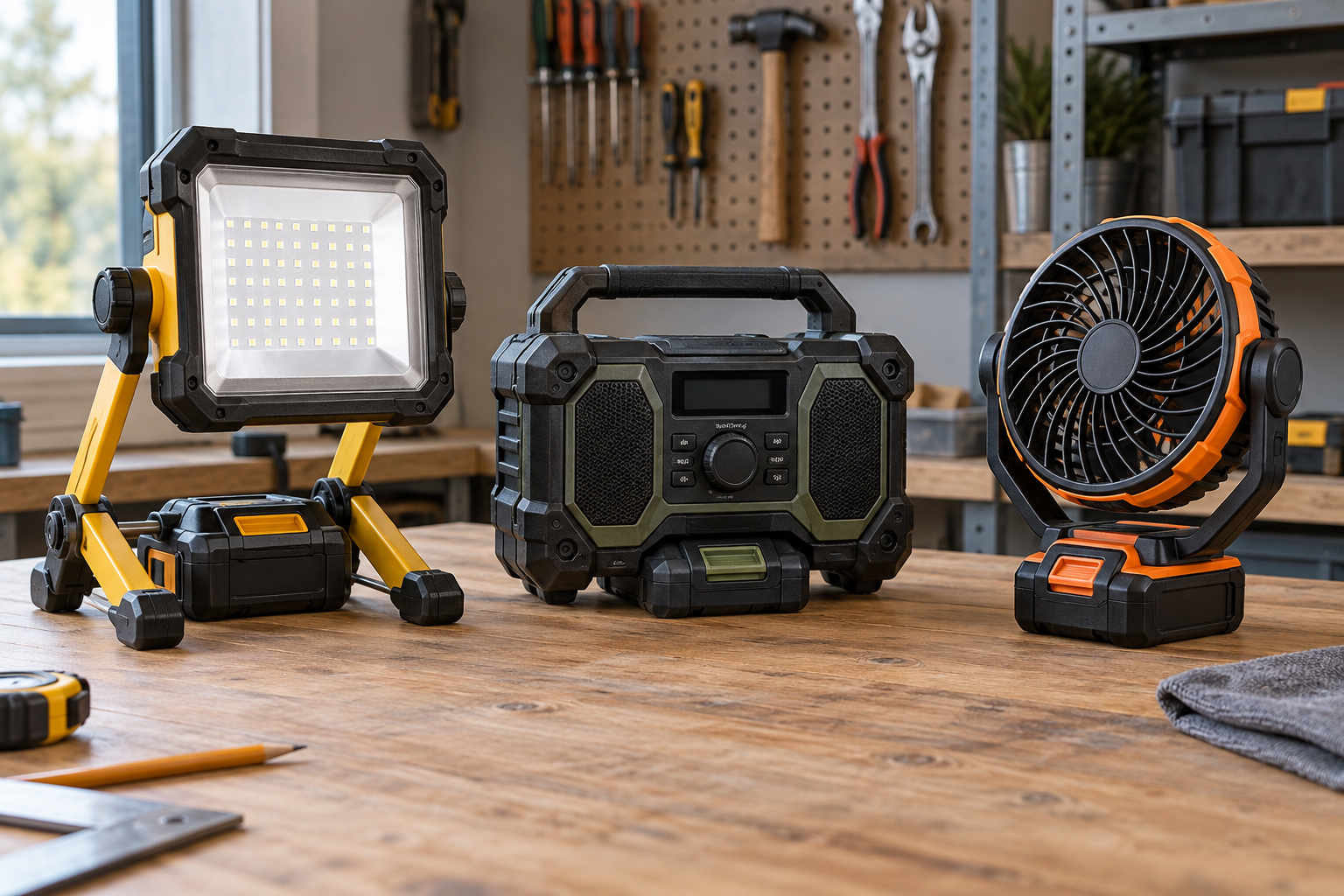
A work light is only useful if it stays put, reaches the work, and can run on batteries you already own. Flexible battery mounting helps with all three: some lights accept a maker’s slide-on packs, while others use an adapter plate or a separate battery lead. Those options are not interchangeable, and an adapter can add cost, bulk, and another point of failure.
For most buyers, the sensible choice is a light made for their existing battery platform. Cross-brand adapters are worth considering when you have several packs from another system, but check the exact light and battery pairing before buying. A battery that physically fits is not necessarily electrically compatible.
As an Amazon Associate we earn from qualifying purchases at no extra cost to you.


What flexible mounting means
There are three common arrangements. A platform-specific light has a built-in mount for one battery family. A multi-platform light uses interchangeable battery plates, so you can swap plates to match different packs. A third-party adapter connects a light designed for one platform to a battery from another.
Flexible mounting can save money if you already have batteries and chargers. It can also make a light heavier or less stable, especially if the battery hangs off the back or is joined by a cable. For a light used on a tripod or hung overhead, a remote battery may be convenient. For a compact light carried room to room, a direct-fitting pack is usually neater.
What to compare before buying
| Feature | What to check | Why it matters |
|---|---|---|
| Battery fit | Exact platform and pack generation | Compatibility varies; do not assume packs from the same brand all fit every light. |
| Brightness | Rated lumens and output settings | High output is useful for broad work areas, but often shortens runtime. |
| Runtime | Hours at each setting, if listed | A runtime figure without its brightness setting is hard to compare. |
| Positioning | Handle, hook, magnets, tripod thread, or pivoting head | Good mounting can matter more than extra brightness when working in a tight space. |
| Protection | Impact and water-resistance rating | A shop light may tolerate dust but still be unsuitable for rain or washdown. |
Compare lights at the output you will actually use, not only at their maximum rating. A claimed 2,000 lumens sounds impressive, but it is less useful if the light has no lower setting for close work or drains a small pack quickly. If runtime is important, look for figures tied to a specific battery capacity and brightness level. As a rough calculation, a 5 Ah pack at 18 volts contains about 90 watt-hours before losses; a light drawing 20 watts could run for a little over four hours in ideal conditions. Real results vary with pack condition, temperature, and the light’s electronics.
Choose by where you work
For general indoor repairs, a compact platform-matched floodlight is usually the practical buy. It can sit on a floor or shelf, and you avoid carrying an adapter. If you already own batteries from a major tool system, start with its cordless work lights for your battery platform. This is generally the lowest-hassle route, though the brand’s light may cost more than a bare third-party unit.
For vehicle repair, cabinets, and other confined spaces, prioritize a pivoting head and a hook or magnetic base. The light should be positionable without putting the battery against hot exhaust parts, oil, or a moving component. Magnets are handy on steel but useless on aluminum, plastic, and many body panels. A hook gives you more options, but check that it supports the light’s weight without rotating.
For lighting a larger room or a jobsite, a tripod-mounted area light spreads light more evenly than a small handheld unit. These are bulkier, and a tall stand can tip if it is bumped or placed on uneven ground. If you want to run a light from batteries you already have across several brands, search for a work-light battery adapter for your exact tool platforms. Confirm that the adapter maker lists both the light and battery family. Avoid improvised wiring or adapters with unclear voltage protection.
Adapters, runtime, and common failure points
An adapter can be a good value when it lets you use existing packs instead of buying into another battery system. The trade-off is added cost and another connection that can loosen, collect dust, or be damaged if the light falls. Some adapters also lack the battery-management features found in a manufacturer’s own tool. Check whether the adapter provides low-voltage cutoff; without it, a light may keep drawing power until the pack is over-discharged. Do not leave an adapted light unattended for long periods unless the setup has appropriate protection.
Battery capacity affects runtime, but brightness setting and light efficiency matter too. A larger pack usually adds weight and may make a small light awkward to balance. For occasional tasks, the smallest compatible pack is often fine. For a full shift, choose a higher-capacity pack or keep a charged spare rather than relying on a headline runtime measured on low output.
A practical buying checklist
Before ordering, verify the light’s bare-tool or kit status, battery compatibility, and whether a charger is included. Check the mounting options against your work: a tripod thread helps with area lighting, while a hook or magnetic base is more useful for repairs. Read the manual for stated temperature and weather limits. A light described as jobsite-ready is not automatically waterproof.
If you own no batteries yet, compare the light’s price with the cost of a battery and charger, not just its bare-tool price. If you already have a compatible pack, a basic platform-matched light is often the better deal than a flexible adapter setup. Spend extra on multi-platform mounting only when you will genuinely use packs from more than one system or need a remote battery arrangement.
Related guides
- Longest Lasting Lawn Mower Battery: AGM vs Lithium vs Flooded Lifespan and Cost per Season
- Duralast Gold Lawn Mower Battery Review: U1 Fit, CCA and When to Pay for AGM
- Greenworks Pro 80V 21-Inch Mower Review: Runtime Math, Push vs Self-Propelled and Yard Fit
- Bosch High Pressure Washer Gun Replacement: Fittings, Adapters and What Fits Your Model