
What's inside
- What Are Ryobi Pressure Washer Attachments?
- 7 Useful Ryobi Pressure Washer Attachments
- Ryobi Pressure Washer Attachment Comparison
- How to Check Ryobi Pressure Washer Attachment Compatibility
- How to Choose the Right Ryobi Pressure Washer Attachments
- How to Install and Use Ryobi Pressure Washer Attachments Safely
- Common Mistakes When Buying Ryobi Pressure Washer Attachments
- Frequently Asked Questions
- Final Thoughts
As an Amazon Associate I earn from qualifying purchases. This post may contain affiliate links at no extra cost to you.
Ryobi pressure washer attachments make outdoor cleaning easier by adapting a pressure washer to different surfaces and cleaning tasks. Whether you need to wash a vehicle, remove dirt from a driveway, rinse patio furniture, or reach difficult exterior areas, the right accessory can improve convenience and cleaning efficiency.
However, choosing an attachment involves more than matching the Ryobi brand name. Different pressure washer models use different connection systems, and accessories have specific pressure, water-flow, and application requirements. Some attachments are designed for conventional electric or gas pressure washers, while others belong to Ryobi’s separate EZClean power cleaner range.
This guide explains the most useful Ryobi pressure washer attachments, their applications, compatibility considerations, and safe operating practices. Understanding these differences will help you choose accessories that work with your equipment without damaging the washer or the surface being cleaned.
What Are Ryobi Pressure Washer Attachments?
Ryobi pressure washer attachments are additional accessories that connect to a pressure washer’s spray gun, lance, hose, or designated connection point. They modify how water or detergent reaches a surface, allowing one machine to handle several cleaning applications.
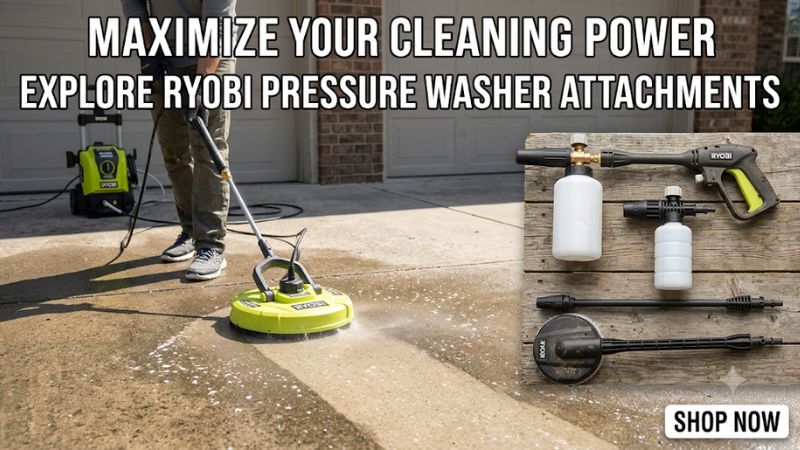
Common attachment types include:
- Surface cleaners: Designed for large, flat areas such as driveways, patios, and concrete walkways.
- Foam blasters: Apply detergent foam to vehicles, outdoor furniture, and equipment.
- Turbo nozzles: Produce a rotating concentrated spray for suitable stubborn dirt.
- Quick-connect nozzles: Change the spray angle to suit different cleaning requirements.
- Extension lances: Increase reach when cleaning difficult-to-access areas.
- Brush attachments: Combine water delivery with physical scrubbing.
- Water brooms: Distribute water across wider ground-level surfaces.
- Hose and connection accessories: Connect compatible components or replace worn parts.
Not every accessory works with every Ryobi pressure washer. Compatibility depends on the machine’s model number, connection design, operating pressure, and water-flow requirements.
7 Useful Ryobi Pressure Washer Attachments
Different accessories solve different cleaning problems. Choosing one based on the surface and type of dirt is generally more effective than purchasing a large accessory bundle without a clear purpose.
1. Surface Cleaners for Driveways and Patios
A surface cleaner is one of the most useful accessories for homeowners who regularly clean concrete, patios, sidewalks, and other large flat areas.
Instead of directing one concentrated spray across the ground, this attachment uses rotating water jets inside a protective housing. The rotating action creates a wider cleaning path and helps produce a more consistent finish.
Typical applications include:
- Concrete driveways and walkways.
- Outdoor patios and suitable paving.
- Large flat stone surfaces.
- Some compatible decking materials.
Ryobi offers different surface cleaner configurations, including a 12-inch model rated for up to 2,300 PSI and a 15-inch model designed for compatible gas pressure washers rated up to 3,400 PSI.
Advantages:
- Covers more ground than a standard spray nozzle.
- Helps reduce visible cleaning stripes.
- Keeps much of the spray contained beneath its housing.
- Reduces the need to repeatedly move a narrow spray pattern.
Limitations: Surface cleaners require sufficient water flow to operate effectively. A washer may meet an attachment’s maximum PSI rating but still provide insufficient flow for satisfactory cleaning. Always check both specifications when available.
2. Foam Blasters for Vehicles and Outdoor Equipment
A foam blaster mixes compatible detergent with water and applies it as foam through the pressure washer system.
This accessory is particularly useful for washing cars, motorcycles, patio furniture, outdoor equipment, and other surfaces that benefit from detergent-assisted cleaning.
Ryobi’s RY31F06 Pressure Washer Foamer is an example of this accessory category. Its published specifications identify compatibility with most suitable pressure washers rated up to 3,300 PSI and a 1/4-inch quick-connect spray wand.
Key benefits include:
- Applying detergent across a wider area.
- Helping loosen dirt before rinsing.
- Making vehicle washing more convenient.
- Reducing the need to apply cleaning solution manually.
Limitations: Foam thickness depends on the detergent, dilution, water conditions, and foamer design. Thick foam does not necessarily mean better cleaning performance.
Use detergent specifically formulated for pressure washers and appropriate for the surface being cleaned. Automotive paint, for example, should not be exposed to aggressive household chemicals.
3. Turbo Nozzles for Stubborn Dirt
A turbo nozzle combines a concentrated water stream with a rotating spray action. It creates a circular cleaning pattern that can remove stubborn dirt more efficiently than a conventional fixed-angle nozzle on suitable hard surfaces.
Typical applications include:
- Tough dirt on compatible concrete surfaces.
- Mud on appropriate outdoor equipment.
- Certain heavily soiled masonry surfaces.
- Cleaning jobs where a standard fan nozzle takes too long.
However, turbo nozzles require careful handling. Their concentrated impact can damage painted surfaces, soft wood, vehicle finishes, seals, and other delicate materials.
Avoid using them on automotive paint, glass, or fragile surfaces. Test an inconspicuous area first when the surface’s resistance is uncertain.
4. Quick-Connect Nozzle Sets
Quick-connect nozzles let users change the spray pattern without replacing the entire spray wand.
A common four-piece nozzle configuration includes:
| Nozzle | Typical application |
| 0° | Highly concentrated spray for suitable durable surfaces |
| 15° | Focused cleaning on compatible hard surfaces |
| 25° | General outdoor cleaning |
| 40° | Wider, gentler rinsing |
Ryobi’s RY31077 four-piece nozzle set is specified for compatible pressure washers up to 3,300 PSI and uses a 1/4-inch quick-connect fitting.
The spray angle determines how concentrated the water stream is. A narrower angle concentrates impact over a smaller area, while a wider angle distributes water across a larger surface.
For general household cleaning, wider spray patterns are usually the safer starting point. A 0-degree nozzle can cause serious surface damage and should not be treated as a general-purpose cleaning option.
5. Extension Lances for Hard-to-Reach Areas
An extension lance increases the distance between the operator and the spray outlet. It can make certain elevated or awkward cleaning jobs easier without requiring the user to stand directly beside the surface.
Useful applications include:
- Reaching sections of exterior walls.
- Cleaning suitable overhead outdoor surfaces.
- Accessing areas behind outdoor equipment.
- Reaching awkward corners and edges.
Before purchasing an extension, check its connection type, pressure rating, and approved washer models.
An extension also increases the physical leverage created by spray reaction force. Maintain a stable stance and avoid using an extension from an unstable ladder or elevated position.
6. Brush Attachments for Physical Scrubbing
Brush attachments combine water delivery with physical contact. They are useful when rinsing alone does not remove accumulated dirt or when a more controlled cleaning method is preferable.
Depending on the model, brushes can help clean:
- Patio furniture.
- Suitable vehicle surfaces.
- Outdoor equipment.
- Certain smooth exterior materials.
Brushes are not interchangeable in terms of application. A stiff brush may scratch delicate finishes, while a softer brush may not provide enough scrubbing action for heavily soiled concrete.
Check the manufacturer’s intended application and use a clean brush to avoid dragging abrasive dirt across painted or polished surfaces.
7. Water Brooms for Wider Ground Coverage
A water broom distributes water through multiple spray outlets across a wider horizontal cleaning path.
It can be useful for rinsing dirt from suitable driveways, walkways, and outdoor ground surfaces. Compared with a single spray nozzle, its wider arrangement can cover more area per pass.
However, water brooms are not necessarily replacements for surface cleaners. They may distribute water efficiently without providing the same enclosed rotating-jet cleaning action.
Choose one when broad rinsing is the priority rather than when you need the more controlled cleaning pattern of a surface cleaner.
Ryobi Pressure Washer Attachment Comparison
The following table summarizes which accessory is most appropriate for common household jobs.
| Attachment | Best For | Main Benefit | Main Limitation |
| Surface cleaner | Driveways and patios | Wider, more consistent cleaning | Requires suitable water flow |
| Foam blaster | Vehicles and furniture | Convenient detergent application | Foam quality varies |
| Turbo nozzle | Stubborn dirt | Concentrated rotating spray | Can damage delicate materials |
| Quick-connect nozzles | General cleaning | Adjustable spray patterns | Requires careful nozzle selection |
| Extension lance | Elevated or awkward areas | Additional reach | Increases handling difficulty |
| Brush attachment | Furniture and equipment | Physical scrubbing | Brush stiffness matters |
| Water broom | Large ground areas | Broad water distribution | Not equivalent to a rotating surface cleaner |
For most homeowners, a surface cleaner, an appropriate nozzle set, and a compatible foam attachment provide a practical starting combination. Other accessories are worth considering when a specific cleaning task justifies them.
How to Check Ryobi Pressure Washer Attachment Compatibility
Compatibility is one of the most important considerations when purchasing Ryobi accessories.
The brand offers conventional pressure washers, cordless power cleaners, and different generations of connection systems. A product described as a Ryobi pressure washer attachment is not necessarily compatible with every machine.
Step 1: Identify Your Exact Pressure Washer Model
Find the model number on the machine’s identification label or in its operator’s manual.
Do not rely on descriptions such as 1,800 PSI Ryobi pressure washer or 40V Ryobi cleaner alone. Two products with similar advertised pressure ratings may have different connection systems.
Step 2: Check the Connection Type
Common connections include:
- 1/4-inch quick-connect: Frequently used for spray-wand accessories, including compatible nozzles and foamers.
- Hose and trigger-handle fittings: Connect the pressure hose to the gun and washer.
- Proprietary connections: Used on certain older or specialized pressure washer systems.
A fitting that looks similar may still have a different locking mechanism or internal dimensions.
Step 3: Verify Pressure and Water-Flow Ratings
Check the maximum PSI supported by the accessory against your washer’s specifications.
Also consider GPM (gallons per minute), which measures water flow. Some attachments require sufficient flow to distribute water or operate rotating components correctly.
Never assume that an attachment is safe simply because its connector fits.
Step 4: Check Whether an Adapter Is Required
Some older Ryobi pressure washers require an adapter or replacement lance to accept newer accessories.
For example, certain regional Ryobi product ranges include dedicated lance and adapter packages for specified older pressure washer models. Compatibility information can differ between the United States, Australia, and other markets.
Always check the regional product documentation rather than assuming an accessory sold in one country will fit a machine purchased elsewhere.
Step 5: Confirm the Accessory’s Intended Washer Family
Pay particular attention to the distinction between conventional pressure washers and EZClean power cleaners.
Ryobi’s product catalog separates pressure washer accessories from EZClean accessories and identifies different power systems, including 18V ONE+ and 40V products.
These are distinct equipment categories. Do not assume their accessories are interchangeable based on brand name or battery voltage.
How to Choose the Right Ryobi Pressure Washer Attachments
The best accessory depends on what you clean most often, how frequently you use the pressure washer, and how much cleaning power the machine can deliver.
Choose According to the Cleaning Task
| Cleaning Task | Recommended Attachment |
| Washing a concrete driveway | Surface cleaner |
| Washing a car | Foam blaster and wide-angle nozzle |
| Removing stubborn dirt from suitable concrete | Turbo nozzle |
| Rinsing outdoor furniture | Wide-angle nozzle or soft brush |
| Cleaning elevated exterior areas | Compatible extension lance |
| Rinsing large outdoor areas | Water broom |
Avoid purchasing accessories simply because they are included in a bundle. A homeowner who mainly washes vehicles may benefit more from a foamer than a large surface cleaner.
Consider the Pressure Washer’s Performance
PSI and GPM are two important specifications when choosing pressure washer attachments.
PSI (pounds per square inch) measures water pressure. It indicates the pressure available to remove dirt from a surface.
GPM (gallons per minute) measures water flow. It indicates how much water the machine delivers over time.
Both specifications influence cleaning performance. Higher PSI does not automatically mean faster cleaning, particularly when water flow is limited.
For example, a surface cleaner designed for a higher-output machine may not perform as intended when connected to a smaller electric pressure washer.
Consider Long-Term Value
The initial purchase price is only one part of accessory ownership.
Consider:
- Whether the attachment requires a separate adapter.
- Whether replacement seals or components are available.
- Whether the accessory works with your existing spray gun.
- Whether it can handle multiple cleaning applications.
- Whether it requires additional detergent or consumables.
A simple quick-connect nozzle set may offer better value for occasional household cleaning, while a surface cleaner can be a worthwhile investment for homeowners who regularly maintain large paved areas.
How to Install and Use Ryobi Pressure Washer Attachments Safely
Most attachments are straightforward to install, but the connection procedure should follow the instructions for the exact pressure washer and accessory.
Use the following general procedure where it is consistent with the manufacturer’s manual.
- Switch off the pressure washer. Release the trigger and disconnect the electrical supply or remove the battery when the machine’s instructions require it.
- Relieve residual pressure. Follow the manual’s shutdown procedure and operate the trigger only as instructed to release trapped pressure.
- Inspect the connection. Check the fitting, locking collar, seals, and accessory for damage or debris.
- Install the attachment. Connect it using the specified fitting. For a quick-connect fitting, verify that the locking mechanism is fully engaged.
- Check the water supply. Confirm that the hose is connected correctly and that the washer has an adequate water supply.
- Start the machine safely. Follow the manufacturer’s starting and priming instructions. Check for leaks before beginning the cleaning task.
- Test the spray pattern. Start with a suitable distance and a wider spray pattern on an inconspicuous section of the surface.
- Clean using controlled movements. Maintain a stable stance and avoid directing the spray toward people, animals, electrical equipment, or fragile materials.
Important Safety Precautions
Pressure washer attachments can create serious hazards when used incorrectly.
- Wear appropriate eye protection and footwear.
- Never point a high-pressure spray at people or animals. High-pressure water can penetrate skin and cause serious injection injuries.
- Never place your hands near a leaking high-pressure hose or fitting.
- Do not use damaged hoses, connectors, or attachments.
- Keep electrical connections protected from water and follow the washer’s grounding and electrical protection requirements.
- Never bypass trigger locks, safety mechanisms, or protective components.
- Avoid spraying electrical outlets, electrical equipment, and exposed wiring.
- Do not use a turbo nozzle or narrow spray pattern on delicate surfaces.
- Follow the detergent manufacturer’s dilution and application instructions.
If a high-pressure injection injury occurs, seek immediate emergency medical attention even if the wound appears small. It can cause serious internal tissue damage.
Common Mistakes When Buying Ryobi Pressure Washer Attachments
Even experienced DIY users can purchase accessories that do not match their equipment.
Assuming every Ryobi attachment is universal
Different models can use different connections. Check the exact model and fitting compatibility information before ordering.
Ignoring maximum pressure ratings
An accessory rated below the washer’s maximum operating pressure may be unsuitable. Never exceed the accessory’s stated limits.
Confusing EZClean accessories with pressure washer accessories
Cordless power cleaners and conventional pressure washers are different product categories. Their accessories may not be interchangeable.
Choosing a surface cleaner based only on diameter
A larger cleaning head is not automatically better. Water-flow requirements and pressure compatibility also matter.
Using aggressive nozzles on delicate surfaces
A narrow spray can strip paint, damage wood, or leave permanent marks. Select an appropriate nozzle and test the surface before proceeding.
Using incompatible detergents
Not every cleaning chemical is suitable for pressure washer systems or every surface. Follow the washer and detergent instructions.
Frequently Asked Questions
Are Ryobi pressure washer attachments universal?
No. Some Ryobi attachments use standard 1/4-inch quick-connect fittings, but others require model-specific connections or adapters. Check the exact pressure washer model, fitting design, and accessory specifications before purchasing.
Can I use Ryobi pressure washer attachments on other brands?
Some Ryobi accessories can work with other brands when the connection type and operating specifications match. For example, compatible 1/4-inch quick-connect nozzle sets can fit other pressure washer systems with matching specifications. However, matching the connector alone does not establish compatibility with every machine.
What is the best Ryobi pressure washer attachment for cleaning a driveway?
A compatible surface cleaner is generally the most practical option for large concrete driveways. Its rotating jets provide a wider cleaning path and help create a more consistent finish than cleaning with a standard narrow spray pattern.
Can I use a Ryobi foam blaster to wash my car?
Yes. A compatible foam blaster can apply suitable automotive detergent to a vehicle before rinsing. Use a car-safe cleaning solution, avoid aggressive spray settings on paint, and follow the detergent manufacturer’s instructions.
Final Thoughts
Ryobi pressure washer attachments can significantly expand the cleaning applications of a pressure washer. Surface cleaners are useful for driveways and patios, foam blasters simplify vehicle washing, and quick-connect nozzles provide flexibility for everyday outdoor cleaning.
The most important purchasing consideration is compatibility. Check the exact machine model, connection type, PSI rating, and water-flow requirements before choosing an accessory. Do not assume that every attachment carrying the Ryobi name will fit every pressure washer.
For most homeowners, starting with a suitable nozzle set and selecting a surface cleaner or foam blaster based on regular cleaning needs is a sensible approach. Prioritize correct specifications and safe operation over buying the largest accessory bundle.
Related guides
More from Amazon
Programs that pair well with the guide above. Offers and eligibility are set by Amazon and may change.
A free business account with business pricing and bulk-buying tools for work, shop or home office.
Create a business accountFree shipping on eligible items, Prime Video and more. Eligible new members can start with a free trial.
Start a Prime free trialAudiobooks and podcasts to listen to on the go. Eligible new members can start with a free trial.
Try Audible freeAd-free music streaming. Eligible new subscribers can start with a free trial.
Try Music Unlimited freeAs an Amazon Associate we earn from qualifying purchases.
Write Your Review
No reviews yet. Be the first to share your experience!