What's inside
As an Amazon Associate I earn from qualifying purchases. This post may contain affiliate links at no extra cost to you.
What “high-output” means
A cordless tool’s battery does more than determine how long it runs. It also has to supply current when the motor demands it. A battery may fit the tool and show a full charge, yet limit how much power the tool can deliver under a heavy load. High-output batteries are designed to provide more current with less voltage sag, often through lower-resistance cells, a different cell layout, or more capable connections and electronics.
This matters most in demanding work: cutting thick lumber, driving large fasteners, drilling wide holes, or grinding under pressure. A tool may run normally with a standard battery during light work but slow down, pulse, or stop when pushed. The same tool with a high-output pack may maintain speed better.
Why battery current affects tool power
Power is measured in watts, and electrical power is roughly voltage multiplied by current. The motor asks for more current as the load rises. But a battery has internal resistance, so voltage at the tool can drop as current increases. That drop is called voltage sag. If it is large enough, the tool’s electronics may reduce output or shut the tool off to protect the cells.
For example, suppose a tool is drawing 40 amps and the battery’s effective internal resistance is 0.05 ohm. The approximate voltage loss is 2 volts (current multiplied by resistance). A pack with lower resistance loses less voltage under the same demand. The actual figures vary with battery design, temperature, charge level, and condition; they are an illustration, not a rating you can assume for a particular pack.
High-output does not mean a pack forces extra power into every tool. The tool draws what it needs, within the limits set by its motor, electronics, and battery. A larger pack may also add capacity, but amp-hours alone do not tell you how well it handles high current.
When the difference shows up
High-output packs are most useful in tools and tasks that draw heavy current for more than a brief burst. A circular saw ripping thick stock, a high-torque impact wrench loosening stubborn hardware, and a large angle grinder are common examples. A compact drill driving small screws into softwood usually places much less demand on the battery.
Signs that a battery is limiting performance include a saw slowing noticeably in a cut, an impact wrench stopping during repeated high-torque work, or a tool’s overload protection triggering despite a charged pack. These symptoms can also come from a dull blade, a binding bit, cold cells, a worn battery, or a tool fault. Try a sharp accessory, avoid forcing the tool, and compare with a known-good pack before buying a replacement.
Standard and high-output packs compared
| Pack type | Best fit | Typical trade-off |
|---|---|---|
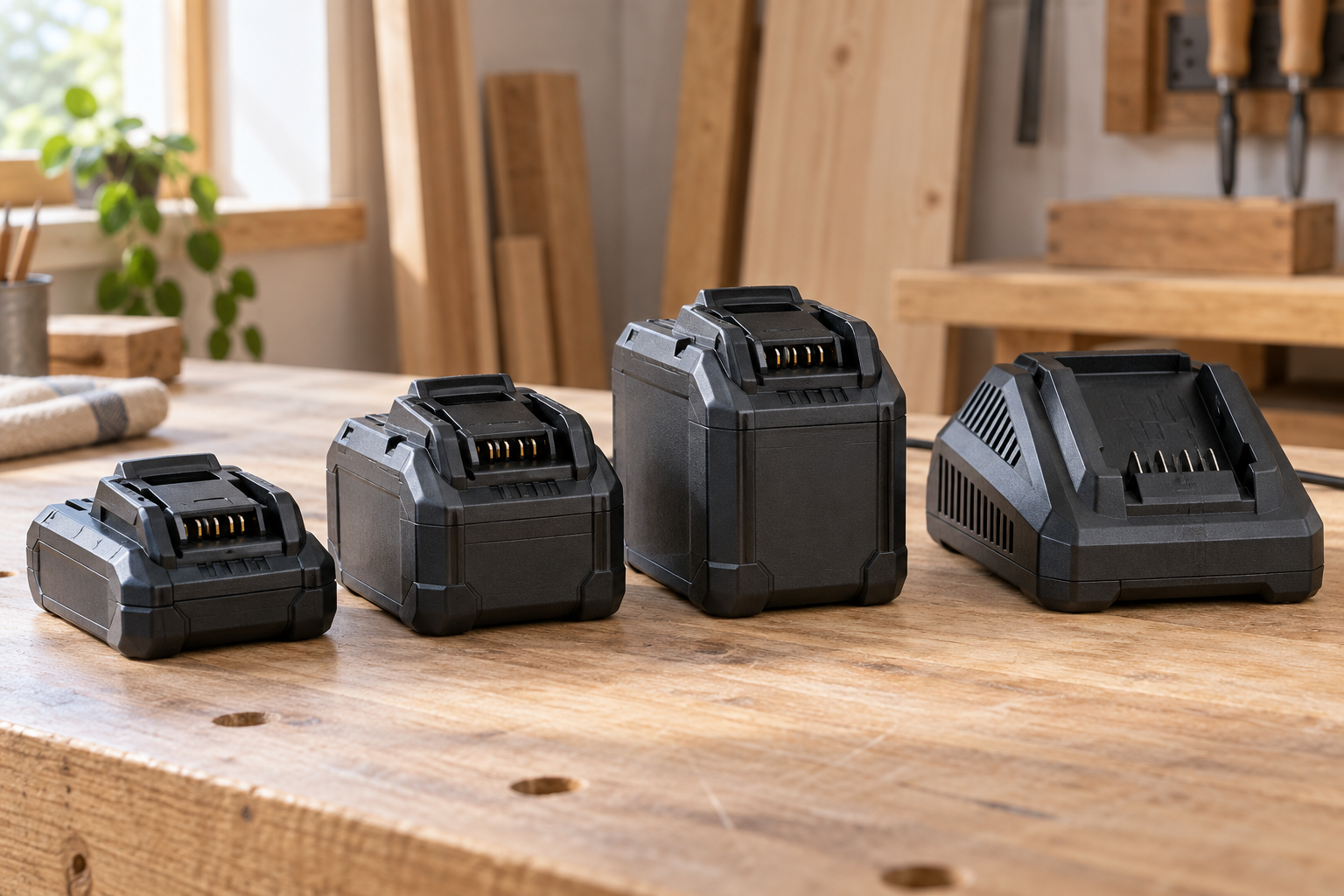
| Compact standard pack | Drills, drivers, light cutting, overhead work | Lower weight and cost; may sag or trigger protection under sustained heavy loads |
| Higher-capacity standard pack | Longer runtime in general-purpose tools | More capacity, but extra amp-hours do not automatically guarantee higher peak output |
| High-output pack | Demanding saws, grinders, high-torque tools, repeated heavy cuts | Often heavier and more expensive; can be unnecessary for light-duty work |
Battery labels and product families vary by brand. Check the tool’s manual and the battery maker’s compatibility and performance guidance rather than assuming that a pack with a larger amp-hour number is necessarily the strongest choice. A 5.0Ah pack and a 5.0Ah high-output pack can have the same stated capacity but behave differently under a heavy load.
Choose the pack for the work
For a drill, impact driver, trim router, or small work light, a compact pack is often the sensible choice. It reduces wrist and arm fatigue, and the tool may never draw enough current for a high-output pack to make a noticeable difference. If your work is mostly short bursts—driving screws, drilling pilot holes, or assembling furniture—spending extra for peak output may buy little beyond added weight.
For a circular saw used on sheet goods or thick framing lumber, a higher-output battery can help maintain cutting speed, especially during long cuts. It cannot compensate for a dull blade, a pinched kerf, or pushing the saw faster than it can cut. If the saw is bogging down, first check the blade, cutting depth, work support, and technique.
Impact wrenches are another case where battery capability can matter, but do not expect a battery alone to turn a lower-torque tool into a more powerful one. The tool’s motor and control system set the ceiling. If you regularly remove rusted or high-torque fasteners, consider a high-output battery compatible with your tool platform, while checking the manufacturer’s guidance for the specific tool.
Heat, runtime, and battery care
Heavy current creates heat in both the battery and the tool. A high-output pack may run cooler for the same task if its design reduces electrical losses, but it is not immune to overheating. Repeated hard use, hot weather, blocked cooling vents, or working with a nearly empty pack can still trigger a temperature or overload cutoff. Let a hot pack cool naturally before charging; do not put it in a freezer or run it under cold water.
Cold weather increases battery resistance and can make voltage sag worse. Keep spare packs at a moderate temperature and swap them when performance drops rather than forcing a tool through repeated cutoffs. A battery that has become unusually hot, swollen, cracked, or damaged should be taken out of service.
High-output packs may also be heavier and cost more. If you work overhead or carry tools all day, the weight penalty can outweigh a modest gain in cutting speed. Some users keep a compact pack in a drill and reserve a larger high-output pack for a saw or grinder. That is a practical way to get performance where it matters without carrying the heaviest battery on every tool.
A practical buying decision
Start with the tool manual: some tools recommend a particular battery class or state that performance varies by pack. Then consider how often you hit the tool’s limits. If a standard pack runs your tool without slowing or cutting out, there is no need to replace it just because a higher-output option exists. If a sound tool repeatedly bogs down on demanding work with a healthy, charged battery, test a compatible higher-output pack before changing platforms.
For a new setup, compare the cost of a tool-and-battery kit with the price of a bare tool and a separate pack. A starter kit with batteries and a charger can be better value if you are building an ecosystem; an extra high-output pack makes more sense when you already own compatible batteries and have a tool that can use the additional current.
The simplest rule is to buy for the hardest regular task, not the most demanding job you might do once. Use compact batteries where low weight matters, and reserve high-output packs for tools that draw heavily enough to benefit. That balances performance, cost, and handling without treating every cordless tool as if it needs the biggest battery available.
Related guides
- Longest Lasting Lawn Mower Battery: AGM vs Lithium vs Flooded Lifespan and Cost per Season
- Duralast Gold Lawn Mower Battery Review: U1 Fit, CCA and When to Pay for AGM
- Greenworks Pro 80V 21-Inch Mower Review: Runtime Math, Push vs Self-Propelled and Yard Fit
- Bosch High Pressure Washer Gun Replacement: Fittings, Adapters and What Fits Your Model