What's inside
As an Amazon Associate I earn from qualifying purchases. This post may contain affiliate links at no extra cost to you.
What a cordless brad nailer can do
A cordless 18-gauge brad nailer is useful for trim, casing, baseboard, cabinet face frames, and small moldings when dragging a compressor and hose would be more trouble than they’re worth. It drives narrow brads, commonly from 5/8 to 2 inches long, depending on the tool. The small holes are easy to fill, and the nails are less likely to split delicate trim than thicker finish nails.
It is not a substitute for every nailer. Brad nails have limited holding power in thick or heavy trim. For long baseboards, door jambs, or pieces that may be pulled away from the wall, a 15- or 16-gauge finish nailer—or a brad nailer paired with adhesive and careful fastening—may be a better choice. A cordless brad nailer also has a wider nose and more weight than a pneumatic tool, which can make precise work in tight corners harder.
As an Amazon Associate we earn from qualifying purchases at no extra cost to you.

How cordless models work
Most cordless brad nailers use a battery to power a flywheel or similar drive mechanism. Some designs also use a gas cartridge; others do not. Battery-only models avoid cartridge cost and odor, but their drive feel and firing delay can differ from a pneumatic nailer. Try a tool in your hand if you can: balance, trigger response, and nose visibility matter more than small differences in advertised features.
Expect a cordless tool to be heavier than a bare pneumatic gun. With a battery installed, many weigh around 6 to 8 pounds, though exact weight varies by model and battery. That is manageable for intermittent trim work but tiring overhead or during a full day of repetitive fastening. Battery runtime depends on nail length, wood hardness, and how often you fire. Check the manufacturer’s stated capacity, but treat it as a best-case estimate rather than a guarantee.
Quick comparison
| Choice | Best fit | Main trade-off |
|---|---|---|
| Battery-only 18-gauge brad nailer | Small and medium trim jobs; users already on that battery platform | Higher tool weight and cost than pneumatic |
| Gas-assisted cordless brad nailer | Users who value a familiar firing feel and already have compatible batteries | Cartridges add cost, storage, and upkeep |
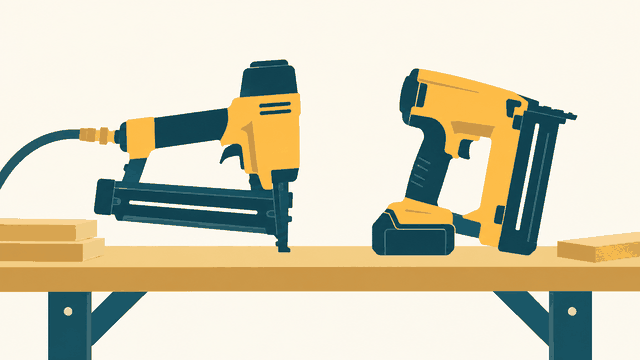
| Pneumatic 18-gauge brad nailer | Frequent shop use or the lowest-cost route | Requires compressor, hose, and setup |
Choose by battery platform first
If you already own cordless tools, start with their battery system. Buying a bare tool can save money, and sharing batteries means fewer chargers and packs to keep on hand. Compare the nailer’s price with the cost of a complete kit, not just the tool body. A kit may be worthwhile if you need a battery and charger, but it can be wasteful if you already have several compatible packs.
For a general-purpose option, compare cordless 18-gauge brad nailers on a platform you already use. If you are starting from scratch, price the battery, charger, and at least one other tool you expect to buy. A cheap bare nailer is not a bargain if the battery ecosystem is a dead end for your needs.
Battery capacity affects balance and runtime. A compact pack is easier to handle on a ladder or when working overhead; a larger pack may be more practical for a long trim day. You usually do not need the largest battery available for a brad nailer. A spare pack is more useful than an oversized one if you are working continuously.
Features that matter on the job
Look for tool-free depth adjustment and a clear jam-release procedure. Test the depth on a scrap offcut of the same material before fastening finished trim. Set the brad just below the surface without crushing the wood. If it sits proud, increase depth a little; if it punches through or leaves a deep crater, reduce depth. Knotty pine, hardwood, and thin molding may need different settings even when the nails are the same length.
Dry-fire lockout helps prevent the tool from cycling with an empty magazine, but it does not replace checking the nail count. A belt hook, work light, and selectable bump or sequential firing can be useful. Sequential firing offers more control for detail work. Bump firing is faster on long runs, but can encourage hurried placement and accidental marks. Check that the nose sits square and that you can see where the brad will enter.
Before buying, confirm the nail range and angle, and check whether the tool accepts common straight 18-gauge brads. Do not assume every 18-gauge strip fits every magazine. For common trim, 1- to 1-1/2-inch brads cover many tasks; use longer nails when the material and substrate call for them, but avoid choosing length by habit. A brad that is too long can emerge through the back or hit wiring and plumbing behind a wall.
When the cheaper pneumatic option is fine
If you already own a compressor, hose, and regulator, a pneumatic nailer is often the sensible buy. The gun is lighter, typically costs less, and avoids waiting for a battery-driven mechanism between shots. For a home shop or occasional renovation, a compact compressor may be adequate; check its noise, recovery time, and duty cycle before assuming it can keep up with other air tools.
A cordless model makes more sense when setup time, portability, or working in finished spaces matters. It eliminates the hose that can snag on ladders, freshly painted walls, or furniture. Search pneumatic 18-gauge brad nailers if you want to compare the lower-cost alternative, then include the compressor and hose in the total if you do not already own them.
Avoid common problems
Misfires and proud nails often come from a poor depth setting, a nail strip that does not match the tool, or firing at an angle. Remove the battery before clearing a jam and follow the manual; never put fingers in the nose or magazine while the tool is powered. Keep the nose clean and inspect it for damaged parts if nails start bending or leaving irregular marks.
For delicate trim, test both nail length and placement on scrap, and keep nails away from thin edges. If the workpiece moves while you fire, clamp it or use a temporary stop rather than trying to hold it with a hand near the nose. Choose cordless for access and convenience, pneumatic for light weight and cost when air is already available, and a larger-gauge nailer when the trim needs more holding power.
Related guides
- Longest Lasting Lawn Mower Battery: AGM vs Lithium vs Flooded Lifespan and Cost per Season
- Duralast Gold Lawn Mower Battery Review: U1 Fit, CCA and When to Pay for AGM
- Greenworks Pro 80V 21-Inch Mower Review: Runtime Math, Push vs Self-Propelled and Yard Fit
- Bosch High Pressure Washer Gun Replacement: Fittings, Adapters and What Fits Your Model