
What's inside
- What Is an Impact Driver Bit Set?
- Impact-Rated Bits vs. Standard Screwdriver Bits
- Types of Bits to Look for in a Set
- How to Choose the Right Impact Driver Bit Set
- Which Impact Driver Bit Set Is Suitable for Your Projects?
- Common Mistakes When Using an Impact Driver Bit Set
- How to Maintain and Store Impact Driver Bits
- Safety Tips for Using Impact Driver Bits
- Frequently Asked Questions
- Final Thoughts
As an Amazon Associate I earn from qualifying purchases. This post may contain affiliate links at no extra cost to you.
An impact driver bit set can make fastening tasks faster, more consistent, and easier to control, but choosing the wrong set can lead to stripped screw heads, damaged fasteners, and broken bits. The best option is not necessarily the set with the most pieces. It is the one with the correct impact rating, drive profiles, bit sizes, lengths, and accessories for the screws you use.
For most DIY users and professional tradespeople, an impact-rated set with a 1/4-inch hex shank, commonly used Phillips, Torx, and square-drive sizes, and a reliable magnetic bit holder is a practical starting point. However, different projects require different bit profiles, and not every accessory marketed as a screwdriver bit is designed for repeated impact-driver use.
This guide explains how impact driver bit sets work, which types and sizes matter, how to evaluate durability and compatibility, and what to consider before purchasing a set for woodworking, construction, automotive maintenance, or general home improvement.
What Is an Impact Driver Bit Set?
An impact driver bit set is a collection of interchangeable fastening accessories designed to drive screws, bolts, and compatible fasteners using a powered impact driver.
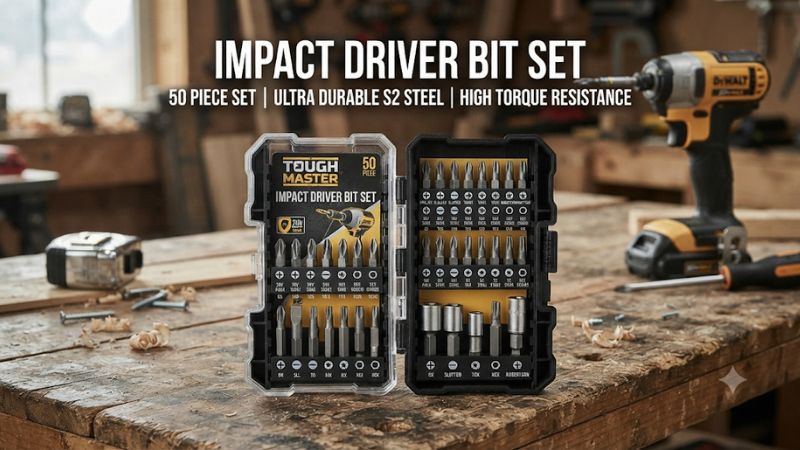
Unlike a conventional drill/driver, an impact driver combines rotational movement with repeated rotational impacts. These impacts deliver short bursts of torque to help turn stubborn fasteners and drive screws into demanding materials.
Because of this operating mechanism, impact drivers place substantial stress on the bit and its connection to the tool. A suitable bit set is designed to handle these repeated loads more effectively than ordinary screwdriver bits.
Most impact driver bit sets contain some combination of:
-
Phillips bits for cross-shaped screw heads.
-
Torx bits for star-shaped screw heads.
-
Square or Robertson bits for square-recess fasteners.
-
Slotted bits for traditional flat-head screws.
-
Hex bits for internal hex fasteners.
-
Magnetic nut drivers for compatible hex-head screws.
-
Magnetic bit holders and extension accessories.
Many sets also include different bit lengths, replacement tips, and storage cases.
The most important distinction is the impact rating. A standard screwdriver bit may physically fit an impact driver, but that does not mean it is designed to withstand repeated impact loading.
Impact-Rated Bits vs. Standard Screwdriver Bits
Impact-rated bits are the preferred choice for impact drivers because they are manufactured to handle repeated impact forces. Their construction often includes a specially designed torsion zone, heat treatment, and precision-machined tips.
How does an impact-rated bit work?
When an impact driver encounters resistance, its internal hammer-and-anvil mechanism delivers rotational impacts. These impacts create sudden torque peaks that place stress on the bit.
An impact-rated bit may use a narrowed or extended torsion section that flexes slightly under load. This helps absorb some of the stress rather than concentrating it entirely at the tip or shank.
Manufacturers use different engineering approaches:
-
DEWALT FlexTorq: Uses an extended torsion zone and precision-machined tips designed to improve engagement and durability.
-
Milwaukee SHOCKWAVE: Uses its Shock Zone design, customized heat treatment, and Wear Guard Tip technology.
-
Bosch Impact Tough: Uses an extended torsion zone, hardened core, and precision-engineered tips.
These are manufacturer-described design features, not proof that one brand always outlasts another. Actual bit life depends on the fastener, material, driver settings, operator technique, and workload.
Can you use regular screwdriver bits in an impact driver?
Some standard 1/4-inch hex-shank bits can physically fit an impact driver, but physical compatibility does not establish impact suitability.
Standard bits may wear, twist, or break more quickly under repeated impact loading. For frequent fastening, choose accessories explicitly identified by their manufacturer as impact-rated or impact-ready.
Also, do not assume that a standard drill bit is suitable for an impact driver simply because it has a hex shank. Drilling accessories and screwdriving bits have different designs and application requirements.
Types of Bits to Look for in a Set
The drive profile must match the screw head. Selecting the wrong profile or size can cause cam-out, where the bit slips out of the recess, potentially damaging both the fastener and the bit.
Common screwdriving profiles and their typical applications
| Bit type | Common sizes | Typical applications |
|---|---|---|
| Phillips (PH) | PH1, PH2, PH3 | General construction, furniture, household repairs |
| Torx (T) | T15, T20, T25, T30 | Decking, cabinetry, construction fasteners |
| Square (SQ/R) | SQ1, SQ2, SQ3 | Woodworking, cabinets, construction |
| Slotted (SL) | Different blade widths | Traditional flat-head screws |
| Hex | 1/8, 3/16, 1/4 in. | Machine screws, equipment assembly |
| Nut driver | 1/4, 5/16, 3/8 in. | Hex-head screws and compatible fasteners |
These are common examples, not a universal list. The correct size should always be determined by the fastener manufacturer’s specifications.
Phillips bits
Phillips bits are common in household repairs, furniture assembly, and general woodworking.
PH2 is a useful size to have because it is frequently used with general-purpose screws. However, a complete set should ideally include PH1 and PH3 for smaller and larger compatible fasteners.
One important consideration is the difference between Phillips and Pozidriv screws. Although their heads look similar, their recess geometry is different. Using a Phillips bit in a Pozidriv screw can result in poor engagement and increased slipping.
If you regularly work with European furniture hardware or imported fasteners, consider a set that includes PZ1, PZ2, and PZ3 bits.
Torx bits
Torx bits have a six-point star-shaped profile. They are commonly used in decking, cabinetry, woodworking, and construction applications.
Their geometry provides multiple contact surfaces between the bit and screw head. When correctly matched, this helps maintain engagement during powered fastening.
Useful sizes include:
-
T15 for smaller compatible fasteners.
-
T20 for general-purpose applications.
-
T25 for many decking and construction screws.
-
T30 for larger compatible fasteners.
Do not assume that all Torx screws use the same size. Check the screw packaging or manufacturer specifications before selecting a bit.
Square-drive bits
Square-drive bits, also called Robertson bits, are useful for woodworking, cabinetry, and construction.
Their square profile can provide stable engagement when the bit matches the fastener correctly. SQ2 is a practical size for many common applications, while SQ1 and SQ3 provide additional coverage.
They are particularly useful when repeatedly driving compatible screws into wood.
Hex bits and nut drivers
Hex bits fit screws with internal hexagonal recesses, while nut drivers engage compatible external hex-head fasteners.
These accessories are useful for equipment assembly, furniture hardware, automotive maintenance, and sheet-metal fastening.
A set containing magnetic nut drivers can be more versatile than one containing only screwdriver bits. However, verify the nut driver’s actual size and the fastener’s external dimensions before use.
How to Choose the Right Impact Driver Bit Set
Choosing a suitable set requires more than checking the piece count. Consider the following factors before making a purchase.
1. Check the impact rating and material
Start by checking whether the manufacturer explicitly identifies the bits as suitable for impact drivers.
Common construction materials and design features include:
-
S2 steel: A tool-steel grade commonly used in screwdriver bits. Its performance depends on heat treatment and final hardness.
-
Modified alloy steel: Some manufacturers use proprietary steel formulations to balance strength, toughness, and wear resistance.
-
Torsion zones: Designed to absorb some of the rotational stress generated during impact operation.
-
Precision-machined tips: Help the bit fit the screw recess more accurately.
Material names alone do not establish overall quality. A well-designed and properly heat-treated bit is generally more important than choosing a set based only on an advertised steel grade.
2. Choose the right bit lengths
Bit length affects access, clearance, and control.
| Bit length | Best use | Main consideration |
|---|---|---|
| 1 inch | General fastening with a compatible holder | Compact and easy to store |
| 2 inches | Recessed screws and improved access | Useful for everyday versatility |
| 3 inches or longer | Deep or obstructed fastening locations | May require additional control and clearance |
Short insert bits are convenient and economical to replace. They normally require a compatible bit holder when used with an impact driver’s chuck.
Longer power bits can eliminate the need for a separate holder and help reach recessed fasteners. However, extra length does not automatically improve performance.
For most homeowners, a combination of 1-inch insert bits, a magnetic holder, and several 2-inch power bits is a sensible arrangement.
3. Check the shank and chuck compatibility
Most conventional impact driver bit sets use a 1/4-inch hex shank.
Many impact drivers feature a 1/4-inch hex quick-release collet designed for compatible hex-shank accessories. However, always check the tool’s manual because chuck designs and accessory requirements can differ.
Pay attention to the following:
-
Shank dimensions and profile.
-
Whether the bit is an insert bit or power bit.
-
Whether a separate holder is required.
-
Whether the holder has an appropriate retention mechanism.
-
Whether extensions and adapters are rated for the intended application.
A magnetic holder should not be treated as a substitute for correct mechanical retention. Check that the bit is securely seated before operating the tool.
4. Evaluate the set contents instead of the piece count
A 100-piece set is not necessarily better than a 30-piece set.
Some large sets contain repeated low-demand sizes, multiple accessories that are rarely used, or ordinary drill bits that are not suitable for impact applications.
Before purchasing, check whether the set contains:
-
Multiple PH2 and other frequently used sizes.
-
Useful Torx and square-drive profiles.
-
Different bit lengths.
-
A magnetic bit holder.
-
Replacement bits for frequently used sizes.
-
Nut drivers if your projects require them.
For general home improvement, a smaller set with useful profiles and reliable construction may offer better value than a large assortment with unnecessary accessories.
5. Consider tip precision and durability
A good bit should fit snugly into the matching screw recess without excessive movement.
Poorly fitting bits can slip under load, especially when driving screws into dense wood or working with harder materials.
Look for precision-machined tips and clear size markings. These features make it easier to select the correct accessory and reduce the risk of using an incorrectly sized bit.
Durability also depends on how the bit is used. Excessive force, incorrect alignment, worn fasteners, and unsuitable impact settings can shorten its service life.
6. Choose a practical storage case
A storage case helps protect accessories and keeps frequently used sizes accessible.
Useful case features include:
-
Secure bit retention.
-
Clearly marked size positions.
-
Easy access to frequently used bits.
-
Space for replacement accessories.
-
A durable latch and protective housing.
If you already use a modular workshop storage system, check whether the bit-set case is compatible with that system. Brand names alone do not establish compatibility between different generations of organizers.
Which Impact Driver Bit Set Is Suitable for Your Projects?
The best configuration depends on the materials and fasteners you work with most often.
| User or application | Recommended set contents | Why it makes sense |
|---|---|---|
| Homeowner | PH1, PH2, PH3, T20, T25, SQ2 | Covers many common household fastening tasks |
| DIY woodworker | PH2, SQ1, SQ2, T20, T25, 2-inch bits | Supports furniture and woodworking projects |
| Deck builder | T20, T25, T30, longer power bits | Covers common Torx fastening requirements when specified by the screw manufacturer |
| Cabinet installer | PH2, PZ2, SQ2, T15, T20 | Provides options for different cabinet hardware |
| Maintenance technician | Phillips, Torx, hex bits, nut drivers | Supports a wider variety of equipment fasteners |
These are suggested configurations rather than universal requirements. Always match the bit to the actual fastener.
Should you buy a small or large set?
A small set is usually sufficient if you perform occasional household repairs and already know which screw profiles you use.
A larger set makes more sense when you regularly encounter different fasteners, work across multiple materials, or need replacement bits readily available.
For professional use, consider purchasing a quality core set and adding specialized bits separately. This can be more practical than carrying a large collection of accessories that rarely leave the case.
Common Mistakes When Using an Impact Driver Bit Set
Even a high-quality impact-rated bit can fail prematurely if it is used incorrectly. Avoid these common mistakes to improve fastening accuracy and reduce accessory wear.
Using the wrong bit size
A bit that is too small may move inside the screw recess, damaging the fastener and wearing down its tip.
Always check the screw head before operating the impact driver. The bit should engage fully without excessive movement.
Confusing Phillips and Pozidriv
Phillips and Pozidriv profiles are not interchangeable. They may appear similar, but their geometry differs.
Use the profile specified for the fastener rather than choosing whichever bit seems to fit.
Applying excessive pressure
An impact driver does not need excessive downward force to operate effectively.
Maintain a straight alignment between the bit and screw. Apply enough pressure to maintain engagement without forcing the tool into the fastener.
If the bit repeatedly slips, stop and check the size, alignment, and condition of the screw head.
Continuing to use worn bits
A worn or damaged bit can increase cam-out and damage screw heads.
Inspect frequently used bits for rounded tips, cracks, twisting, and other visible damage. Replace damaged accessories instead of continuing to use them.
How to Maintain and Store Impact Driver Bits
Proper maintenance helps keep bits in usable condition and makes it easier to identify damaged accessories.
Follow these practical recommendations:
-
Clean after use: Remove wood dust, metal particles, and debris with a dry cloth or suitable brush.
-
Inspect the tips: Check for rounded edges, deformation, cracks, and unusual wear.
-
Check the shanks: Do not use bits with visibly bent or damaged hex sections.
-
Keep profiles separated: Return accessories to their labeled positions to avoid mixing sizes.
-
Store in a dry location: Protect steel accessories from moisture and corrosive workshop conditions.
-
Replace damaged bits: Do not attempt to repair cracked or deformed impact bits.
Before changing accessories, release the trigger and follow the manufacturer’s instructions for safely removing the bit. Disconnect the battery where the tool design and manual require it.
Avoid using damaged magnetic holders or extensions. A poorly retained accessory can become dislodged during operation.
Safety Tips for Using Impact Driver Bits
Impact drivers are powerful tools, and correct accessory selection does not eliminate operating hazards.
Follow these precautions:
-
Wear appropriate safety glasses or goggles to protect against flying debris.
-
Use hearing protection when required by the noise level and working conditions.
-
Secure the workpiece with clamps when practical.
-
Keep hands away from the rotating bit and fastening area.
-
Maintain stable footing and a comfortable working position.
-
Keep loose clothing, jewelry, and long hair away from moving parts.
-
Use the correct accessory for the fastener and application.
-
Follow the impact driver’s operating instructions and avoid bypassing safety features.
When working with metal, wood, or other materials, consider additional hazards such as sharp edges, flying particles, and dust.
Stop operating the tool if the bit cracks, the holder becomes loose, or the accessory behaves unusually. Remove the battery before inspecting or changing accessories when required by the manufacturer’s instructions.
Frequently Asked Questions
1. What is the best type of bit set for an impact driver?
An impact-rated bit set with a 1/4-inch hex shank is a good starting point for most impact drivers. Look for Phillips, Torx, and square-drive sizes that match your regular fasteners, along with a compatible magnetic holder.
2. Are impact driver bits interchangeable between brands?
Most standard 1/4-inch hex-shank impact-rated bits can be used with compatible impact drivers from different manufacturers. However, verify the shank and retention requirements in your tool manual before purchasing.
3. How long do impact driver bits last?
Impact driver bit lifespan depends on the bit’s construction, fastener type, material, workload, and operating technique. There is no universal replacement interval. Inspect frequently used bits and replace them when their tips become worn, cracked, or deformed.
4. Can I use an impact driver bit set with a regular drill?
Yes, compatible 1/4-inch hex-shank impact-rated screwdriver bits can generally be used in a drill/driver with a suitable chuck. Check the drill’s chuck specifications and ensure the bit is securely held before operation.
Final Thoughts
Choosing the right impact driver bit set is about matching accessory quality, drive profiles, sizes, and lengths to the fastening work you actually perform. A large collection is not essential if it contains profiles you rarely use.
For general DIY and home improvement, prioritize impact-rated bits with a compatible 1/4-inch hex shank, useful Phillips and Torx sizes, a few square-drive options, and a reliable magnetic holder. Woodworkers and construction professionals may benefit from additional long power bits, nut drivers, and specialized profiles.
Most importantly, match every bit to its fastener, inspect accessories regularly, and follow the impact driver’s operating instructions. These simple practices help reduce premature bit wear, protect screw heads, and make fastening work more consistent.
Related guides
More from Amazon
Programs that pair well with the guide above. Offers and eligibility are set by Amazon and may change.
A free business account with business pricing and bulk-buying tools for work, shop or home office.
Create a business accountFree shipping on eligible items, Prime Video and more. Eligible new members can start with a free trial.
Start a Prime free trialAudiobooks and podcasts to listen to on the go. Eligible new members can start with a free trial.
Try Audible freeAd-free music streaming. Eligible new subscribers can start with a free trial.
Try Music Unlimited freeAs an Amazon Associate we earn from qualifying purchases.

Write Your Review
No reviews yet. Be the first to share your experience!