What's inside
- Best Drill Bits for Stainless Steel at a Glance
- 1. Milwaukee RED HELIX Cobalt Drill Bit Set — Best Overall
- 2. Bosch CO14B 14-Piece Cobalt M42 Set — Best Compact M42 Set
- 3. Bosch CO14 Cobalt Set — Best for General Workshop Use
- 4. Milwaukee RED HELIX Cobalt Individual Bits — Best for Replacements
- 5. Milwaukee Cobalt Step Drill Bits — Best for Larger Holes in Thin Sheet
- How We Selected These Drill Bits
- How to Choose the Best Drill Bits for Stainless Steel
- How to Drill Stainless Steel Without Damaging the Bit
- Frequently Asked Questions
- Final Verdict
As an Amazon Associate I earn from qualifying purchases. This post may contain affiliate links at no extra cost to you.
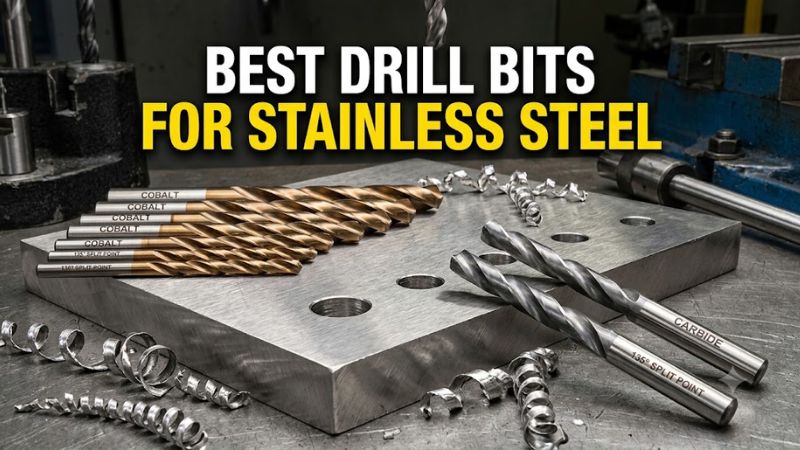
The best drill bits for stainless steel are generally cobalt-alloy high-speed steel (HSS-Co) twist bits, particularly for drilling holes in common stainless grades such as 304 and 316. For most DIYers and home workshops, a quality cobalt set with a sharp cutting point, suitable sizes, and a secure shank offers the best balance of versatility and cost.
Best Drill Bits for Stainless Steel at a Glance
| Product | Best for | Key specifications | Compatibility | Main limitation |
| Milwaukee RED HELIX 29-Piece Cobalt Set | Best overall for varied metalworking jobs | 29-piece set; cobalt bits; 135° split-point geometry on the product family | Compatible drill/drivers with a suitable chuck | Larger set costs more than buying a few individual bits |
| Bosch CO14B 14-Piece Cobalt M42 Set | Best compact M42 set | 14 pieces; M42 cobalt; sizes from 1/16 to 1/2 inch | Drill/drivers with compatible chucks | Limited size selection and no duplicate of every size |
| Bosch CO14 14-Piece Cobalt Set | General-purpose workshop drilling | 14 pieces; fractional sizes from 1/16 to 1/2 inch | Compatible drill/drivers | Not the same M42 designation as the CO14B |
| Milwaukee RED HELIX Cobalt Individual Bits | Replacing frequently used sizes | Individual bits; 135° split point; 3-flat reduced shank on the cited 25/64-inch model | Drill chuck that accepts the specified shank | Buying several individual bits may cost more than a set |
| Milwaukee Cobalt Step Drill Bits | Larger holes in thin stainless sheet | Multiple stepped diameters; #9 model covers 7/8–1-1/8 inches | Compatible drill/drivers | Not a substitute for a conventional twist bit in every hole size or material thickness |
Price note: US prices and availability vary by retailer and package. No current US retail price is listed here because a reliable, directly comparable price for each exact product was not established. Check the linked manufacturer pages and authorized retailers before purchasing.
1. Milwaukee RED HELIX Cobalt Drill Bit Set — Best Overall
Best for home workshops, repairs, and frequent stainless-steel drilling
The Milwaukee RED HELIX 29-Piece Cobalt Drill Bit Set is the strongest all-around choice for users who need a range of drill sizes for metalworking rather than a single specialty bit.
Milwaukee specifies a QUAD EDGE tip, variable-helix flute geometry, a thicker tapered web, and a three-flat Secure-Grip shank on this product family. These design features address starting accuracy, chip removal, bit strength, and slippage in the chuck. The manufacturer identifies stainless steel, cast iron, and thick metal among its intended hard-metal applications.
- Multiple sizes for different fasteners, brackets, and fabrication tasks.
- Geometry designed to help remove chips and manage heat.
- Three-flat shanks on applicable sizes help resist spinning in the chuck.
- Intended for use with drill/drivers, without requiring a proprietary battery platform.
Limitations
- The manufacturer’s claim of up to 15 times the life of black-oxide bits is a comparative marketing claim, not a guaranteed result for every stainless alloy or drilling condition.
- A full set may be unnecessary if you only need one or two hole diameters.
- Small drill bits still require careful alignment and controlled pressure to avoid breakage.
Buy if: You regularly drill different hole sizes in stainless steel, steel brackets, and other hard metals.
Skip if: You only need a few holes in thin sheet metal or want to make large-diameter holes with a step bit.
2. Bosch CO14B 14-Piece Cobalt M42 Set — Best Compact M42 Set
Best for buyers who prefer an explicitly identified M42 cobalt grade
The Bosch CO14B contains 14 cobalt drill bits, including fractional sizes from 1/16 inch to 1/2 inch. The set includes two 1/8-inch bits and one of each of the other listed sizes.
Its main advantage is the clearly identified M42 cobalt construction. M42 is a high-speed steel alloy containing approximately 8% cobalt. Cobalt improves hot hardness, helping a cutting edge retain its hardness at elevated temperatures. That is useful when drilling heat-sensitive cutting edges into stainless steel, provided speed, feed, and lubrication are appropriate.
Bosch lists the set for rotary drills and drivers and describes its cobalt bits as suitable for drilling stainless steel. Its three-flat shank design promotes grip on applicable larger bits. Bosch product details.
Strengths
- M42 grade is explicitly specified.
- A useful fractional-inch range for common workshop tasks.
- Compact 14-piece assortment.
- Compatible with suitable three-jaw drill chucks.
Limitations
- The set does not provide every fractional size or duplicates of every bit.
- M42 does not compensate for excessive speed, inadequate feed, or a dull cutting edge.
- The higher cobalt content alone does not establish that it will outperform every M35 bit; geometry, heat treatment, and operating conditions also matter.
Buy if: You want a compact cobalt set and specifically prefer M42 high-speed steel.
Skip if: You need a broader size selection or routinely drill many holes in just one diameter.
3. Bosch CO14 Cobalt Set — Best for General Workshop Use
Best for DIY users who want a versatile metal-drilling assortment
The Bosch CO14 14-Piece Cobalt Metal Drill Bit Set covers the same listed fractional-inch sizes as the CO14B. It is intended for rotary drills and drivers and is marketed for stainless-steel drilling.
The important distinction is the model designation: CO14 and CO14B are separate products, and Bosch specifically identifies the CO14B as its M42 version. Do not assume the CO14 has the same M42 material specification merely because both sets carry the cobalt name.
For a home workshop, this assortment is a sensible starting point if you need small holes for screws and fasteners as well as larger holes up to 1/2 inch. It can also serve as a general metal-drilling set for projects involving ordinary steel and other compatible materials.
Strengths
- Covers a useful selection of common fractional-inch diameters.
- Suitable for users who work across different metal projects.
- Available as a distinct option alongside Bosch’s M42 set.
Limitations
- The set’s exact alloy grade should be checked against the current product listing.
- No single set is ideal for every sheet-metal thickness or hole geometry.
- Frequent users may benefit from buying replacement bits in their most-used sizes.
Buy if: You want a general cobalt set for occasional stainless-steel drilling and broader workshop jobs.
Skip if: Your purchasing requirement specifically calls for M42 and you want that grade confirmed on the product listing.
4. Milwaukee RED HELIX Cobalt Individual Bits — Best for Replacements
Best for replacing worn or broken sizes without buying another set
If you already own a useful drill-bit assortment, buying individual bits can be more economical than purchasing a second case. Milwaukee offers individual RED HELIX cobalt bits in a range of diameters.
For example, the manufacturer’s 25/64-inch RED HELIX cobalt drill bit has a 135-degree split point, variable-helix flute geometry, and a 3/8-inch reduced three-flat shank. Milwaukee lists wood, stainless steel, metal, plastic, and PVC among its applications for this particular model.
The reduced shank is an important specification: the bit’s cutting diameter is 25/64 inch, but its shank diameter is 3/8 inch. Confirm that the drill chuck accepts the shank and that the bit length suits the workpiece.
Strengths
- Lets you replace frequently used sizes individually.
- The cited model has a split point intended to help it start accurately.
- Useful when you already have a complete set but one size is missing.
Limitations
- Buying individual bits across many sizes can become more expensive than purchasing a set.
- The reduced-shank configuration differs from the cutting diameter.
- The cited 25/64-inch model is not a universal choice for every hole size.
Buy if: One or two frequently used bits need replacing.
Skip if: You are starting from scratch and need a wide range of sizes.
5. Milwaukee Cobalt Step Drill Bits — Best for Larger Holes in Thin Sheet
Best for sheet-metal enclosures, panels, and similar thin stock
A step bit is a different tool from a conventional twist drill. Rather than cutting one fixed-diameter hole, its stepped profile enlarges a hole through successive diameters. This makes it useful for thin sheet metal where several larger hole sizes may be needed.
Milwaukee’s Cobalt Step Drill Bit range is designed for stainless steel and other sheet-metal applications. The manufacturer’s #9 model covers diameters from 7/8 inch to 1-1/8 inches and is recommended for material up to 14 gauge. Confirm the exact product’s range and material limitations before use.
A step bit can reduce the need to change between multiple conventional bits when enlarging holes in suitable sheet. However, it is not the right choice for every thick plate, deep hole, or precision-machining operation.
Strengths
- Multiple hole diameters in one accessory.
- Designed for larger holes in appropriate sheet-metal applications.
- Useful for enclosures, panels, and installation work.
Limitations
- Intended material thickness and diameter range vary by model.
- Requires stable workpiece support and control to prevent the sheet from spinning.
- Not a replacement for a conventional twist bit when drilling deep or thick stainless stock.
Buy if: Your main job is making larger holes in thin stainless sheet.
Skip if: You primarily drill small holes, thick plate, or deep holes that require conventional twist bits.
How We Selected These Drill Bits
This roundup prioritizes products with identifiable manufacturer specifications and a clear use case for stainless steel. The selection considers alloy designation where available, size range, cutting-point geometry, shank compatibility, intended applications, and suitability for typical DIY or workshop jobs.
The research was conducted on October 19, 2026. Manufacturer product pages were used to verify listed features and dimensions. Independent coverage from Pro Tool Reviews provides additional context on the trade-offs between cobalt drill bits and standard high-speed steel.
No controlled head-to-head drilling results were available for all five selections under identical conditions. Accordingly, the ranking reflects application fit and published specifications, not a claim that one product drills a fixed number of holes faster or lasts longer in every stainless-steel grade.
How to Choose the Best Drill Bits for Stainless Steel
The right bit depends on the stainless-steel grade, hole diameter, material thickness, and frequency of use. For most home projects, a quality cobalt twist bit is the most versatile starting point.
1. Choose the right bit material
| Bit material | Best application | Main trade-off |
| Standard HSS | Occasional drilling in easier metals and suitable lower-demand jobs | Cutting edge loses hardness more readily under high heat |
| M35 cobalt HSS | General stainless-steel drilling and workshop fabrication | Less hot-hardness margin than M42 |
| M42 cobalt HSS | Demanding metalworking where heat resistance and wear life matter | Can cost more; the harder cutting material may be less tolerant of misuse |
| Carbide | Appropriate production machining with suitable machine rigidity and cutting conditions | More brittle and generally less forgiving in handheld applications |
M35 typically contains around 5% cobalt, while M42 typically contains around 8%. These are alloy grades, not simply surface coatings. A gold-colored finish alone does not establish that a bit contains cobalt.
For general DIY drilling, start with M35 or a reputable cobalt set whose material specification is clearly documented. Consider M42 when the work justifies the additional cost and the drilling setup can take advantage of its properties.
2. Look at the cutting-point geometry
A 135-degree split point is a useful feature for many stainless-steel drilling jobs because it helps the bit start accurately and reduces walking. However, it is not a universal requirement: other point geometries can suit particular bit designs, machines, and materials.
For thin sheet, secure the workpiece and use an appropriate punch or spotting method where suitable. Avoid allowing the drill bit to skate across the surface.
3. Match the bit to the hole diameter
- Small holes: Use a sharp twist bit in the required diameter. Small bits are particularly vulnerable to breakage from misalignment or excessive pressure.
- Medium holes: A standard cobalt twist bit is generally versatile for brackets, hardware, and workshop fabrication.
- Larger holes in thin sheet: Consider a cobalt step bit if the manufacturer’s specified diameter range and material thickness cover the job.
- Thick plate or deep holes: Check the bit’s working length and the manufacturer’s recommended drilling method. Production work may call for a more specialized drill geometry or machine setup.
4. Check the shank and drill compatibility
Most conventional cobalt twist bits fit compatible three-jaw drill chucks. Some models use a reduced or three-flat shank to improve grip.
Before buying, verify the shank diameter, cutting diameter, usable length, and chuck capacity. You do not need a particular battery brand for a standard twist bit; what matters is whether the drill can hold the shank securely and operate at a suitable speed.
A cordless drill/driver can handle many home stainless-steel projects. For repetitive drilling or larger holes, a drill press may offer better alignment and control. A hammer setting is not appropriate for ordinary metal drilling.
How to Drill Stainless Steel Without Damaging the Bit
Even an expensive cobalt bit can dull quickly if the drilling technique creates excessive heat. Stainless steel can work-harden, so a bit that rubs without cutting can make the remaining material harder to drill.
- Secure the workpiece. Clamp the stainless steel firmly to a stable support. Never hold a small metal piece in your hand while drilling.
- Mark the hole. Measure carefully and use a suitable center punch or spotting technique where appropriate.
- Select a suitable speed. Use a conservative rotational speed appropriate to the bit diameter, stainless grade, and drilling setup. Larger diameters generally require lower RPM than smaller ones.
- Apply cutting fluid. Use a cutting lubricant suitable for the stainless steel and the bit manufacturer’s instructions. Keep lubricant away from electrical components and follow its safety directions.
- Apply steady feed pressure. Allow the cutting edges to remove material rather than letting the bit spin against the surface without advancing. Avoid excessive force that could break the bit.
- Clear chips safely. Stop the drill before removing accumulated chips or adjusting the workpiece. Do not clear metal chips with bare fingers.
- Inspect the hole and bit. Stop if the bit squeals, stops cutting, overheats, or shows signs of damage. Allow the workpiece and accessory to cool safely before handling.
Wear appropriate eye protection and follow the drill’s manual. Metal chips can be sharp and hot, and loose clothing, hair, and gloves can become entangled in rotating equipment. Choose any additional protective equipment according to the task and manufacturer guidance.
Frequently Asked Questions
Are cobalt drill bits better than titanium-coated bits for stainless steel?
Yes, cobalt-alloy HSS is generally the better starting choice for repeated stainless-steel drilling because its heat-resistant properties extend through the cutting material rather than depending on a surface coating. Titanium-coated HSS can suit less demanding work, but performance depends on the underlying steel, coating, geometry, and operating conditions.
What drill-bit angle is best for stainless steel?
A 135-degree split point is a useful option for many stainless-steel applications because it helps the bit start accurately. Other geometries can also work, so confirm the point design recommended for the exact bit and drilling setup.
Can I drill stainless steel with a regular cordless drill?
Yes, a regular cordless drill/driver can handle many stainless-steel jobs when fitted with a suitable sharp metal-drilling bit. Use an appropriate speed, steady feed pressure, suitable cutting lubricant, and a securely clamped workpiece. For repetitive or demanding work, a drill press may offer better control.
Why do my drill bits keep burning out in stainless steel?
The most common causes include excessive rotational speed, insufficient feed pressure, poor lubrication, a dull bit, or a setup that allows the bit to rub instead of cut. Stainless steel can work-harden under these conditions. Stop if the bit ceases cutting, inspect it after the tool has stopped, and correct the drilling setup before continuing.
Final Verdict
For most home workshops, the Milwaukee RED HELIX Cobalt Drill Bit Set is the best all-around choice among these selections because it offers a broad assortment and manufacturer-documented features for hard-metal drilling. Choose the Bosch CO14B if you specifically want an M42 cobalt set in a compact fractional-inch assortment.
If you mostly drill larger holes in thin stainless sheet, Milwaukee’s cobalt step bits are worth considering instead of buying a larger collection of conventional twist bits.
Whichever option you choose, match the bit to the material and hole size, use suitable lubrication and speed, and keep the workpiece secure. Those decisions matter as much as the bit’s alloy designation.