What's inside
As an Amazon Associate I earn from qualifying purchases. This post may contain affiliate links at no extra cost to you.
Start with the cut, not the advertised power
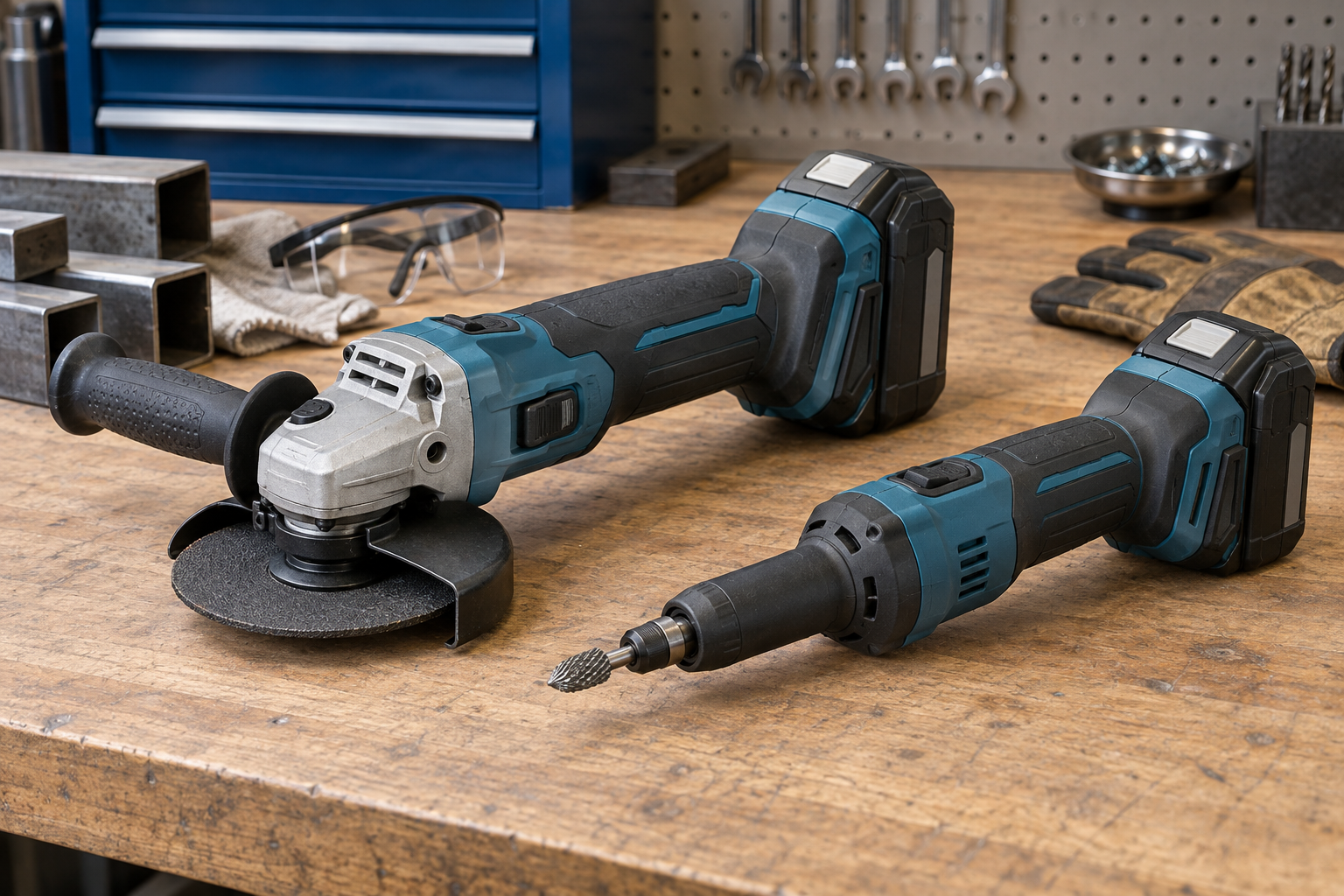
For occasional cuts in 3/8-inch rebar or mild-steel angle iron, a compact 4½-inch cordless grinder is usually enough. It is easier to control overhead and costs less than a high-output kit. For repeated cuts, thick angle, or work where corded speed matters, a larger 5-inch grinder with a high-output battery is less likely to bog down.
Most cordless angle grinders turn at roughly 8,000 to 10,000 rpm, but no-load speed alone does not tell you how quickly a tool will cut under load. Battery voltage, motor design, battery capacity and the grinder’s electronics all affect sustained output. A small battery may fit the tool but deliver less power and run time than the manufacturer’s high-output pack.
Choose wheel size and guard capacity
A 4½-inch grinder is a good default for rebar and common angle iron. Its thin cutoff wheels are widely available, and the tool is manageable in tight spaces. A 5-inch grinder can use larger wheels, allowing a deeper cut per pass, but is typically heavier and may need a larger battery to maintain its advantage. Check the tool’s manual: wheel diameter, arbor size and guard must match. Never remove or modify the guard to fit a larger wheel.
Cutoff wheels are thin and intended for cutting, not grinding sideways. For steel, use a wheel marked for ferrous metal and rated for at least the grinder’s maximum rpm. A common 4½-inch wheel is 0.045 inch thick; thinner wheels can cut quickly but are easier to damage if twisted. Keep a spare or two on hand, since a pinched wheel can break.
Match the grinder to a battery platform
If you already own cordless tools, staying on that battery platform is often the best value. It avoids buying another charger and gives you more choices for batteries. But do not assume every pack on a platform performs equally: a compact 2.0 Ah pack is light, while a high-output 5.0 Ah or larger pack generally sustains a grinder better. The exact pack recommendations vary by brand and tool.
Battery capacity in amp-hours is a run-time measure, not a direct measure of cutting power. A grinder can still feel weak with a large battery if the pack cannot supply enough current, or if it is nearly empty, cold, or worn. If buying into a platform for this job, compare a 4½-inch cordless grinder kit with the price of a bare tool plus a compatible high-output battery and charger.
Compare practical options
| Option | Best for | Trade-off |
|---|---|---|
| 4½-inch grinder, compact battery | A few cuts, light duty, portability | More slowdown and shorter run time under heavy load |
| 4½-inch grinder, high-output battery | Regular rebar and angle-iron cuts | Heavier and more expensive than a compact setup |
| 5-inch grinder, high-output battery | Repeated cuts or material that benefits from extra depth | More bulk; check wheel availability and total kit cost |
| Corded grinder | Long sessions near an outlet | Needs a cord and suitable power access |
For one short project, a basic kit is fine; there is little reason to pay a premium for a larger platform battery if the grinder will sit unused. For a day of cutting, a second charged pack can be more useful than buying the grinder with the highest advertised speed. A compatible high-output battery is worth considering if your existing compact pack repeatedly triggers the tool’s overload protection.
Features worth paying for
Look for a tool with a solid guard, a side handle that can be fitted on either side, and a spindle lock for wheel changes. A paddle switch can be easier to shut off quickly than a sliding switch, though personal preference and work position matter. Electronic brake, kickback control and restart protection can add useful control: restart protection helps prevent the grinder from starting unexpectedly after a battery is reinstalled with the switch on.
Overload protection is not a substitute for adequate battery capacity or a sharp, undamaged wheel. If the tool repeatedly stops, do not keep forcing it. Let it cool, check the battery, and inspect the wheel for damage or pinching. Compare bare-tool and kit prices carefully; a bare tool is only a bargain if you already have compatible batteries and a charger.
Cut rebar and angle iron safely
Clamp the stock securely so the cut cannot close on the wheel. Support long pieces on both sides, but position the supports to leave the cut free to open rather than pinch. Mark the line, stand out of the wheel’s plane, and let the grinder reach full speed before touching the metal. Use light, steady pressure. For thick angle iron, cut each leg deliberately and reposition the work rather than twisting the wheel to finish the corner.
Wear safety glasses under a face shield, hearing protection, gloves that fit, and clothing that will not catch on the tool. Sparks can ignite dust, fuel vapors and nearby materials; clear the area and keep a suitable fire extinguisher nearby. Inspect the wheel before fitting it, use the supplied guard, and unplug the charger or remove the battery before changing accessories. If you expect many cuts in thick stock, a portable band saw or a cutoff saw may be faster and produce less heat and burrs than a hand-held grinder.
Related guides
- Longest Lasting Lawn Mower Battery: AGM vs Lithium vs Flooded Lifespan and Cost per Season
- Duralast Gold Lawn Mower Battery Review: U1 Fit, CCA and When to Pay for AGM
- Greenworks Pro 80V 21-Inch Mower Review: Runtime Math, Push vs Self-Propelled and Yard Fit
- Bosch High Pressure Washer Gun Replacement: Fittings, Adapters and What Fits Your Model