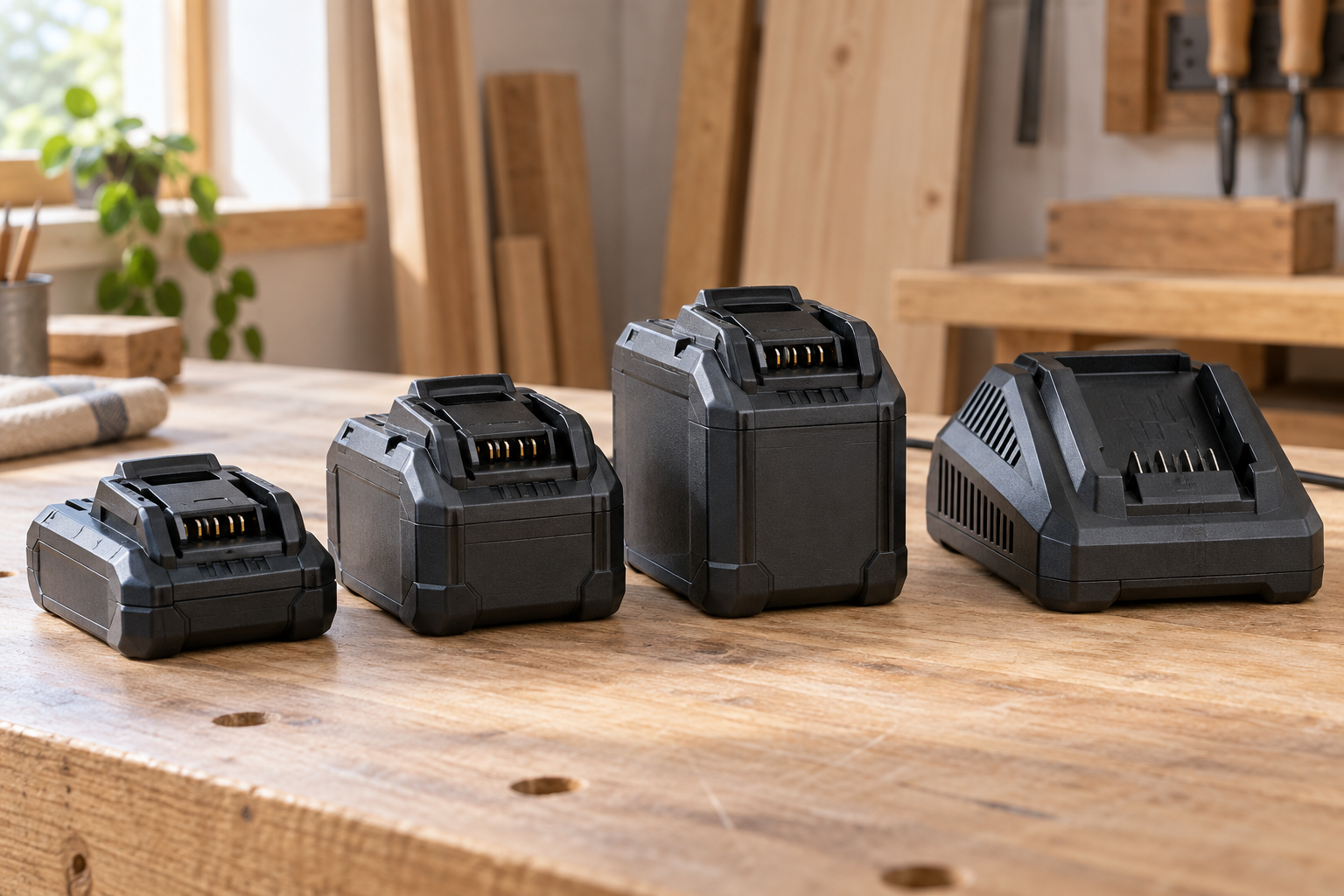
What's inside
As an Amazon Associate I earn from qualifying purchases. This post may contain affiliate links at no extra cost to you.
Yes. Cordless tool batteries from the same brand can have substantially different electronics, even when they slide onto the same tool rail and carry the same nominal voltage. The plastic case and connector may be shared across a battery platform, while the cells, protection board, temperature sensors, data contacts, and firmware vary by capacity and generation.
That does not automatically make one battery unsafe or incompatible. It does mean that “same brand” is not enough information when you are choosing a battery, charger, or replacement pack.
What is inside a cordless battery?
A modern tool battery is more than a group of lithium-ion cells. Most packs include a battery-management system (BMS), which monitors cell voltage and temperature and controls charging and discharge. Some packs also communicate digitally with the tool and charger.
Common electronic parts include:
- Protection circuitry: disconnects the pack during overcharge, excessive discharge, short circuit, or excessive current.
- Temperature sensors: usually thermistors placed near the cells or on the circuit board.
- Cell-balancing components: help keep series-connected cells at similar voltages during charging.
- Current sensing: measures load and may help the pack calculate remaining capacity.
- Communication contacts: allow the tool, battery, and charger to exchange information.
- Firmware: in smart packs, software can control output, report faults, and identify the battery.
A compact 2.0Ah pack may use a different circuit board and current limit than a high-output 8.0Ah pack. Both can be sold as part of the same 18V or 20V MAX platform.
Why capacity changes the electronics
Capacity is measured in amp-hours, but amp-hours alone do not tell you how well a battery handles a power tool. A pack’s ability to deliver current depends on its cell type, cell count, internal resistance, bus bars, wiring, and BMS settings.
For example, a 5.0Ah pack made with five larger high-drain cells in parallel may deliver more current with less voltage sag than a 2.0Ah pack using two smaller cells in parallel. The larger pack may also have heavier conductors and a BMS designed for longer high-load operation.
Voltage sag can cause a tool to shut down even when the pack still shows charge. This is common with compact batteries used on grinders, saws, and high-torque impact tools. The battery protection circuit sees a temporary low-voltage condition and cuts output to protect the cells. A larger pack often solves the problem, but it is heavier and more expensive.
Cell chemistry and generation matter too. A newer high-output pack may use lower-resistance cells and improved thermal monitoring without changing the platform voltage or mounting system.
Same rail does not mean identical behavior
| Battery type | Typical strength | Likely limitation | Best use |
|---|---|---|---|
| Compact 1.5–2.0Ah | Light weight and low cost | More voltage sag under heavy loads | Drills, drivers, lights, light-duty fastening |
| Mid-size 4.0–5.0Ah | Good balance of runtime and output | Heavier than compact packs | General construction and maintenance |
| High-output 6.0–8.0Ah | Better sustained current and runtime | Higher price, weight, and charging time | Saws, grinders, rotary hammers, high-torque tools |
| Smart or connected pack | Detailed status and tool communication | More electronics and possible compatibility limits | Fleet management and newer connected tools |
Some tools will run with any mechanically compatible pack. Others use the communication terminals to check battery temperature, identity, or discharge capability. A tool may operate at reduced power, refuse to start, or display a fault if it does not receive the expected signal.
Battery and charger compatibility
Use the charger specified for the battery platform and battery type. A charger does not simply apply a fixed voltage until the pack is full. It normally uses a controlled charge profile and may rely on temperature and voltage signals from the pack.
Two batteries with the same nominal voltage can require different charge currents or charge decisions. A modern charger may charge several capacities safely because the battery reports its condition. Older or aftermarket packs may omit expected communication components, causing a charger to reject them or, in poorly designed cases, charge them incorrectly.
For replacement batteries, compare the exact platform, voltage class, physical interface, charger compatibility, and manufacturer’s approved battery list. These cordless tool replacement batteries are not interchangeable just because the label shows a similar voltage.
Aftermarket and rebuilt packs
Aftermarket batteries can be perfectly adequate for low-demand work, but quality varies more than it does with original packs. Two packs claiming the same 5.0Ah capacity may use different cells, a different BMS, or a capacity that is measured under unrealistic conditions.
Common failure modes include a pack that shuts off during startup, refuses to charge, overheats under load, or loses capacity after a few months. A poorly fitted connector can also cause intermittent power loss or arcing. Avoid packs with vague specifications, no cell or protection information, damaged housings, or unusually low prices.
The cheaper option is often fine for a drill, inspection light, or occasional screwdriving. For a circular saw, grinder, chainsaw, or rotary hammer, the cost of a reliable high-output battery is easier to justify. If you buy an aftermarket pack, use a charger intended for that platform and stop using the pack if it becomes swollen, unusually hot, cracked, or wet.
How to choose the right battery
Start with the tool’s manual, not just the battery label. Look for a recommended capacity or high-output designation. If the tool stalls or cuts out with a small pack, moving to a larger pack is usually more effective than buying another battery of the same size.
For occasional light work, a compact 2.0Ah tool battery keeps weight down. For all-day drilling and fastening, a 5.0Ah tool battery is usually the practical middle ground. Heavy saws and grinders benefit from a high-output cordless battery when the platform offers one.
Finally, inspect the contacts and housing before use. Keep terminals clean and dry, store packs away from extreme heat, and do not defeat the battery’s protection electronics. The battery that fits is not necessarily the battery that delivers the best performance—or the safest charging behavior—for your tool.
FAQ
What is inside a cordless battery?
Related guides
- Longest Lasting Lawn Mower Battery: AGM vs Lithium vs Flooded Lifespan and Cost per Season
- Duralast Gold Lawn Mower Battery Review: U1 Fit, CCA and When to Pay for AGM
- Greenworks Pro 80V 21-Inch Mower Review: Runtime Math, Push vs Self-Propelled and Yard Fit
- Bosch High Pressure Washer Gun Replacement: Fittings, Adapters and What Fits Your Model