
What's inside
As an Amazon Associate I earn from qualifying purchases. This post may contain affiliate links at no extra cost to you.
What Milwaukee CP and XC Batteries Mean
Milwaukee’s M18 battery names describe the pack’s size and capacity class. CP means “compact pack,” while XC means “extended capacity.” The label does not identify a single battery. An M18 CP pack might be a 1.5Ah, 2.0Ah, 3.0Ah, or 5.0Ah battery depending on the generation and product line. XC packs are generally larger, with common capacities of 3.0Ah, 4.0Ah, 5.0Ah, 6.0Ah, 8.0Ah, and 12.0Ah.
That makes the capacity number more useful than the CP or XC name alone. A 5.0Ah CP battery can store roughly the same energy as a 5.0Ah XC battery, but it is usually shorter and lighter. The internal cell layout and maximum output can still differ, so identical amp-hour ratings do not guarantee identical performance on demanding tools.
As an Amazon Associate we earn from qualifying purchases at no extra cost to you.


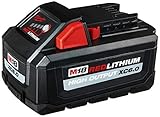
For a general replacement, compare the battery’s Ah rating, physical size, weight, and output class. If you are buying into the system, a Milwaukee M18 CP battery is usually the better match for compact drills, impact drivers, and lights.
Runtime: How Much Longer Does XC Last?
Runtime is primarily proportional to watt-hours. M18 batteries operate at about 18 volts nominally, so a rough energy estimate is:
watt-hours = nominal voltage × amp-hours
That gives a 2.0Ah pack roughly 36Wh, a 5.0Ah pack roughly 90Wh, and an 8.0Ah pack roughly 144Wh. Actual runtime is lower because tools are not perfectly efficient, batteries lose capacity under heavy loads, and the battery management system may shut the pack down before it is completely empty.
| Battery class | Approximate energy | Typical advantage | Main drawback |
|---|---|---|---|
| M18 CP 2.0Ah | 36Wh | Lightest and shortest setup | Short runtime on saws and grinders |
| M18 CP 3.0Ah | 54Wh | Good balance for drills and impacts | Less reserve than larger packs |
| M18 XC 4.0Ah | 72Wh | Noticeably longer runtime without being huge | More weight below the tool |
| M18 XC 5.0Ah | 90Wh | Strong all-around runtime and output | Bulky on compact tools |
| M18 XC 8.0Ah | 144Wh | Long runtime for saws and high-draw tools | Heavy and expensive |
There is no universal runtime figure in minutes. A drill making small pilot holes may run for hours with a 2.0Ah pack, while a compact circular saw cutting dense lumber can drain that same pack in a small number of cuts. A grinder, vacuum, rotary hammer, or high-output saw can also trigger thermal protection before the battery is empty.
Balance on Compact Tools
On a compact drill or impact driver, battery weight is at the bottom of the handle. Adding a large XC pack increases the tool’s total weight and shifts its balance toward the rear. That can be useful when driving long screws because the tool feels planted, but it is tiring during overhead work, cabinet installation, and repetitive fastening.
A typical M18 2.0Ah compact pack weighs around 1.5 pounds. A 5.0Ah XC pack is commonly around 2.1 pounds, and larger high-output packs can approach or exceed 3 pounds. The difference may sound small, but it is held at the end of your arm for every hole and fastener. On an impact driver used all day, the lighter pack is often the more productive choice.
Compact batteries also reduce interference. A larger XC pack can hit a workpiece, restrict access inside a cabinet, or prevent a drill from standing upright. On a right-angle drill or compact reciprocating saw, the extra length can make the tool awkward in tight framing or plumbing spaces.
For these jobs, a small M18 compact battery is often worth choosing even though it requires more frequent charging.
When an XC Battery Is the Better Choice
Choose an XC pack when the tool draws high current or when changing batteries interrupts the work. Circular saws, reciprocating saws, grinders, rotary hammers, impact wrenches, and vacuums benefit most. The larger pack provides more energy and generally maintains voltage better under load.
Voltage sag is a practical failure mode with small packs. A nearly full compact battery may run a drill normally, but a high-draw saw can slow down, flash a low-battery warning, or shut off when the blade binds. A larger XC pack may complete the same cut without tripping protection. This does not mean an XC pack makes a compact tool more powerful in every situation; it gives the tool more reserve before heat and voltage limits take over.
For saws and other high-drain tools, a 5.0Ah M18 XC battery is a sensible baseline. It offers a useful balance of runtime, output, cost, and weight. Move to an 8.0Ah or larger pack when long cuts, demolition, or vacuuming justify the extra mass.
Charging, Heat, and Battery Life
Large packs take longer to charge. A 2.0Ah battery can often be topped up during a short break, while a 5.0Ah or 8.0Ah pack may require substantially longer depending on the charger. If you own two batteries, pairing a compact pack with a larger XC pack can work better than buying two identical large batteries: use the light one for fastening and the XC pack for cutting.
Heat is harder on lithium-ion batteries than ordinary cycling. Do not immediately charge a pack that is hot from sawing or grinding; let it cool first. Likewise, stop using a battery that is swollen, cracked, leaking, or unusually hot. A battery that repeatedly shuts down under a normal load may be worn out, damaged, or mismatched to the tool. Do not bypass the protection electronics or use a physically altered pack.
Which Battery Should You Buy?
Buy CP batteries for compact drills, impact drivers, installation tools, lights, and occasional homeowner work. They are also the better choice when tool balance matters more than maximum runtime. The cheaper option is fine if you already keep a spare charged and the tool is used in short bursts.
Buy XC batteries for saws, grinders, rotary hammers, vacuums, and heavy fastening. For a mixed M18 collection, one or two 5.0Ah XC packs plus one or two small CP packs cover more situations than a collection made entirely of large batteries. Check the exact Ah rating and dimensions before ordering, since Milwaukee’s battery generations and output classes are not all the same.
FAQ
Runtime: How Much Longer Does XC Last?
Which Battery Should You Buy?
Related guides
- Longest Lasting Lawn Mower Battery: AGM vs Lithium vs Flooded Lifespan and Cost per Season
- Duralast Gold Lawn Mower Battery Review: U1 Fit, CCA and When to Pay for AGM
- Greenworks Pro 80V 21-Inch Mower Review: Runtime Math, Push vs Self-Propelled and Yard Fit
- Bosch High Pressure Washer Gun Replacement: Fittings, Adapters and What Fits Your Model