What's inside
As an Amazon Associate I earn from qualifying purchases. This post may contain affiliate links at no extra cost to you.
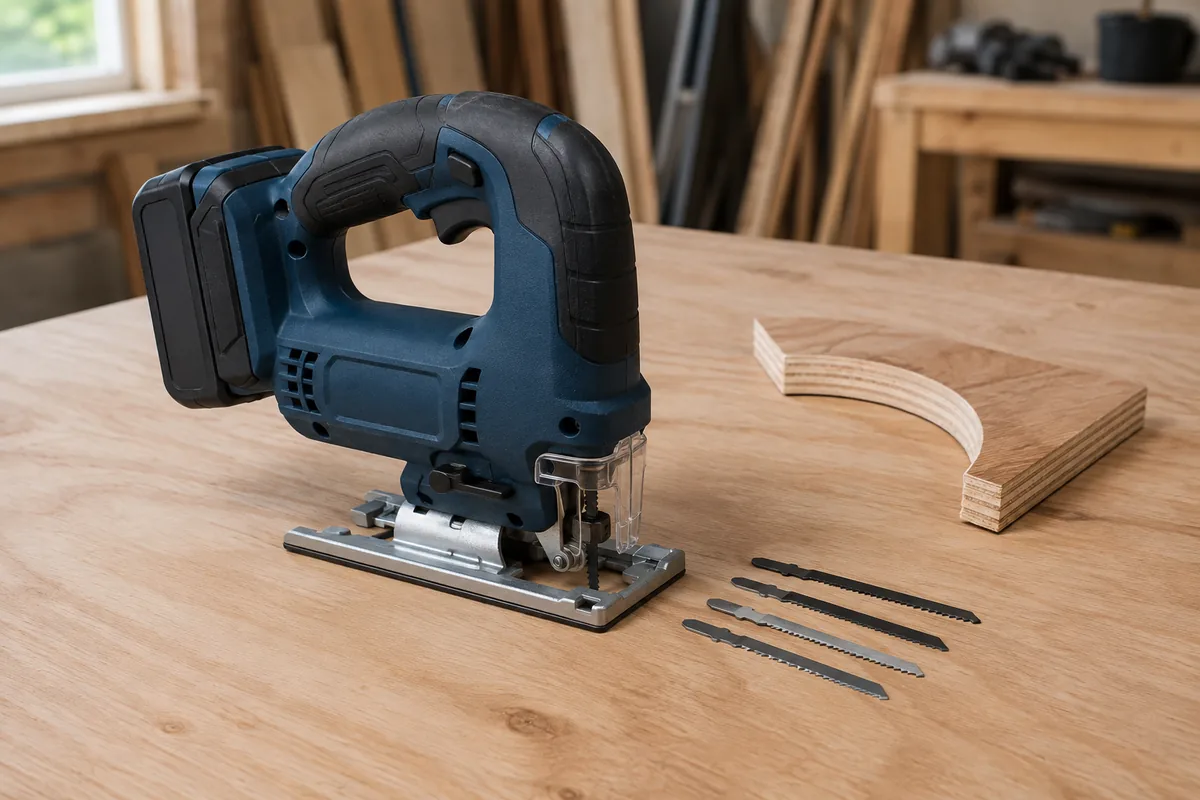
The right jigsaw blade depends on which face of the sheet you want clean, how thick the material is, and whether you value speed or edge quality. For laminate-faced panels, tooth direction matters as much as tooth count. For plywood, the main trade-off is between a fast cut and fewer splinters. A cordless jigsaw can handle both, but its orbital setting, blade fit and battery condition affect the result.
Start with the material and cut
“Laminate” can mean a thin decorative layer bonded to particleboard, MDF or plywood, or a separate sheet of plastic laminate. Check what is underneath the surface: a blade suitable for a laminate countertop may not be the best choice for a thick plywood panel. Also note the panel thickness and whether the visible face is on top or underneath. Many jigsaw blades cut on the upstroke, which tends to chip the top face.
For a straight cut in ordinary plywood, a general-purpose wood blade is often enough. If the edge will be visible or the sheet has a brittle veneer, use a finer-tooth blade and slow the feed. For a laminate-faced panel, a reverse-tooth blade can reduce chipping on the top face, but it pushes the saw away from the workpiece. Keep the shoe firmly planted and avoid forcing the saw.
Blade choices at a glance
| Blade type | Best use | Trade-off |
|---|---|---|
| Standard up-cut wood blade, about 6–10 TPI | Fast cuts in plywood; rough edges that will be hidden or sanded | More splintering on the top face |
| Fine-tooth wood blade, about 10–20 TPI | Slower, cleaner cuts in thin plywood and veneered panels | Can clog or burn if pushed too hard in thick stock |
| Reverse-tooth blade | Reducing chips on the top face of laminate-faced panels | Harder to control because cutting force lifts the shoe |
| Down-cut laminate or clean-cut blade | Clean top face where the blade type suits the panel | Typically slower; check that the blade is rated for the material |
Tooth count is only a guide. TPI means teeth per inch: fewer, larger teeth clear chips quickly, while more teeth generally leave a finer edge. Blade width also matters. A narrow blade turns more easily for curves but can wander on a long straight cut; a wider blade tracks straighter but needs more room to turn.
What to buy
For most home projects, a small mixed pack is a sensible start, but check that it includes the tooth direction and length you actually need. Blade length must leave enough teeth engaged through the material at the bottom of the stroke. For a panel around 18 mm thick, choose a blade with ample usable length beyond that thickness; a blade barely reaching through can snag and overheat.
If clean laminate edges are a priority, compare reverse-tooth jigsaw blades for laminate with a down-cut option. For general sheet work, a clean-cut wood blade assortment is more useful than a large pack of blades for metal, tile and other materials you may not cut.
Most current cordless jigsaws use T-shank blades, but older or budget saws may use U-shank blades or a proprietary clamp. Check the saw manual or blade clamp before buying; a blade that does not lock securely can slip or break. Brand battery platform usually does not determine blade compatibility, though the tool’s blade clamp does. If you are choosing a saw as well, verify the battery system you already own, the bare-tool price and whether the saw has tool-free blade changes. Avoid buying a second charger and battery kit just to get a compatible saw if a bare tool is available.
Set up the cut to reduce chipping
Support the panel close to the cut on both sides, and clamp it so it cannot vibrate. Put painter’s tape over the cut line if it helps mark the cut or hold fragile fibers; tape is not a substitute for the correct blade. Mark the line on the face you want to protect. With a standard up-cut blade, place that face down. With a reverse-tooth or down-cut blade, it is generally the face-up side that benefits, but follow the blade maker’s direction and test on a scrap.
Set orbital action low or off for laminate and visible plywood cuts. Orbital action moves the blade forward on the cutting stroke, improving speed in rough cuts but increasing tear-out. Use a moderate speed and let the teeth work. Pushing hard can bend the blade, make a straight cut wander, or overheat the edge. On cordless saws, a nearly empty battery or a small, overheated battery may reduce cutting speed; pause or fit a charged pack rather than forcing the tool. A higher-capacity battery can extend runtime, but it does not fix a dull blade or poor technique.
Common mistakes and when cheap blades are fine
A dull blade is a frequent cause of burning, slow progress and ragged veneer. Replace it when it takes noticeably more pressure, starts wandering, or leaves scorch marks. Do not try to compensate by raising speed or orbital action. If the blade is getting hot, stop and check for a pinched kerf, packed sawdust or a blade that is too fine for the material.
Cheap blades are fine for a one-off cut that will be hidden behind trim, or for rough shaping where the edge will be sanded. They are a poor economy if the teeth dull halfway through a long cut or the blade wanders on expensive sheet goods. Buy a few good blades for the cuts that show, and use budget blades for disposable, rough work. Make a short test cut in offcut material first: it reveals chip direction, blade drift and whether your chosen speed and feed rate suit that particular panel.
Related guides
- Longest Lasting Lawn Mower Battery: AGM vs Lithium vs Flooded Lifespan and Cost per Season
- Duralast Gold Lawn Mower Battery Review: U1 Fit, CCA and When to Pay for AGM
- Greenworks Pro 80V 21-Inch Mower Review: Runtime Math, Push vs Self-Propelled and Yard Fit
- Bosch High Pressure Washer Gun Replacement: Fittings, Adapters and What Fits Your Model