What's inside
As an Amazon Associate I earn from qualifying purchases. This post may contain affiliate links at no extra cost to you.
A cordless brake-service kit does not need to include an impact wrench for every fastener. The useful setup is a compatible battery platform, a charger, and a few tools that save time without tempting you to use power where control matters. For most home mechanics, the core jobs are removing wheels, retracting calipers, cleaning hardware, and tightening fasteners to the vehicle maker’s specifications.
Start by checking the service procedure for your car. Rear brakes may use an electronic parking brake that requires a scan tool or a specific service mode; forcing the piston with a clamp can damage the actuator. A cordless tool kit does not replace a torque wrench, jack stands, or the right brake procedure.
Choose a battery platform
If you already own cordless tools, staying on that platform is usually the least expensive choice. A battery and charger can cost as much as a bare tool, and existing batteries may already be adequate for intermittent brake work. If you are starting from scratch, compare the platform’s compact tools, battery prices, charger options, and availability of replacement batteries—not just the price of one impact wrench.
For occasional wheel changes and brake service, a 2.0–4.0 Ah battery is generally a practical range for compact tools. A larger battery can extend run time, but adds weight and may make a small ratchet awkward in a tight wheel well. Battery capacity does not determine torque; the tool’s motor and gearing do that. Buy a charger that is compatible with the batteries you select, and follow the maker’s guidance for charging and storage. Avoid damaged, swollen, or counterfeit packs.
Build the core kit
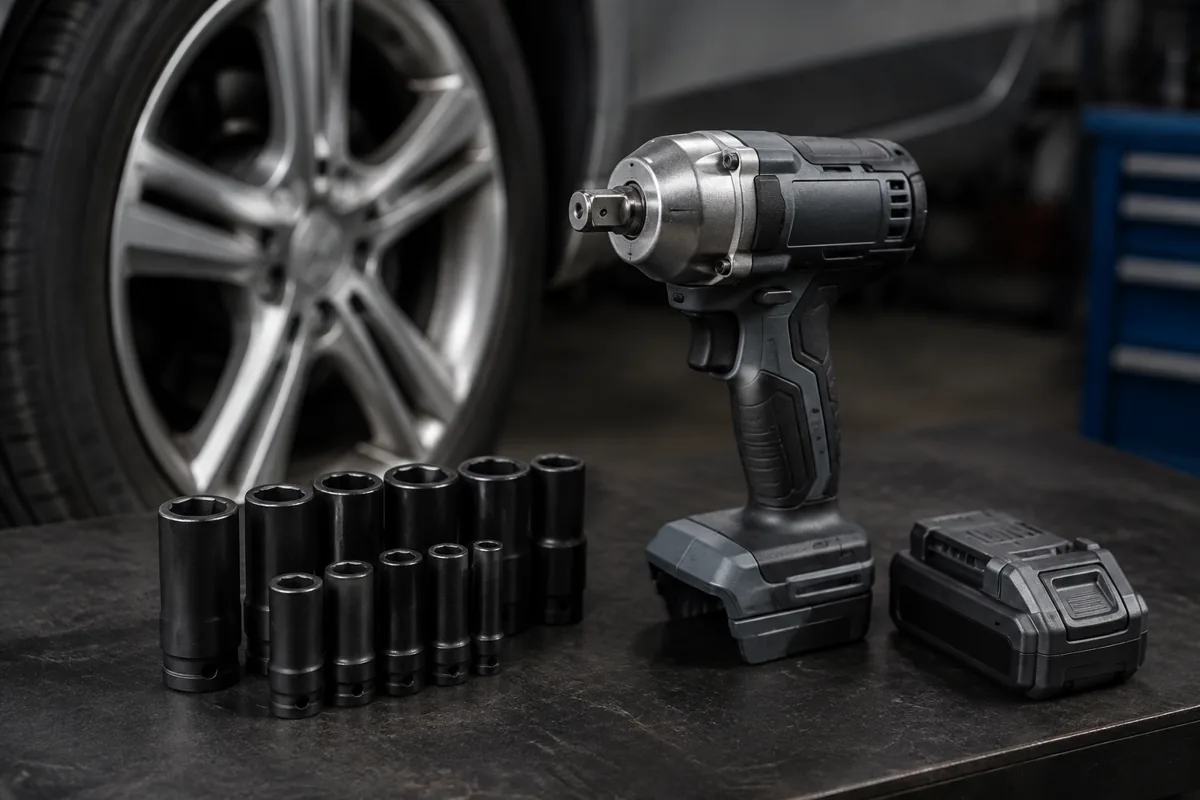
A compact impact wrench is useful for lug nuts and stubborn, accessible fasteners. Choose a drive size that matches the sockets you already own; 1/2-inch drive is common for wheel work. A mid-torque tool is often enough for passenger vehicles, but no impact wrench should be used to establish final lug-nut torque. Use it to remove nuts and, if needed, run them down gently; finish with a calibrated torque wrench set to the vehicle’s specification.
A cordless ratchet is a convenience tool for caliper and bracket bolts where there is room to reach. It is not a substitute for a breaker bar on seized fasteners, and its head can be too large for cramped spaces. Do not let the motor drive a fastener against its stop: start and finish threads by hand, then use the ratchet only where access and the service procedure allow. If you service one car occasionally, a manual ratchet may be the better value.
For cleaning, consider a cordless drill or compact driver with a suitable brush attachment. Use a brush appropriate for the part and avoid damaging rubber boots, seals, or friction surfaces. Never use a power tool to grind a rotor or aggressively remove material from a brake component unless the repair procedure specifically calls for it. A hand wire brush is cheaper and gives better control for light rust removal.
Useful searches when comparing tools include a cordless mid-torque impact wrench, a cordless ratchet, and a compatible battery-and-charger kit. Check that the battery platform and charger match before ordering; similar-looking batteries from different systems are not interchangeable.
Compare tool roles
| Tool | Best use in brake service | Main trade-off |
|---|---|---|
| Impact wrench | Removing lug nuts and accessible fasteners | Fast, but easy to over-tighten or damage small fasteners |
| Cordless ratchet | Spinning out accessible bolts after loosening | Convenient reach, but limited breakaway force and bulky head |
| Drill or driver | Low-force cleaning with an appropriate brush | Versatile, but easy to use too aggressively |
| Manual ratchet and breaker bar | Controlled work and stubborn fasteners | Slower, but inexpensive and less dependent on battery charge |
What not to buy first
Skip a high-torque impact wrench unless you have regular work that genuinely needs one. It is heavier, often more expensive, and can snap smaller bolts or damage threads before you react. Also skip duplicate batteries until you know how quickly you drain the first one. A single charged pack is usually enough for a weekend brake job, especially if you have a manual backup.
Do not use an impact wrench to push a caliper piston back. Use the correct piston tool or brake-caliper press and follow the vehicle procedure; some rear calipers rotate while retracting, while electronic parking-brake systems may require a service mode. If a piston will not retract smoothly, stop and diagnose the cause rather than adding force. A seized caliper, trapped pressure, or incorrect procedure can turn a routine pad change into a more expensive repair.
Work safely and protect the tools
Support the vehicle on rated jack stands on a firm, level surface; never rely on a jack alone. Keep the battery away from brake fluid, solvents, and hot components. Brake dust should not be blown into the air with compressed air; use an appropriate wet-cleaning method and follow product directions. Keep friction material and lubricant off the rotor and pads.
After reassembly, use a torque wrench for wheel fasteners and any other fasteners specified by the repair procedure. Torque values vary by vehicle and fastener, so do not use a generic number. Pump the brake pedal until it feels firm before moving the car, check fluid level, and verify braking at low speed in a safe area. The cordless tools should make repetitive work quicker; they should not replace those checks.
A practical buying order
For a new kit, buy in this order: one battery platform with charger, a suitable impact wrench if you remove wheels often, then a cordless ratchet or drill only if your jobs show a clear need. Keep a manual ratchet, breaker bar, sockets, and torque wrench in the kit regardless. The cheaper setup—existing cordless drill, hand tools, and a torque wrench—is entirely adequate for occasional brake service. Spend more only where repeated use, access, or time savings justify it.
Related guides
- Longest Lasting Lawn Mower Battery: AGM vs Lithium vs Flooded Lifespan and Cost per Season
- Duralast Gold Lawn Mower Battery Review: U1 Fit, CCA and When to Pay for AGM
- Greenworks Pro 80V 21-Inch Mower Review: Runtime Math, Push vs Self-Propelled and Yard Fit
- Bosch High Pressure Washer Gun Replacement: Fittings, Adapters and What Fits Your Model