What's inside
As an Amazon Associate I earn from qualifying purchases. This post may contain affiliate links at no extra cost to you.
A nailer can use a surprising amount of battery during a full shift, especially when it fires hundreds of fasteners or runs in cold weather. The right pack is not automatically the largest one: extra capacity adds weight, and a heavy battery can make a trim or framing nailer tiring to hold. Choose for the nailer’s platform, the work rate, and how often you can recharge.
As an Amazon Associate we earn from qualifying purchases at no extra cost to you.


Start with the nailer’s battery platform
Use a battery the nailer’s manufacturer specifies as compatible. Voltage, battery rails, and electronics differ between platforms; a pack that fits physically is not necessarily safe or approved to use. Within a compatible platform, higher-capacity packs generally provide more runtime, but may be larger and heavier. Check the tool manual and the pack’s weight before buying, particularly for overhead or finish work.
If you already own batteries and a charger, staying on that platform is usually the economical choice. Buying into a new ecosystem just for a nailer means paying for a charger and spare packs too. For a broader platform comparison, look at cordless nailer battery platforms, then confirm compatibility on the manufacturer’s site before ordering.
Balance capacity against weight
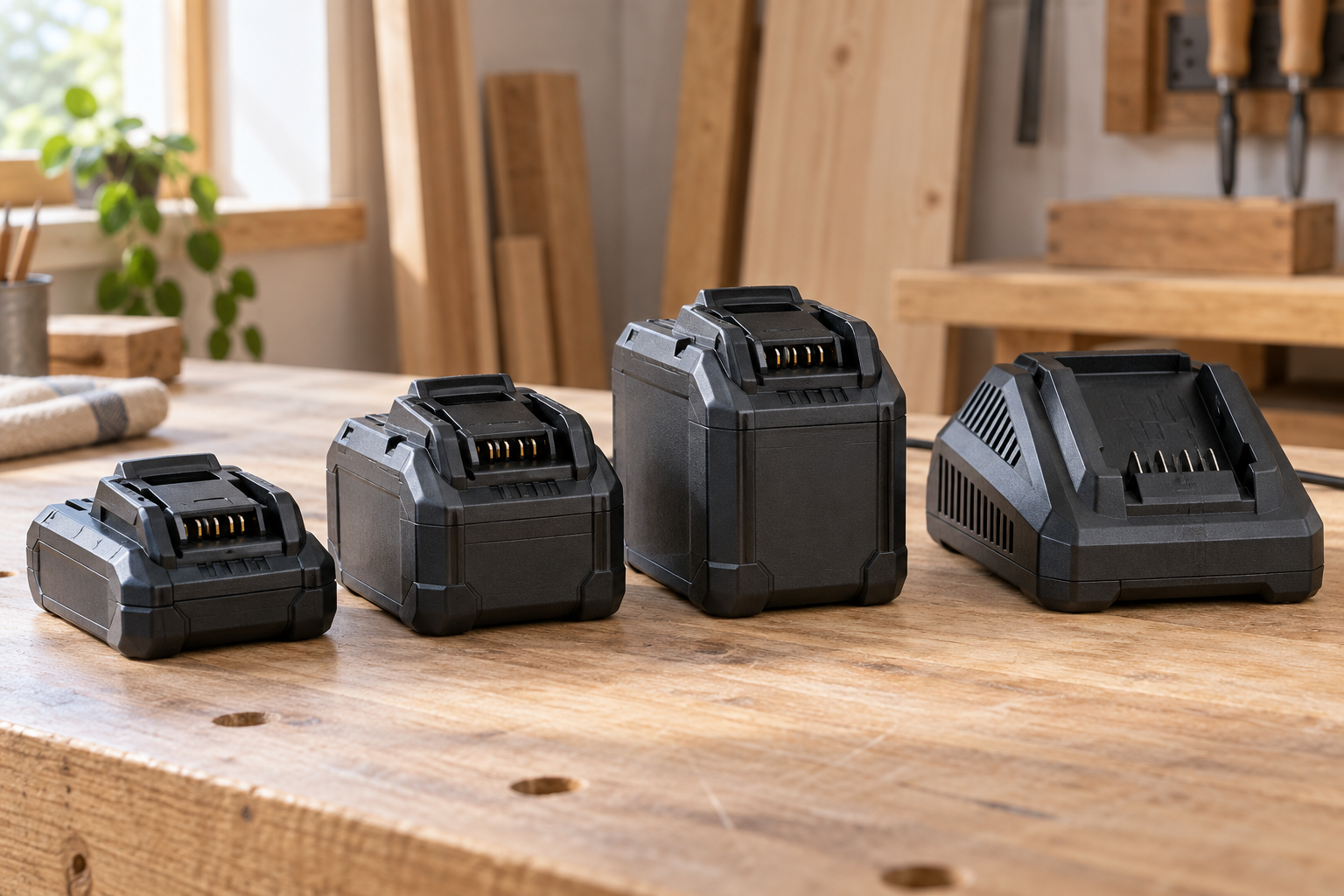
Amp-hours (Ah) indicate battery capacity within a given voltage platform: a 5Ah pack typically stores more energy than a 2Ah pack from the same system. They do not guarantee a particular number of nails. Fastener length, wood hardness, temperature, firing rate, and the nailer’s design all affect consumption. A dense framing job is a different test from occasional brad nailing into softwood.
For a finish nailer used at arm’s length, a compact pack can be worth the shorter runtime. For repetitive framing or fencing, a higher-capacity pack usually means fewer interruptions. Do not assume every larger pack improves performance; a tool may already drive nails consistently with a smaller one, while the added battery weight makes it less comfortable.
Battery choices for a workday
| Setup | Best fit | Main trade-off |
|---|---|---|
| Compact pack, around 2Ah | Short jobs, finish work, overhead nailing | Light and easy to handle, but may need swapping sooner |
| Mid-capacity pack, around 4–5Ah | General site use and mixed fastening | Useful balance of runtime and weight |
| High-capacity pack, 6Ah or more | Long, repetitive work with limited charging access | More runtime, but more weight and bulk on the tool |
| Two compatible packs and a charger | Full shifts with scheduled breaks or changing tasks | Higher upfront cost; charging must keep pace with use |
These are capacity ranges, not promises about nail counts. Battery chemistry and pack design vary, and a 5Ah battery on one platform is not directly comparable to a 5Ah battery on another voltage platform. When comparing products, check the pack’s stated voltage, capacity, weight, and compatibility rather than relying on Ah alone. A mid-capacity cordless tool battery is a sensible starting point for many users who need one pack for several tools.
Plan runtime around the actual job
Think in terms of the day’s work, not a seller’s headline runtime. If the nailer is used in bursts while material is measured and positioned, one pack may last far longer than during continuous production nailing. Keep a simple record for the first day: note the starting charge, how many packs you use, and whether the battery or nailer gets hot. That gives you a more useful estimate than an unverified nails-per-charge claim.
For a steady workday, two batteries are often more practical than one oversized pack. One can run the tool while the other charges, provided the charger can replenish it before the spare is needed. A second pack also avoids a dead-stop when the only battery is depleted. If the charger is slow or the site has no reliable power, carry enough charged capacity for the job rather than counting on a short break to restore it. A battery-and-charger kit for your platform may cost less than buying each piece separately, but compare the included pack size with what the nailer can comfortably carry.
Avoid common battery and nailer problems
A weak or nearly empty battery can cause a nailer to stop cycling, pause between shots, or show a low-charge warning. If nails are left proud, do not assume the battery is at fault: check the depth setting, fastener type, material, and tool maintenance as well. A fresh, fully charged compatible pack is a useful first diagnostic, but it will not correct a jam, wrong nails, or a worn driver.
Cold batteries can deliver less power than warm ones. Keep spare packs in a dry, insulated bag rather than leaving them overnight in a freezing vehicle, and follow the manufacturer’s temperature guidance for charging. Do not charge a pack that is hot from heavy use; let it cool as directed. Dirt on contacts, damaged casing, or a pack that becomes unusually hot, swells, or behaves erratically are reasons to stop using it and follow the manufacturer’s service guidance.
What to buy
For occasional trim work, a compact compatible pack is usually enough, and paying extra for the biggest battery is hard to justify. For mixed daily use, start with a mid-capacity pack and keep a second charged battery nearby if the schedule cannot tolerate downtime. For high-volume framing, prioritize enough total capacity to cover your measured consumption and a charger that can replenish packs during the shift. If the nailer is uncomfortable with a larger battery, split the capacity across lighter packs instead.
Before buying, verify the exact platform and approved battery list, compare battery weight, and check the charger’s stated charging time for that pack size. The best workday setup is the lightest compatible arrangement that lasts through your real workload—or lets you swap packs without stopping the job.
Related guides
- Longest Lasting Lawn Mower Battery: AGM vs Lithium vs Flooded Lifespan and Cost per Season
- Duralast Gold Lawn Mower Battery Review: U1 Fit, CCA and When to Pay for AGM
- Greenworks Pro 80V 21-Inch Mower Review: Runtime Math, Push vs Self-Propelled and Yard Fit
- Bosch High Pressure Washer Gun Replacement: Fittings, Adapters and What Fits Your Model