What's inside
As an Amazon Associate I earn from qualifying purchases. This post may contain affiliate links at no extra cost to you.
Best Copper Pot Stills for Home Distilling: Choose by Batch Size, Condenser, and Setup
The best copper pot still for home distilling is a small, complete unit sized to your actual batch, with clearly specified copper thickness and a condenser suited to your workspace—not simply the largest still you can buy. Before comparing models, check local laws: home distilling alcohol may require permits or be prohibited, even where home brewing is allowed. Never distill alcohol without understanding fire, vapor, pressure, and contamination risks.
First, decide whether a pot still fits your use
A pot still is generally chosen when preserving a flavorful character matters more than producing a highly neutral spirit in one pass. Its boiler, vapor path, and condenser all influence the result, but copper alone does not guarantee quality. A pot still also needs a stable, compatible heat source, a correctly fitted vapor path, and a condenser with sufficient cooling capacity.
As an Amazon Associate we earn from qualifying purchases at no extra cost to you.
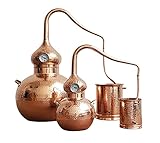


The recommendations below are buying categories, not endorsements of particular listings. Many products sold as “copper stills” vary substantially in construction, and product names or capacities can change. Ask the maker for written specifications before purchasing.
| Situation | Useful nominal capacity | Condenser to consider | Why it may fit | Check before buying |
|---|---|---|---|---|
| First purchase; limited storage | 3–5 L | Small liebig-style tube or compact coil | Smaller footprint and less liquid to handle | Actual working fill limit, not just boiler volume |
| Occasional batches; room for a dedicated setup | 8–12 L | Liebig-style tube with documented cooling requirements | Balances batch size with manageable storage | Boiler diameter, loaded weight, and heat-source compatibility |
| Frequent use; experienced operator | 15–20 L | Condenser sized for the maker’s stated operating range | Fewer, larger batches if the space and rules permit | Support, seals, joints, cooling flow, and safe mounting |
| Very tight counter or storage space | 3–5 L, compact overall height | Compact coil, if accessible for cleaning | May be easier to store and position | Coil access, water connections, and clearance above the boiler |
These capacities are nominal boiler volumes, not recommended fill volumes. A boiler needs appropriate headspace, and the safe operating limit must come from the manufacturer’s instructions for that specific design. Do not infer a fill limit from a product photo.
How to compare the construction
Capacity and usable space
Choose by the amount you can legally and safely process, not by a promised output figure. Output depends on the starting liquid, operating conditions, and collection choices; a listing’s “yield” claim is not a dependable planning measure. Larger boilers also mean more weight when filled, more stored liquid, and a greater need for a stable surface and reliable cooling.
Measure the full assembled height and width, including the vapor arm and condenser hoses. Allow room to reach joints and clean the equipment. If you cannot secure the still without blocking ventilation or creating a trip hazard, a smaller unit is the better fit.
Copper thickness and material disclosure
Look for an explicit copper thickness in millimeters, plus a clear statement of which parts are copper. “Copper finish” or “copper plated” is not the same as a copper boiler. Ask whether the boiler, head, and vapor path are solid copper, and whether the condenser contains copper or another material.
Thickness is only one durability factor. A well-made joint, sound lid connection, and stable base matter just as much. Very thin metal can dent or distort more easily; heavier copper can be costly and awkward to handle. There is no universal thickness that makes a still safe. Treat vague material descriptions or missing specifications as a reason to pause, not as a bargain.
Condenser type: coil versus liebig-style
- Coil condenser: A coiled tube sits inside a water jacket or cooling vessel. Its compact shape can suit small setups, but the coil may be harder to inspect and clean. Confirm how the cooling water enters and exits and what flow or temperature range the maker specifies.
- Liebig-style condenser: A straight inner vapor tube is surrounded by a cooling-water jacket. Its linear layout can be easier to inspect and fit into a bench arrangement, but it needs enough clearance and secure support. Verify the total length and cooling connections.
Neither type is automatically superior. The right condenser is one that the maker has sized for the intended boiler and operating conditions, and that you can supply with dependable cooling. Avoid units that provide no condenser dimensions, cooling instructions, or guidance on compatible heat input.
Match the still to your situation
| Buyer profile | Best starting point | Trade-off |
|---|---|---|
| New owner, infrequent use | 3–5 L complete kit with published material specs and instructions | Small batches; some compact designs are less convenient to clean |
| Limited budget | Buy a smaller, documented unit rather than a large unit with unclear construction | Capacity is limited, but missing safety and materials information is not a worthwhile saving |
| Regular use and suitable workspace | 8–12 L unit with accessible joints and a condenser matched to the boiler | Requires more storage, handling, and careful planning |
| Frequent use with dedicated space | 15–20 L only when legal, supported, and compatible with the full setup | Heavier, more demanding to operate, and less forgiving of poor workspace planning |
Ownership details that matter after purchase
Ask whether the kit includes the boiler, head, condenser, seals, clamps, hoses, and a written operating manual. A low advertised price may exclude several items needed to assemble the system. Confirm replacement-part availability, especially for seals and fittings, and whether the maker identifies materials that contact vapor or liquid.
For cleaning and storage, follow the manufacturer’s instructions. Inspect joints and seals before each use, and stop if a connection is loose, damaged, or leaking. Keep the vapor path unobstructed; a distillation apparatus must not be operated as a sealed, pressurized vessel. Use only an appropriate setup in a legal location with adequate ventilation and a heat source approved for the equipment. Alcohol vapor is flammable, so keep ignition sources and open flames away from any possible vapor release.
Copper can tarnish, and joints or seals may need attention over time. Avoid abrasive cleaning that can damage a surface, and do not assume that a shiny exterior proves the interior is clean. If the maker cannot explain safe cleaning, inspection, and replacement procedures, choose a better-documented product.
Bottom line
For most buyers comparing the best copper pot stills for home distilling, a documented 3–5 L unit is the more manageable starting point; an 8–12 L unit makes sense when you have a suitable permanent workspace and a clear reason for the added capacity. Prioritize disclosed copper construction, a condenser matched to the boiler, accessible cleaning, replacement parts, and complete safety instructions. If a listing cannot answer those questions, keep looking.