What's inside
As an Amazon Associate I earn from qualifying purchases. This post may contain affiliate links at no extra cost to you.
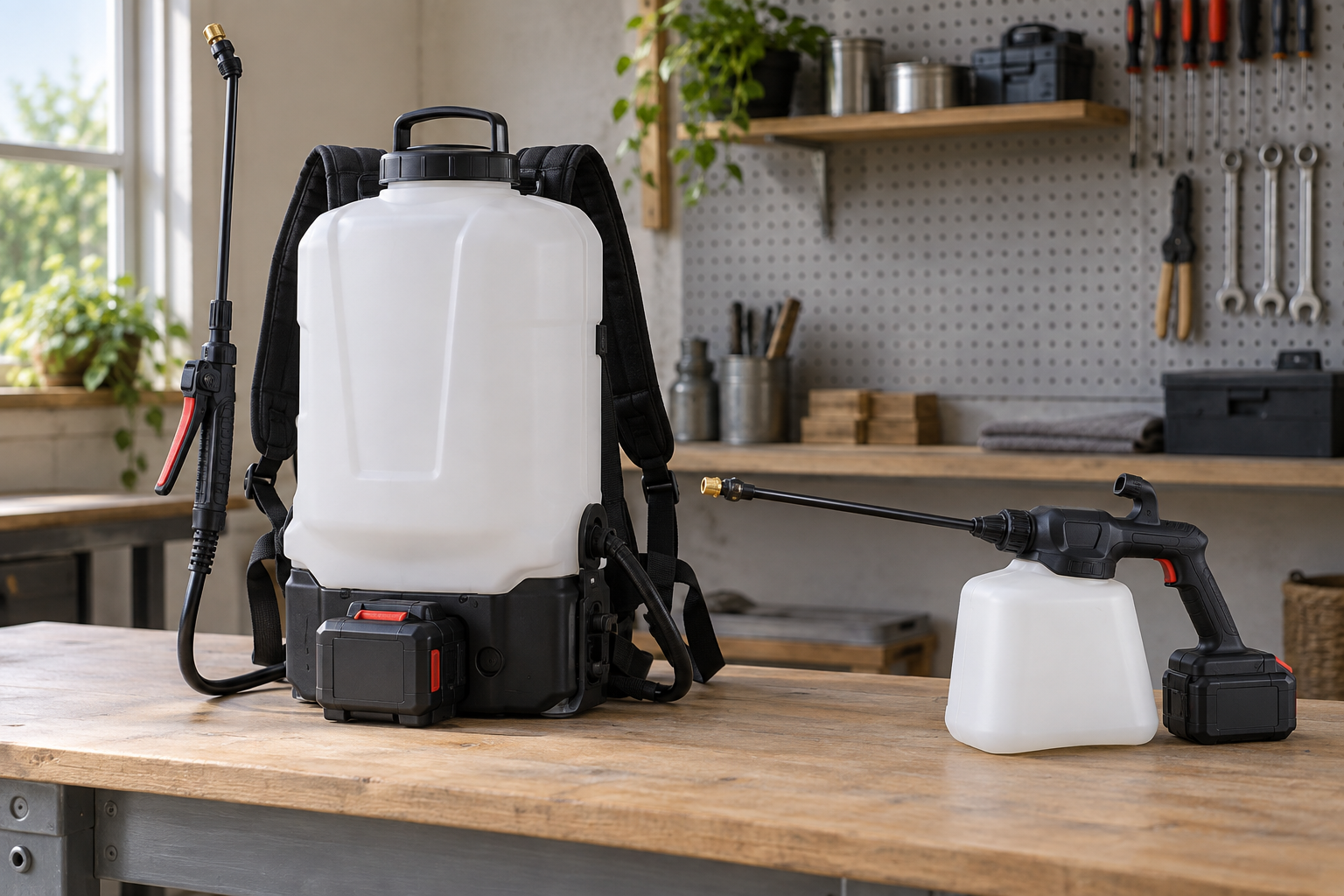
If you already own cordless tools, a backpack sprayer that runs on the same batteries saves you from buying another charger and another dying proprietary pack. Tool-battery sprayers also fix the two biggest complaints about manual pump sprayers: constant pumping to keep pressure up and inconsistent spray pattern as pressure drops. A battery-powered pump holds steady pressure until the tank is empty, which matters for herbicide, insecticide, and fertilizer work where coverage has to be even.
The trade-off is weight and cost. A 4-gallon sprayer weighs about 12 lbs empty, close to 45 lbs full. Add a 5.0Ah battery and you’re carrying more than a manual unit. And if you don’t already own the battery platform, a kit with battery and charger often costs $250 to $400, roughly double a good manual backpack sprayer. If you only spray a few hundred square feet a couple times a year, manual is still fine. If you spray an acre, a fence line, or treat weeds weekly, battery power is worth it.
As an Amazon Associate we earn from qualifying purchases at no extra cost to you.

Why Tool-Battery Sprayers Make More Sense Than Standalone Battery Sprayers
Standalone sprayers from Solo, Chapin, or Petra come with their own lithium pack and charger. They work, but when that pack dies in 3-4 years you are hunting for a proprietary replacement that may be discontinued. A sprayer that uses Ryobi ONE+, Milwaukee M18, Makita LXT, or DeWalt 20V MAX batteries solves that. You can swap in any pack from your drill or blower, charge on the charger you already own, and keep a spare in your pocket.
Interchangeable systems like the Milwaukee M18 Switch Tank sprayer take this further. The tank and pump base separate, so you can swap a 4-gallon sprayer tank for a water supply tank or pesticide tank without dumping chemicals. You pay more upfront for the base, but you don’t buy a whole second sprayer.
For homeowners already on Ryobi 18V, that platform is hard to beat on price. Ryobi’s 4-gallon backpack sprayer is often sold as a bare tool for under $150, which makes it the cheapest entry if you own the batteries. Performance is not class-leading, but for general weed spraying it is adequate.
What to Look For Before You Buy
Tank size is almost always 4 gallons. That is the practical limit for what most people can carry comfortably. Don’t chase a larger tank; it just means more weight on your back. What matters more is pump type and pressure control.
Look for a diaphragm pump rated for bleach, herbicides, and light fertilizers. Cheap piston pumps corrode or swell with sodium hypochlorite. If you plan to spray 2-3% glyphosate or 1-2% bleach mix for house wash, confirm chemical compatibility in the manual. Viton seals are what you want.
Adjustable pressure from about 20 to 80 PSI lets you switch from a gentle mist for foliar feeding to 60+ PSI for distance. Most tool-battery sprayers have a rotary knob. Avoid units with only on/off – you will waste chemical and get drift. Flow rate around 0.4 to 0.6 GPM at 40 PSI is typical and efficient. Higher is not better; it just empties the tank faster.
Wand and nozzle quality matter more than marketing claims. A 20-inch stainless or brass wand with a brass adjustable cone and a fan tip covers 90% of jobs. If the included wand is plastic with a proprietary thread, plan to replace it. Standard TeeJet-compatible tips are a plus because you can buy 8002, 11004, and adjustable cone tips anywhere.
Weight distribution and straps decide whether you finish the job sore. Padded shoulder straps with a sternum strap and a waist belt help a lot at 40+ lbs. A rigid frame that holds the tank off your back improves ventilation. Check where the battery sits. Rear-mounted batteries stay drier than bottom-mounted trays that collect drips.
Platform Comparison: The Real Options
There are only a handful of sprayers actually powered by major tool batteries. Everything else is a generic sprayer with an adapter. Stick to the native tools for warranty and seal compatibility.
| Platform / Sprayer Type | Tank | Pressure Range | Bare Tool Weight | Typical Bare Tool Price | Best For |
|---|---|---|---|---|---|
| Ryobi 18V ONE+ 4 Gallon | 4 gal | up to 60 PSI | ~10.5 lbs | $120 – $160 | Budget homeowners already on Ryobi |
| Milwaukee M18 Switch Tank 4 Gallon | 4 gal (interchangeable) | 20 – 120 PSI | ~12.5 lbs (base + tank) | $220 – $280 (base + tank) | Pros / frequent users needing adjustable pressure |
| Makita 18V LXT 4 Gallon (XSU series) | 4 gal | ~38 – 75 PSI | ~11.5 lbs | $200 – $270 | Makita shops wanting LXT compatibility |
| DeWalt 20V MAX 4 Gallon | 4 gal | up to 60 PSI | ~11 lbs | $180 – $230 | DeWalt users who spray occasionally |
| Chapin / Solo with tool-battery adapter | 4 gal | 40 – 60 PSI | ~9 – 10 lbs | $130 – $190 + adapter | Adapting if your platform has no native sprayer |
Prices are bare tool (no battery). If you need to buy a battery and charger, add $80 to $150 for a 4.0Ah or 5.0Ah pack. The Milwaukee system costs more because you are buying a powered base that accepts multiple tanks, but the pump is stronger and the pressure control is finer than the budget units.
Battery Life and Real Runtime
Marketing often claims “sprays up to 12 tanks per charge.” That is misleading. Pump runtime depends on pressure and duty cycle. On a 4.0Ah 18V pack (72Wh), expect about 1.5 to 2.5 hours of continuous pumping at 40 PSI. In practice that is 6 to 10 full tanks (24 to 40 gallons) before the battery is dead, because you are not spraying nonstop – you walk, reposition, and spot-spray.
A compact 2.0Ah pack will do 3 to 5 tanks, which is enough for a quarter-acre lot. For an acre or more, bring a 5.0Ah or 6.0Ah pack. Higher voltage platforms (18V/20V) are more efficient than 12V sprayers, which is why the 12V tool-battery sprayers have largely disappeared.
Battery placement affects runtime perception too. Cold weather cuts lithium capacity by 10-20% below 40F. If you spray early spring or late fall, keep the spare battery in a jacket pocket, not in a cold garage.
If you are buying into a platform just for spraying, consider future tool use. A DeWalt 20V backpack sprayer makes more sense if you will also use DeWalt drills and blowers. If you are already deep on Makita LXT, the Makita sprayer keeps you on one charger. Do not buy a new battery ecosystem for one sprayer.
Common Failure Modes and How to Avoid Them
Most dead sprayers are not dead pumps. They are clogged nozzles, cracked wands, or chemical damage from not rinsing.
1. Clogging: Wettable powders and granular herbicides that are not fully dissolved will clog the filter and nozzle. Mix in a separate bucket, stir thoroughly, and pour through the included strainer basket. Clean the inline filter after every tank.
2. Seal swelling: Leaving glyphosate, 2,4-D, or bleach in the tank for days swells seals and corrodes the pump check valve. Triple-rinse the tank with clean water after each use, then spray clean water through the wand for 20-30 seconds. If you sprayed bleach, rinse twice and leave the tank lid off to dry.
3. Battery tray corrosion: Chemical drips into the battery compartment kill contacts. Wipe the tray dry, and remove the battery before filling. Never fill the tank while it is on your back.
4. Hose leaks: The hose-to-tank fitting is the most common leak point. Hand-tight plus a quarter turn with pliers is enough. Over-tightening cracks the plastic bulkhead. Keep a spare hose washer in the parts bag.
5. Pressure loss: If pressure drops to a dribble but the motor runs, the intake filter is clogged or the pump has air-locked. Invert the sprayer briefly to prime, clean the filter, and check for a kinked hose.
Which One Should You Buy
Buy on the battery platform you already own. That is the whole point.
If you own Ryobi ONE+ and spray weeds, fence lines, and small food plots a few times a month, the Ryobi 4-gallon is good enough. It is the lightest on your wallet and replacement parts are easy to find. Accept that pressure adjustment is coarse and the wand is basic. Upgrading the nozzle to a TeeJet fan tip for $12 improves it immediately.
If you spray for pay, treat large properties, or need to switch between water, concrete sealer, and herbicide without cross-contamination, the Milwaukee Switch Tank is the better tool. The variable pressure dial actually holds calibration, the pump is rebuildable, and the interchangeable tanks save cleanup time. It is heavier and more expensive, but it is the only system built for daily use.
Makita and DeWalt sit in the middle. Both are solid, quiet diaphragm-pump sprayers with decent straps and brass-tipped wands. Choose whichever matches your batteries. Do not pay a premium to switch platforms for spray performance alone – the difference between them at 60 PSI is marginal compared to nozzle selection and mixing accuracy.
If your platform has no native sprayer (Ridgid, Craftsman, Kobalt), a Chapin or Solo 4-gallon with an aftermarket tool-battery adapter is a workable compromise. Just verify the adapter provides proper low-voltage cutoff so you don’t over-discharge the pack. A dedicated cordless backpack sprayer 4 gallon with its own charger is still cheaper than buying into a new tool line for one job.
Whatever you buy, budget $25 for a spare nozzle set, an extra inline filter, and a bottle of tank cleaner. Those small parts determine whether the sprayer is still useful in year three.
Related guides
- Longest Lasting Lawn Mower Battery: AGM vs Lithium vs Flooded Lifespan and Cost per Season
- Duralast Gold Lawn Mower Battery Review: U1 Fit, CCA and When to Pay for AGM
- Greenworks Pro 80V 21-Inch Mower Review: Runtime Math, Push vs Self-Propelled and Yard Fit
- Bosch High Pressure Washer Gun Replacement: Fittings, Adapters and What Fits Your Model