What's inside
As an Amazon Associate I earn from qualifying purchases. This post may contain affiliate links at no extra cost to you.
Cordless battery chargers do more than push current into a pack. A good charger watches battery temperature, voltage, and charging time, then reduces or stops charging when conditions become unsafe. That matters because lithium-ion packs can be damaged by charging while too cold, too hot, or internally out of balance.
Most major tool platforms already include temperature monitoring in their standard chargers. The important buying decision is usually not finding a charger that claims to monitor temperature; it is choosing a charger that works with your battery system, handles the pack’s charge rate sensibly, and gives you useful warning or status information.
As an Amazon Associate we earn from qualifying purchases at no extra cost to you.


What temperature monitoring does
Tool batteries commonly use an internal thermistor or temperature sensor. The charger reads that sensor through an extra contact on the battery. If the pack is too hot after heavy use, charging may pause until it cools. If it is too cold, the charger may delay charging or limit the current.
This prevents several common failure modes. Charging a hot pack can accelerate cell degradation and increase the risk of swelling. Charging a battery below freezing can cause permanent internal damage, even if the pack appears to work normally afterward. Temperature monitoring also helps identify a pack with a failed sensor or abnormal internal resistance.
Monitoring is not the same as active cooling. A charger may detect a hot battery and wait, but it usually cannot cool the pack quickly. Fan-cooled chargers can move air over the battery and shorten the wait after demanding work, but they still need a reasonable room temperature and clear ventilation.
The best charger types to consider
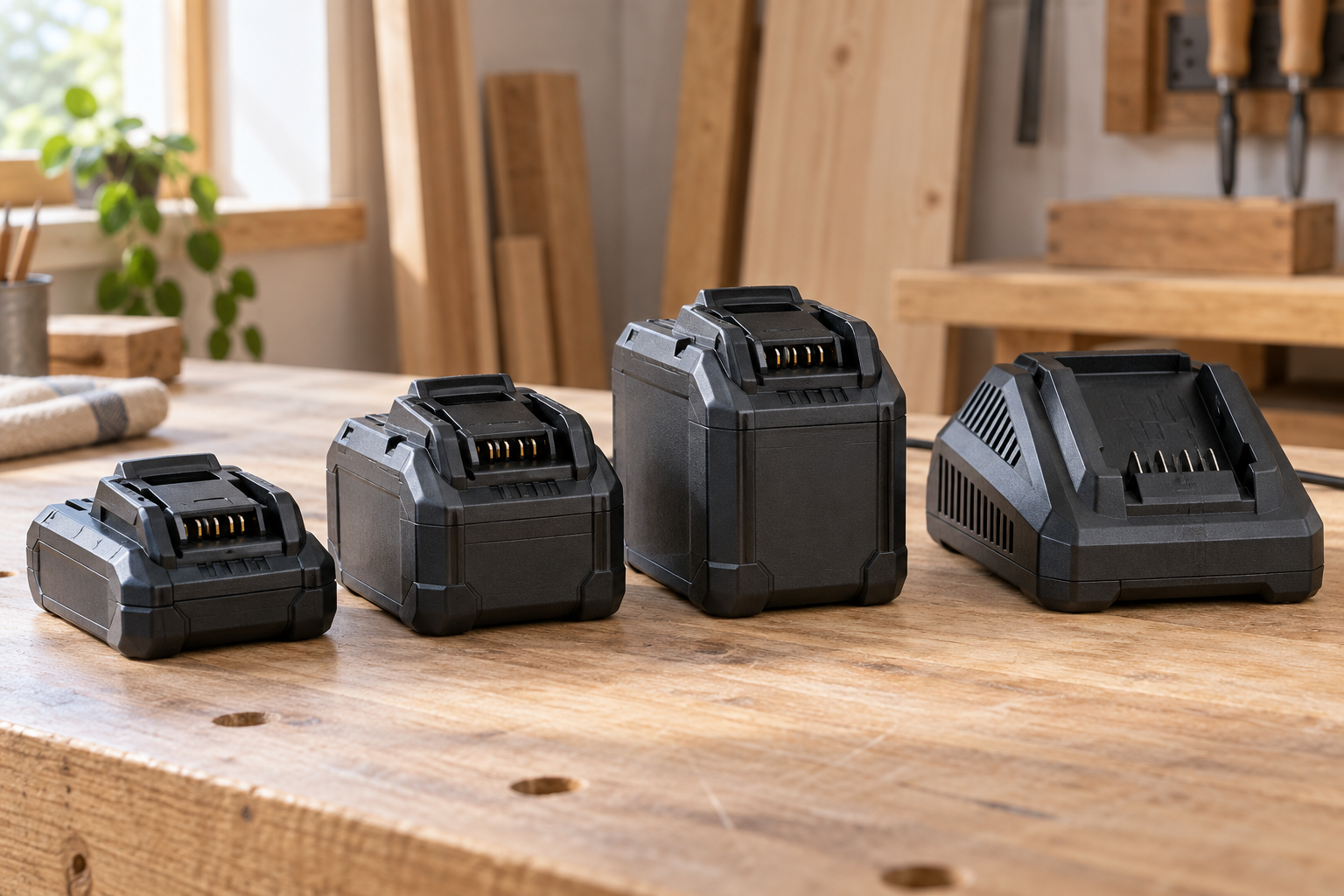
For most owners, the best choice is the manufacturer’s standard charger for the battery platform. It communicates with the pack correctly, supports the battery’s temperature sensor, and avoids compatibility problems. Look for a temperature-monitoring cordless battery charger matched to your exact brand and voltage family.
Standard single-bay chargers are the sensible low-cost option. They often charge a typical 2.0Ah pack in roughly 30 to 60 minutes, depending on the platform. They are compact, inexpensive, and perfectly adequate for occasional drilling, fastening, or light maintenance. The trade-off is that they may charge more slowly and provide fewer diagnostic lights than premium chargers.
Rapid chargers use higher current and may include a cooling fan. A 5.0Ah pack that takes around 90 minutes on a basic charger might charge in roughly 30 to 45 minutes on a rapid unit, though times vary substantially by brand and battery generation. Rapid charging creates more heat, so thermal monitoring becomes especially important. It is useful for crews and heavy users, but often unnecessary for a homeowner with two or three batteries.
Multi-bay chargers are convenient when several tools share one platform. Some charge batteries sequentially; others charge multiple packs at once. Sequential chargers may look like they offer four-battery capacity but still leave you waiting if only one bay receives charging current at a time. Check the manufacturer’s specifications before paying extra.
For mixed-brand workshops, a universal cordless tool battery charger can look attractive, but compatibility is a serious limitation. Battery connectors, communication contacts, charge voltages, and safety protocols differ. Do not use an adapter or “universal” charger unless it explicitly supports your battery model and preserves the pack’s temperature and protection circuits.
Charger comparison
| Charger type | Best for | Typical trade-off | Temperature behavior |
|---|---|---|---|
| Basic single-bay | Occasional home use | Slower charging and fewer indicators | Usually pauses or limits charging when the pack is hot or cold |
| Rapid or fan-cooled | Daily work and multiple tools | Higher price, more noise, greater heat during charging | Often uses fan cooling and closer temperature control |
| Multi-bay | Workshops with several batteries | Large size; some bays charge sequentially | Monitoring is normally handled independently by each charging circuit |
| Portable vehicle charger | Field repairs and mobile work | May charge slowly and require a suitable power source | Still depends on the battery’s sensor and charger electronics |
What to look for before buying
First, match the charger to the battery platform, not merely the voltage printed on the pack. A charger for one brand’s 18V or 20V system is not automatically safe for another brand’s pack. Even within one ecosystem, older and newer batteries can have different communication requirements.
Second, check the published charge times for the battery sizes you actually own. A charger optimized for a compact 2.0Ah pack may be frustrating with 8.0Ah high-capacity batteries. Conversely, a high-output rapid charger may offer little practical benefit if your largest battery is 2.0Ah or 3.0Ah.
Useful indicators include a separate “too hot,” “too cold,” or “fault” light. A basic red/green indicator only tells you that charging is active or complete. More detailed diagnostics can distinguish a temporarily hot battery from a pack that has a failed sensor or bad cell group.
Look for ventilation space around the charger. Do not cover the vents, place the charger on a soft surface, or leave it in direct sun. Charging at about 50 to 86 degrees Fahrenheit is a reasonable target for many lithium-ion packs, although the battery and charger manuals take priority. After hard use, let the pack sit for 15 to 30 minutes if it is noticeably warm.
Safe charging practice
Inspect the battery before inserting it. Stop using packs with swelling, cracked housings, melted plastic, corrosion, or a strong chemical smell. A charger cannot make a damaged battery safe. Do not charge a pack that has been submerged or heavily impacted until it has been assessed by the manufacturer or a qualified battery service.
Keep charging on a hard, nonflammable surface, away from sawdust, solvents, cardboard, and heat sources. Unplug the charger when it is not needed, especially in a workshop where metal debris can bridge exposed contacts. If a normally healthy battery repeatedly stops with a temperature or fault warning, replace or service the battery rather than repeatedly reseating it.
A cheaper standard charger is fine when you use the tools intermittently and have spare batteries. Spend more on a rapid, fan-cooled, or multi-bay charger when downtime costs more than the charger, or when several people depend on the same battery platform. In every case, the safest choice is the charger designed for that battery ecosystem, with its temperature-sensing and protection features intact.
Related guides
- Longest Lasting Lawn Mower Battery: AGM vs Lithium vs Flooded Lifespan and Cost per Season
- Duralast Gold Lawn Mower Battery Review: U1 Fit, CCA and When to Pay for AGM
- Greenworks Pro 80V 21-Inch Mower Review: Runtime Math, Push vs Self-Propelled and Yard Fit
- Bosch High Pressure Washer Gun Replacement: Fittings, Adapters and What Fits Your Model