What's inside
As an Amazon Associate I earn from qualifying purchases. This post may contain affiliate links at no extra cost to you.
A small shop bench rarely has room for a row of chargers, and a charger that blocks an outlet or cooks a battery can be more trouble than it saves. The right setup depends less on headline charge speed than on how many batteries you rotate, which tool platform you own, and whether you can leave a charger plugged in safely.
As an Amazon Associate we earn from qualifying purchases at no extra cost to you.


Start with your battery platform
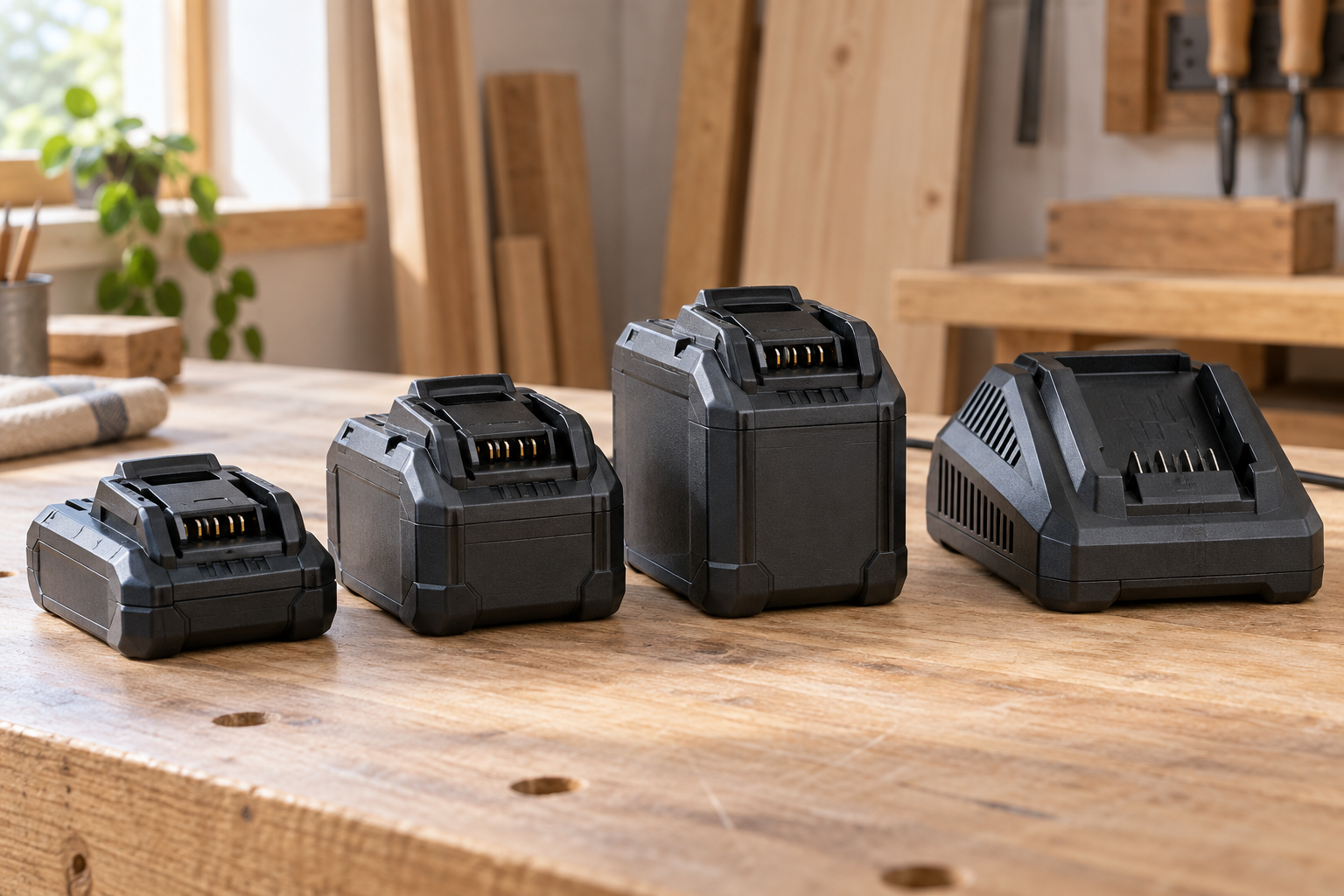
Buy a charger that is explicitly compatible with your battery’s brand and voltage platform. Similar-looking packs are not interchangeable, and an adapter does not make an incompatible charger safe. If you use two brands, plan on two chargers or a legitimate multi-platform solution from the manufacturers involved.
Check the charger label or manual for its output current, supported battery types, and charging time. A 2-amp charger is often adequate for occasional home-shop use; a higher-current charger can cut waiting time, especially with large packs, but may cost more and take up more bench space. Charge times vary by pack capacity and temperature, so treat the manufacturer’s estimate as a guide, not a guarantee.
Charger types at a glance
| Type | Good fit | Trade-off |
|---|---|---|
| Compact single-port | One or two batteries, limited bench space | Only one pack charges at a time |
| Fast single-port | Frequent use of a small battery rotation | May be larger, noisier, or more expensive |
| Multi-port | Several packs and a regular charging routine | Ports may charge sequentially rather than simultaneously |
| Basic kit charger | Light use and low upfront cost | Can be slow when a depleted pack is needed soon |
Look carefully at multi-port claims. Some units charge several packs at once; others prioritize one battery and move to the next. That distinction matters if you expect to refill a stack of packs before a job. Read the manual or product specifications for charging behavior rather than relying on the number of battery slots.
Match speed to your work
For a drill, impact driver, and occasional saw, a compact charger is often enough if you have a spare battery. If you regularly drain a high-capacity pack in a circular saw or grinder, a faster charger can reduce downtime—but a spare charged pack may be the simpler fix. Compare the cost of one more battery with the premium for a fast charger before buying.
One common failure is putting a hot battery straight back on charge after hard use. Most modern systems monitor temperature and may pause charging, but repeated heat is still hard on cells. Let a warm pack cool in a dry, shaded spot, then charge it. Also avoid charging a battery that has been stored in a freezing shop; bring it into the manufacturer’s recommended temperature range first.
For a modest bench, consider a compact charger for your tool platform. It is usually the sensible choice when you own only a few batteries and can charge between sessions. Paying extra for the fastest unit is hard to justify if the battery sits idle most days.
Set up the bench safely
Place the charger on a stable, dry surface with open space around its vents. Keep sawdust, metal chips, solvents, and rags away from the intake and exhaust; packed dust can restrict airflow, while conductive debris can create an electrical hazard. Do not bury the charger under a shelf or pile of offcuts. If the manual specifies clearance, follow it.
Mounting can save space, but only if the charger is designed for it and the fasteners hold securely. A charger that vibrates loose or hangs over the bench edge can damage both the unit and the battery. Keep the power cord out of walkways and away from sharp edges. Use a properly grounded outlet where required, and don’t daisy-chain overloaded power strips to run several chargers.
Charging lights are useful, but don’t assume a blinking indicator always means “charging.” Manufacturers use different codes for temperature delays, faults, and completion. Keep the manual or a photo of its indicator chart nearby. If a pack repeatedly reports an error, has cracked casing, leaks, smells unusual, or gets excessively hot, stop using it and follow the manufacturer’s service or disposal instructions. Do not open the pack or try to bypass its protection circuit.
When a multi-port charger makes sense
A multi-port unit earns its bench space when you own several batteries and charge them often, especially if it helps keep packs and chargers organized. It is less useful if you have only two packs and one is usually ready to go. Before buying, check whether it supports your battery sizes, whether it charges concurrently, and whether it can be wall-mounted or stacked as intended.
If you work across two compatible product lines from one manufacturer, check the official compatibility list before buying a shared charger. For several packs on one platform, compare a multi-port tool battery charger with the price of a second standard charger. Two separate chargers can be a better value if you need two batteries charging at the same time.
What to buy for a small shop
For light DIY work, use the charger supplied with your tool kit unless it is too slow for your routine. For steady work with one platform, choose a compatible faster single-port charger if charge delays regularly stop the job. For several batteries and repeated sessions, choose a multi-port unit only after confirming whether it charges simultaneously or sequentially.
Keep at least one charged spare if uninterrupted work matters, and store packs away from direct sun, damp floors, and hot equipment. A tidy charging spot with clear airflow and a charger matched to your actual battery rotation is usually more useful than the most expensive charger on the shelf.
Related guides
- Longest Lasting Lawn Mower Battery: AGM vs Lithium vs Flooded Lifespan and Cost per Season
- Duralast Gold Lawn Mower Battery Review: U1 Fit, CCA and When to Pay for AGM
- Greenworks Pro 80V 21-Inch Mower Review: Runtime Math, Push vs Self-Propelled and Yard Fit
- Bosch High Pressure Washer Gun Replacement: Fittings, Adapters and What Fits Your Model