
What's inside
As an Amazon Associate I earn from qualifying purchases. This post may contain affiliate links at no extra cost to you.
For trim crews, a cordless finish nailer is mainly a battery-platform decision. The nailer itself matters, but so do charger speed, spare-battery cost, tool weight, and whether the crew already carries batteries for drills, saws, and lights. A good 15-gauge nailer should sink 1-1/4- to 2-1/2-inch nails consistently, leave a small hole that is easy to fill, and avoid the compressor, hose, and gas cartridges of older systems.
As an Amazon Associate we earn from qualifying purchases at no extra cost to you.


What to look for in a cordless finish nailer
A 15-gauge nailer is the usual choice for door casing, window trim, baseboard, and heavier crown. It provides more holding power than an 18-gauge brad nailer, but the holes are larger. For delicate shoe molding or very narrow trim, an 18-gauge tool is less likely to split the workpiece.
Check the tool’s useful nail range rather than just its maximum length. Most current cordless 15-gauge models handle 1-1/4 to 2-1/2-inch nails. That covers typical 3/4-inch casing over drywall and most baseboard. A depth dial, tool-free jam release, selectable bump or sequential firing, and a narrow nose are worth paying for on a production crew.
Weight is important. A bare nailer may weigh around 5 to 6 pounds, but a 4.0Ah battery can add roughly 1.5 to 2 pounds. That becomes tiring when installing crown or standing on a ladder. Compact batteries reduce fatigue, while larger batteries can improve balance and reduce battery changes.
Best battery-platform choices
| Platform | Typical strength | Best fit | Main drawback |
|---|---|---|---|
| DeWalt 20V Max | Proven 15-gauge nailer lineup and broad tool range | Crews already using DeWalt saws and drills | Tool and battery combination is not especially light |
| Milwaukee M18 | Strong framing, trim, and jobsite ecosystem | Heavy-use crews invested in M18 | Higher battery and tool prices |
| Makita 18V LXT | Good ergonomics and an extensive mature platform | Users who value balance and existing LXT batteries | Some stores carry fewer nailer accessories and nails |
| Metabo HPT 18V | Competitive nailer performance and batteries | Crews seeking a capable alternative to the largest brands | Smaller overall ecosystem |
| Ryobi 18V ONE+ | Low entry cost and a huge homeowner tool range | Occasional trim work or a budget-conscious small crew | Less compelling for high-volume daily use |
Best for professional crews: DeWalt 20V Max or Milwaukee M18
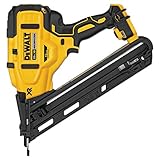
DeWalt’s 20V Max 15-gauge finish nailer is a practical default for contractors already carrying that battery system. It uses a flywheel-style drive system, so there is no fuel cell to buy and no gas smell in an occupied home. Depth adjustment is straightforward, and the platform has widely available batteries, chargers, and replacement parts. Consider the DeWalt 20V Max 15-gauge finish nailer when compatibility with existing batteries matters more than saving a few ounces.
Milwaukee’s M18 15-gauge option is another strong production choice. It is well suited to repeated casing and baseboard installation, with useful firing controls and a broad M18 ecosystem. Milwaukee batteries tend to cost more, but the investment makes sense when the same packs run impact drivers, saws, vacuums, and lights every day. Look at the Milwaukee M18 15-gauge finish nailer if your crew already owns several M18 tools.
Neither platform is automatically better at sinking every nail. Hard oak, dense maple, and angled shots can expose any cordless nailer. Test depth on scrap, keep the nose pressed squarely against the trim, and avoid using a nearly empty battery for final visible work.
Best balance and value: Makita and Metabo HPT
Makita’s 18V LXT system is a good choice for crews that carry LXT already and want a manageable tool. Makita tools commonly have a comfortable grip and good balance, which helps during long casing runs. The downside is less about performance than logistics: depending on your area, the exact nailer, parts, and battery promotions may be less readily stocked than DeWalt or Milwaukee.
Metabo HPT’s 18V finish nailers deserve consideration when kit pricing is favorable. They offer the core features needed for trim work and can be a sensible way to avoid paying premium-platform prices. Buy one only after confirming local availability of 15-gauge nails, batteries, and service support. A low tool price is not a bargain if a damaged magazine takes weeks to repair.
For either system, a Makita 18V LXT 15-gauge finish nailer or comparable Metabo HPT kit is most attractive when the crew already owns compatible packs.
When a cheaper platform is fine
Ryobi’s 18V ONE+ system can be reasonable for a homeowner, punch-list carpenter, or small crew installing trim a few days per month. The lower battery and tool cost leaves more money for a second nailer or a cordless saw. A Ryobi 18V ONE+ 15-gauge finish nailer makes sense when the platform is already in the shop.
The trade-off is production efficiency. You may encounter more slow cycles, larger tool weight, or less refined balance than with premium professional models. That difference is minor for 20 door casings but significant for hundreds of pieces per month. Do not buy into a new battery system solely for one nailer unless the total cost includes at least two batteries and a rapid charger.
Battery and jobsite practice
For a trim crew, two batteries per nailer is a practical minimum: one working and one charging. A 2.0Ah or 3.0Ah pack keeps the tool lighter, while a 4.0Ah or 5.0Ah pack reduces swaps during long runs. Actual nail count varies with wood hardness, nail length, temperature, and how often the tool cycles, so do not plan the day around optimistic runtime claims.
Keep batteries warm in cold weather and let overheated packs cool before charging. Clear jams with the battery removed, inspect the driver blade if the tool begins leaving proud nails, and clean dust from the magazine. Proud nails are often caused by incorrect depth, poor nose contact, a weak battery, or a worn driver—not simply a defective nailer.
Finally, buy nails that match the manufacturer’s specified angle, collation, gauge, and length range. Cheap or damaged strips can cause feeding failures that look like a tool problem. For most trim crews, the best purchase is the 15-gauge nailer that shares batteries with the rest of the truck, supported by a spare pack and a charger fast enough to keep both in rotation.
Related guides
- Longest Lasting Lawn Mower Battery: AGM vs Lithium vs Flooded Lifespan and Cost per Season
- Duralast Gold Lawn Mower Battery Review: U1 Fit, CCA and When to Pay for AGM
- Greenworks Pro 80V 21-Inch Mower Review: Runtime Math, Push vs Self-Propelled and Yard Fit
- Bosch High Pressure Washer Gun Replacement: Fittings, Adapters and What Fits Your Model