What's inside
As an Amazon Associate I earn from qualifying purchases. This post may contain affiliate links at no extra cost to you.
What the Battery Has to Do
All-day trim work is less about maximum battery capacity than about balancing runtime, tool weight, recharge speed, and the nailer’s firing rate. A cordless finish or brad nailer may drive hundreds of fasteners on a small pack, but repeated firing, hard material, cold weather, and poor battery condition can change that quickly.
For most interior trim, a practical setup is two batteries: one on the nailer and one charging or ready to use. A single battery can be enough for a small room, but it leaves no margin for a long baseboard run, a large casing job, or a pack that loses power in cold conditions.
Choose Battery Capacity by Workload
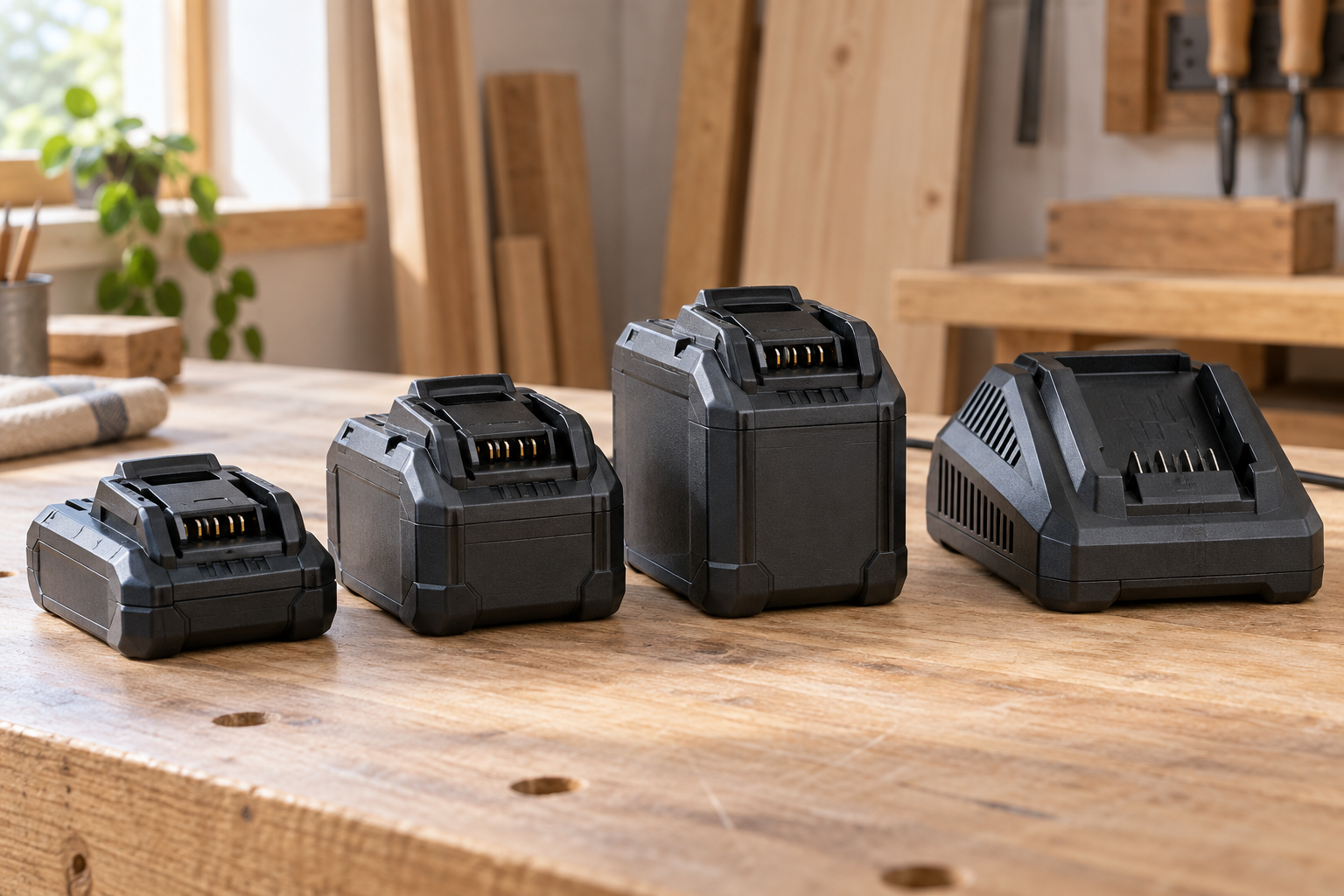
Amp-hours (Ah) describe energy storage, not directly how many nails a battery will drive. A 4.0Ah battery generally stores about twice the energy of a 2.0Ah battery at the same voltage. Actual nail count depends on the tool, fastener length, material, depth setting, and how often the driver cycles.
| Battery size | Best use | Main advantage | Main drawback |
|---|---|---|---|
| 1.5–2.0Ah | Short punch-list work and overhead trim | Lowest weight | More battery changes; less reserve |
| 3.0–4.0Ah | Most room-by-room trim installation | Good runtime-to-weight balance | Heavier than compact packs |
| 5.0Ah and larger | Large jobs and limited charging access | Longest runtime | More weight and bulk on the tool |
For a finish nailer or brad nailer used on baseboard, door casing, and window trim, a 3.0Ah or 4.0Ah pack is usually the sensible starting point. A compact 2.0Ah pack can be the better choice when you are holding the tool above shoulder height for hours. The lighter battery reduces wrist fatigue, even if it requires a swap at lunch.
If the platform offers a compact high-output battery, it may deliver better performance than an older standard pack of similar capacity. However, do not buy a high-output battery solely for a trim nailer unless you also use demanding saws or grinders. The nailer may not benefit enough to justify the price.
Match the Nailer’s Voltage and Platform
The battery must belong to the same voltage platform and physical battery family as the nailer. A 20V-class battery is not interchangeable with an 18V-class system just because the numbers are close, and batteries from different brands normally cannot be fitted safely with an adapter.
Choose the platform based on the rest of your cordless tools. If you already own an impact driver, drill, light, or compact saw, staying with that battery ecosystem is usually cheaper than starting over. A bare nailer often costs less than a kit, but only when you already have compatible batteries and a charger.
For a new platform, compare the charger and battery prices rather than the tool price alone. A low-priced nailer that needs two expensive batteries may cost more over its first year than a better-supported system.
Browse bare cordless finish nailers if you already own compatible packs. If you are starting from nothing, a nailer kit with battery and charger can be the better value.
Plan for Runtime and Failure Modes
Do not judge runtime by the number of nails listed in advertising. Those figures often come from controlled testing with short fasteners and minimal pauses. A trim installer may fire several nails per minute for hours, repeatedly reposition the tool, and use longer 2-1/2-inch fasteners in dense material.
Common battery-related failures include a sudden low-battery warning, slow cycling, failure to sink nails fully, and the tool stopping under load. A pack can show a reasonable charge on its indicator but still sag under load when its cells are cold, worn, or damaged. If the nailer begins leaving proud heads, first check depth adjustment, fastener compatibility, and the driver blade before blaming the battery.
For a full day, carry two charged batteries and keep the spare out of direct sun, rain, and freezing conditions. Do not leave lithium-ion packs in a hot vehicle; high heat accelerates aging and can permanently reduce capacity. In cold weather, let the battery warm indoors before use. Many packs will refuse to charge while too cold, which can turn a short break into a long delay.
Charger Speed Matters More Than It Seems
A fast charger is useful only if you have enough batteries to keep working while one charges. A slow charger may be perfectly adequate for occasional trim work or a small renovation. For daily production work, prioritize a charger that can refill a mid-size pack during lunch or a normal break.
Charging time varies by battery size, charger output, temperature, and battery age. A large 5.0Ah pack can take substantially longer than a 2.0Ah pack, even on the same charger. If your workday includes frequent breaks, two 3.0Ah or 4.0Ah batteries may be more practical than one large pack because you can rotate them continuously.
Look for rapid cordless tool chargers when the nailer is part of regular paid work. For a homeowner installing trim in one or two rooms, the standard charger included with a kit is usually fine.
Do Not Ignore Weight and Balance
The battery sits at the handle end of the nailer, so every extra pound affects wrist position and overhead control. A large pack may provide more shots, but it can make it harder to hold the tool square against narrow casing. That increases the chance of angled nails, surface marks, and fatigue.
Test the tool with the battery attached if possible. Hold it at shoulder height for several minutes and check whether the grip forces your wrist backward. For overhead crown molding or extended punch-list work, a compact pack is often worth the extra battery swap. For floor-level baseboard across a new house, the larger pack’s runtime may be more valuable.
A Practical Buying Checklist
Before buying, confirm the nailer’s required battery platform, the fastener lengths it accepts, and whether the battery blocks the belt hook or magazine release. Buy batteries from the tool maker or an established authorized seller; questionable replacement packs can have poor cell matching, unreliable protection electronics, and limited warranty support.
For most users, the best all-day trim setup is a compatible 18V or 20V-class nailer, two 3.0Ah to 4.0Ah batteries, and a charger capable of replenishing one pack during breaks. Choose compact 2.0Ah packs when tool weight is the bigger problem. Choose 5.0Ah or larger only when long uninterrupted runtime matters more than balance and fatigue.
Related guides
- Longest Lasting Lawn Mower Battery: AGM vs Lithium vs Flooded Lifespan and Cost per Season
- Duralast Gold Lawn Mower Battery Review: U1 Fit, CCA and When to Pay for AGM
- Greenworks Pro 80V 21-Inch Mower Review: Runtime Math, Push vs Self-Propelled and Yard Fit
- Bosch High Pressure Washer Gun Replacement: Fittings, Adapters and What Fits Your Model