What's inside
As an Amazon Associate I earn from qualifying purchases. This post may contain affiliate links at no extra cost to you.
Between service calls, a dead battery can cost more time than the repair itself. The right cordless charger keeps a work vehicle supplied without turning every stop into a long wait. The best choice depends less on maximum charging speed than on your battery platform, available power, vehicle setup, and whether you need one battery ready quickly or several batteries maintained all day.
As an Amazon Associate we earn from qualifying purchases at no extra cost to you.


What matters between service calls
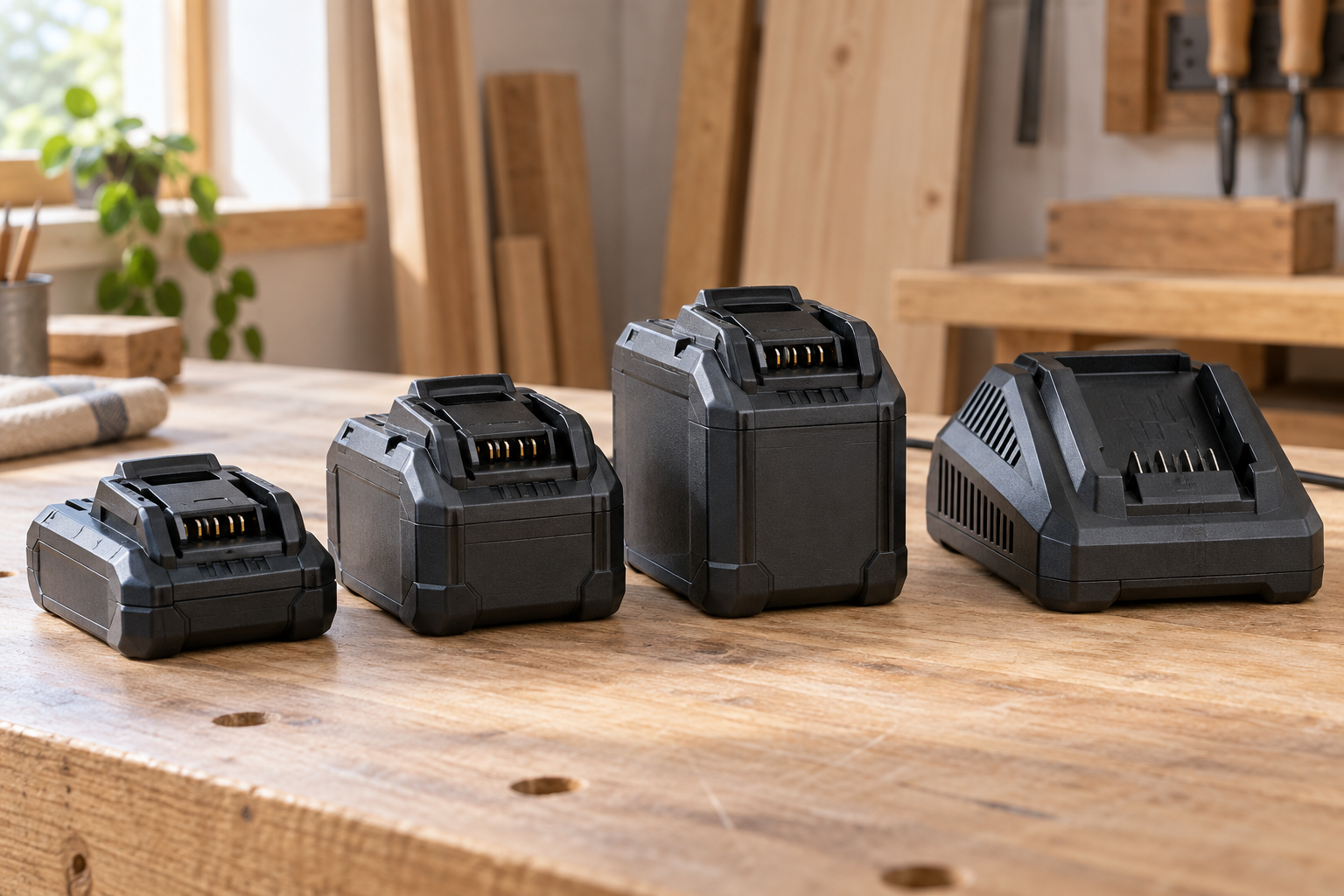
Start with compatibility. A charger made for one battery ecosystem generally will not charge another brand’s pack, even when the batteries look similar. Within a platform, check voltage and battery generation. A charger may accept both compact and high-capacity packs, but some older chargers do not deliver the best performance with newer high-output batteries.
Charging speed is the next consideration. A typical compact 18V or 20V battery may take roughly 30 to 60 minutes on a standard charger. A 5.0Ah pack can take about 45 to 90 minutes, depending on the charger and battery electronics. Rapid chargers may cut that time substantially, but they usually cost more and create more heat. Heat is not automatically a defect, but repeated high-temperature charging can reduce long-term battery life if the pack is charged immediately after heavy use.
For most technicians, a standard platform battery charger is the sensible starting point. It is inexpensive, portable, and fast enough when you have 30 minutes or more between appointments.
Charger types compared
| Charger type | Best use | Typical trade-off |
|---|---|---|
| Standard single-bay charger | One technician carrying a few batteries | Lowest cost, but only one pack charges at a time |
| Rapid charger | Short gaps between demanding jobs | Higher price, more heat, and sometimes more bulk |
| Dual-port charger | Technicians who need two batteries ready | May charge sequentially rather than simultaneously |
| Multi-bay charger | Fleet vehicles, shops, and heavy daily use | Less portable and often expensive |
| 12V/vehicle charger | Charging directly from a service vehicle | Convenient, but dependent on the vehicle electrical system |
Best for most technicians: a standard single-bay charger
A single-bay charger is usually the best value when you own two or three batteries and can charge at a shop, home, or lunch stop. Keep one battery in the tool, one on the charger, and one as a reserve. This rotation avoids the pressure to charge a completely depleted pack in a few minutes.
Look for a charger with a clear full-charge indicator, cooling vents, and a stable base. A charger that slides around on a van shelf is more annoying than a charger that is a few minutes slower. The battery should lock in positively, and the release should remain accessible when the charger is mounted near a wall or storage bin.
The cheaper option is fine here. If your jobs use drills, drivers, lights, and compact saws intermittently, paying extra for the fastest charger may not improve your day. A basic charger from the same battery platform is often the right purchase, particularly if you already have enough batteries to cover travel time.
Best for tight schedules: a rapid charger
A rapid charger earns its cost when batteries are being drained faster than they can be rotated. This is common with cordless grinders, reciprocating saws, rotary hammers, high-powered circular saws, and outdoor equipment. A rapid charger may refill a compact pack in around 20 to 30 minutes, though the exact time depends on battery capacity, temperature, and the charger’s charging profile.
Do not judge a charger by its advertised minimum time alone. That figure usually applies to a small battery under favorable conditions. A large 8.0Ah or 12.0Ah pack will still need considerably longer. Also, a hot battery may pause or charge slowly while its internal sensors protect the cells. Set used batteries aside for 10 to 20 minutes after hard work when possible.
Choose a rapid cordless tool battery charger when every appointment depends on high-demand tools. Otherwise, use the savings for another battery. An extra pack often provides more practical uptime than a faster charger because it lets you keep working while the depleted battery cools and charges.
Charging in a service vehicle
Vehicle charging is useful, but it has limitations. A charger designed for a 12V vehicle outlet can be convenient for compact battery systems and light-duty travel. Check the charger’s input requirements before plugging it into a USB adapter or accessory socket. Many tool chargers need more power than a basic USB port can provide.
An inverter can run a normal AC charger from a vehicle, but size it correctly. A small inverter may handle a standard charger while failing with a rapid charger because of startup and sustained wattage demands. A 300-watt pure-sine inverter gives more margin than a tiny 100-watt unit, but the charger’s actual input rating is the final authority.
Repeated charging with the engine off can drain a vehicle battery. If you charge during stops, monitor the vehicle’s battery condition and avoid leaving an inverter connected overnight. For fleets, a professionally installed auxiliary battery or regulated power system is safer than improvising with several adapters.
When a dual-port or multi-bay charger makes sense
A dual-port charger is useful when you return to the shop with several depleted batteries. Be careful with the wording: some dual-port units charge one battery first and then switch to the second. Others can charge simultaneously, but at reduced output. Read the charging sequence before buying.
For a van serving multiple technicians, a multi-bay cordless battery charger reduces cable clutter and keeps a charging station organized. It is less attractive for a solo technician because it takes up shelf space and can become a single point of failure. If the unit fails, several batteries may be waiting on it.
Avoiding common charging failures
Use the manufacturer’s charger for the battery platform. Cheap universal chargers and damaged aftermarket adapters can create fit, communication, and overheating problems. Inspect contacts for dirt, corrosion, or bent metal, and do not charge a pack that is swollen, cracked, wet, or unusually hot.
Keep chargers ventilated rather than buried under coats, parts, or tool bags. Do not charge lithium-ion batteries in extreme heat or freezing conditions unless the manufacturer specifically permits it. Finally, mark batteries with a simple date or rotation number. This makes it easier to identify a weak pack before it strands you between calls.
Related guides
- Longest Lasting Lawn Mower Battery: AGM vs Lithium vs Flooded Lifespan and Cost per Season
- Duralast Gold Lawn Mower Battery Review: U1 Fit, CCA and When to Pay for AGM
- Greenworks Pro 80V 21-Inch Mower Review: Runtime Math, Push vs Self-Propelled and Yard Fit
- Bosch High Pressure Washer Gun Replacement: Fittings, Adapters and What Fits Your Model