What's inside
As an Amazon Associate I earn from qualifying purchases. This post may contain affiliate links at no extra cost to you.
A van charger has to do more than recharge a battery. It must fit a crowded shelf, survive vibration, avoid overheating a small electrical system, and make it easy to find a charged pack when a job runs late. The best choice depends on how many batteries you use each day and whether your van has reliable mains power.
What matters in a van charger
Start with the charger’s physical footprint. A typical single-battery charger occupies roughly 6 by 8 inches, while a dual-port or high-output unit can take up twice that area. Measure the shelf, drawer, or wall panel before buying. Leave space around the charger vents; packing it tightly against plywood or a tool case can trap heat and extend charge times.
Check the input power as well. Most workshop chargers run from 120-volt AC power, commonly drawing between 2 and 8 amps. That is not a problem on shore power, but it matters if you run the charger from a power inverter. A 500-watt charger load can require more than 40 amps from a 12-volt battery after inverter losses. That can flatten a van’s starter battery surprisingly quickly.
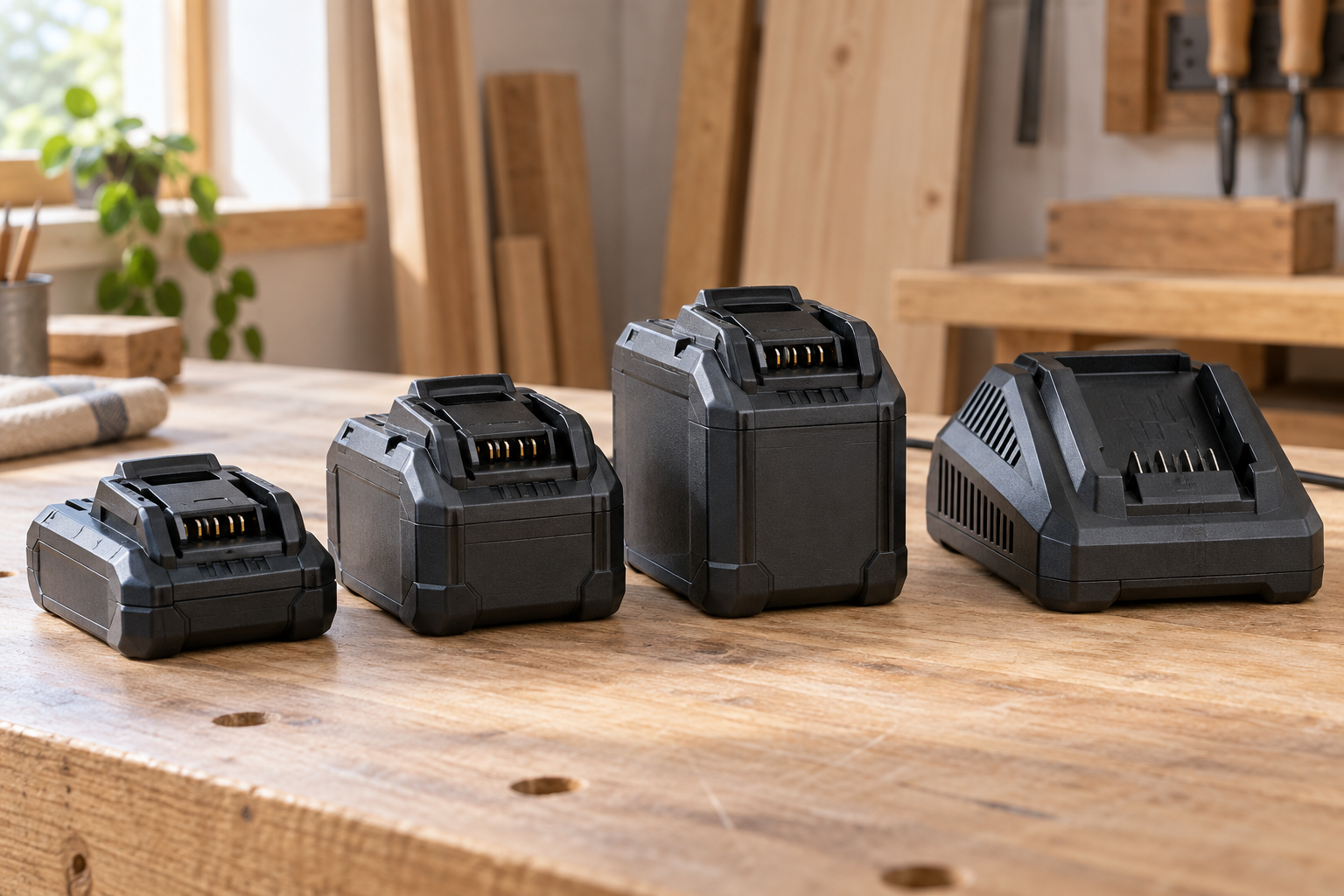
For most tradespeople, a compact compact cordless tool battery charger is the sensible baseline. It is inexpensive, easy to replace, and small enough to keep in a dedicated charging box. The limitation is simple: one battery charges at a time.
Charger types compared
| Charger type | Best for | Main advantage | Main drawback |
|---|---|---|---|
| Basic single-port | Light users and backup kits | Small, cheap, low power draw | Only one battery charging |
| Rapid single-port | One-platform users with heavy daily use | Gets a working pack ready quickly | More heat, cost, and electrical demand |
| Dual-port sequential | Users carrying several batteries | Compact way to automate the next charge | Usually does not charge both packs at full speed together |
| Multi-port charger | Crews sharing one battery platform | Less charger clutter and fewer loose cables | Larger footprint and higher price |
| 12-volt vehicle charger | Mobile charging between jobs | Works without shore power or an inverter | Usually slower and platform-specific |
Best choice for most vans
A single rapid charger is usually the best compromise for a one-person van using four to eight batteries on a normal day. Keep one battery on the charger whenever the van is parked at a customer’s site or connected to mains power. A 4Ah pack may charge in roughly 30 to 60 minutes on a rapid unit, depending on the brand and charger, while a basic charger may take 90 minutes or longer. Larger 6Ah and 8Ah packs generally take longer and produce more heat.
Rapid charging is not automatically better. Heat is the enemy of lithium-ion battery life. If a pack comes off a tool hot after cutting or drilling, let it cool for 15 to 30 minutes before charging. Some chargers refuse a hot battery; others reduce current automatically. Do not defeat those protections. Repeatedly charging hot packs can shorten their useful life even if the charger appears to work normally.
If your workday consumes batteries faster than one charger can replenish them, consider a dual-port cordless tool battery charger. Check whether it charges sequentially or simultaneously. Sequential models often fill one battery, then switch to the next. That is still useful, but it will not deliver two full charges in the time of one.
Match the charger to your battery platform
Chargers are not universal across cordless tool brands. Even batteries with similar voltage labels may use different terminals, temperature sensors, and charging controls. Buy a charger made for the exact battery ecosystem, not merely one rated for “18V” or “20V MAX.” Those voltage labels often describe the same nominal class, but the electronics and physical connections remain different.
Staying within one platform has a major storage benefit. One charger can serve drills, impact drivers, saws, lights, inflators, and other tools. If you own tools from two platforms, keeping one compact charger for each is usually better than buying adapters. Adapters add another failure point and may not preserve the battery’s temperature or low-voltage protections.
For a mixed-brand van, look at battery charger organizer cases only if they provide ventilation and cable management. A soft case is useful for transport, but do not run a charger inside a closed case. A simple plywood shelf with a raised rear edge and a short retaining strap is often safer and easier to repair.
12-volt charging and inverters
A dedicated vehicle charger can make sense if you spend much of the day driving. It connects to a 12-volt outlet or auxiliary circuit and avoids inverter losses. However, charging is commonly slower than with the manufacturer’s mains charger, and not every battery platform offers a proper vehicle charger. Avoid cheap universal adapters that rely on questionable terminal conversions.
An inverter is more flexible because it can power the charger you already own. Use a pure sine-wave inverter sized above the charger’s continuous wattage; 1,000 watts gives useful headroom for many compact chargers. Connect it to an auxiliary battery or approved high-current circuit with the correct fuse. Do not run a high-power inverter from a lightly wired dashboard outlet. A charger that trips the inverter, warms the cable, or causes voltage alarms is undersized for the installation.
Safe compact storage
Mount the charger where its intake and exhaust vents remain clear, ideally with at least 2 inches of open space around them. Secure it against braking and cornering, but do not block the battery connection with a strap or bracket. Keep metal tools, loose screws, and battery terminals separated. A dropped wrench across battery contacts can cause a short, heat, and fire.
Do not leave batteries permanently on a hot dashboard or in an unventilated metal box. High temperatures accelerate battery aging, while freezing temperatures can prevent charging until the pack warms. In winter, bring cold batteries into the cab and let them reach room temperature before charging.
For light use, the cheaper basic charger is fine. Spend more on a rapid or dual-port charger only when downtime costs more than the charger, or when your daily battery rotation genuinely requires it. In a compact van, a smaller charger that is always accessible is often more useful than a faster unit buried under cases.
Related guides
- Longest Lasting Lawn Mower Battery: AGM vs Lithium vs Flooded Lifespan and Cost per Season
- Duralast Gold Lawn Mower Battery Review: U1 Fit, CCA and When to Pay for AGM
- Greenworks Pro 80V 21-Inch Mower Review: Runtime Math, Push vs Self-Propelled and Yard Fit
- Bosch High Pressure Washer Gun Replacement: Fittings, Adapters and What Fits Your Model