What's inside
As an Amazon Associate I earn from qualifying purchases. This post may contain affiliate links at no extra cost to you.
Finish work looks light on paper, but cordless tools can drain batteries quickly when the day includes a trim router, random-orbit sander, vacuum, and a nailer. The right battery setup is not simply the largest pack you can afford. It is enough stored energy to cover your actual tool mix, plus a charging plan that prevents the last battery from becoming a work stoppage.
Start With the Work, Not the Battery
List the tools you will use and estimate how long each will run under load. A cordless finish nailer may fire hundreds of nails on one battery because its motor runs only briefly for each shot. A sander or vacuum runs continuously and is a much heavier consumer.
For a typical eight-hour trim or built-in installation day, the battery demand often looks like this:
| Tool | Typical active use | Practical battery demand |
|---|---|---|
| Finish or brad nailer | Intermittent, 200–600 shots | One 2.0Ah to 5.0Ah pack |
| Random-orbit sander | 30–90 minutes of motor-on time | One 4.0Ah to 5.0Ah pack |
| Trim router | 15–45 minutes of cutting | One 4.0Ah to 8.0Ah pack |
| Compact dust extractor | 1–3 hours, often alongside another tool | One or more 5.0Ah to 8.0Ah packs |
| Drill or impact driver | Intermittent fastening and drilling | One 2.0Ah to 5.0Ah pack |
These are planning ranges, not promises. Hardwood, dull abrasives, long screws, dense MDF, and a clogged filter can double consumption. Battery temperature, tool age, and how aggressively you work matter too.
Understand Amp-Hours Without Overcomplicating It
Amp-hours are a measure of stored charge. On the same voltage platform, a 5.0Ah battery contains roughly 2.5 times the energy of a 2.0Ah battery. It also tends to weigh more, cost more, and take longer to charge.
Voltage differences make direct comparisons misleading. The rough energy calculation is:
watt-hours = nominal volts × amp-hours
A 20-volt-class 5.0Ah pack stores about 100 watt-hours using the nominal 20-volt label. An 18-volt 5.0Ah pack stores about 90 watt-hours. In real use, the numbers are not perfectly comparable because manufacturers measure and market packs differently, but the calculation is useful for spotting large differences.
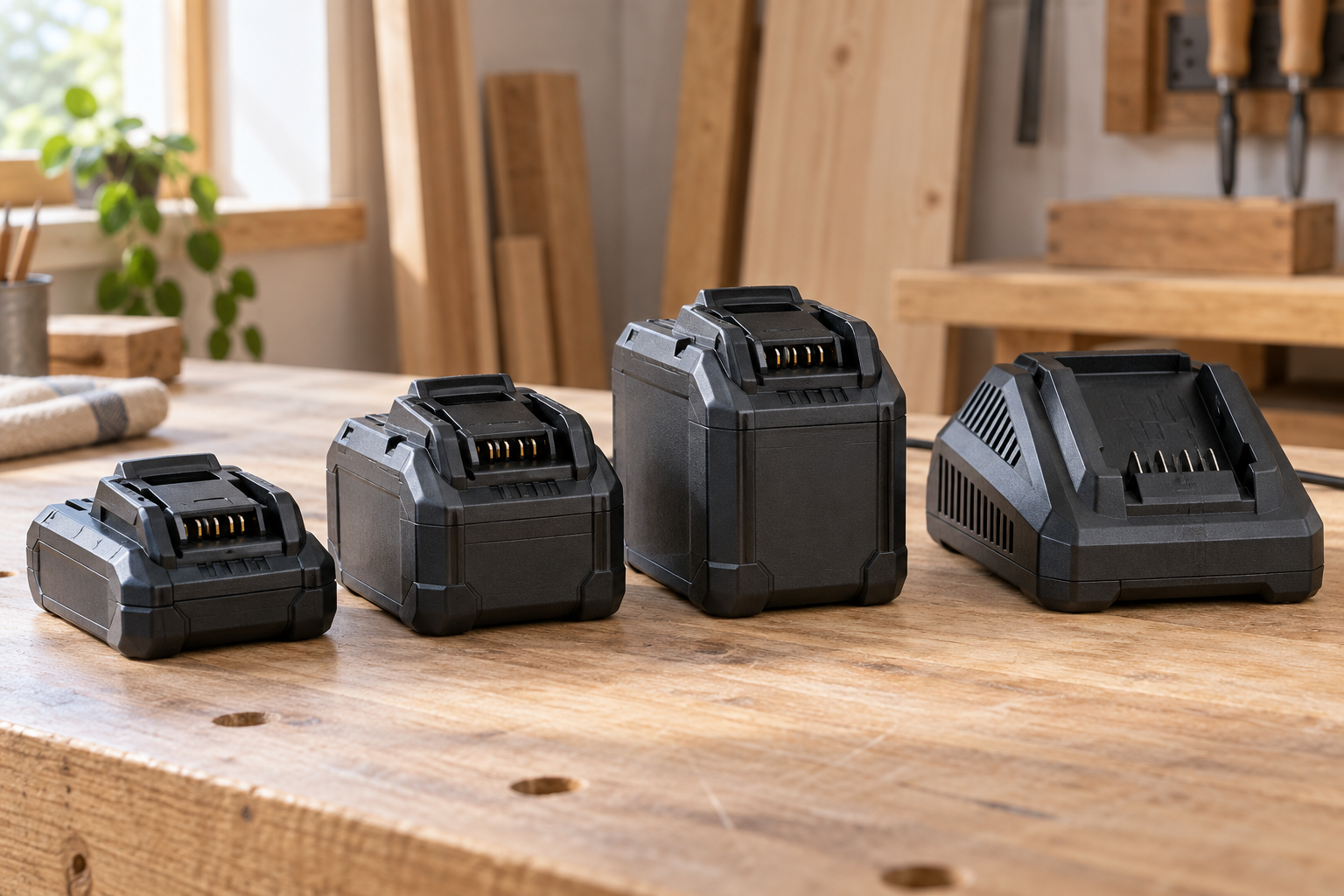
For finish work, a 2.0Ah or 3.0Ah battery is often ideal on a nailer or drill. It keeps the tool compact and reduces wrist fatigue. A 5.0Ah pack is a better general-purpose size for sanders and routers. Larger high-output packs make sense for vacuums and saws, but they can make a nailer awkward and top-heavy.
Build a Full-Day Battery Plan
For one person doing ordinary interior trim, a sensible starting point is two small packs and three or four medium packs. For example, two 2.0Ah packs can stay on a nailer and drill, while three 5.0Ah packs rotate through a sander, router, and vacuum.
If the work includes continuous sanding or dust extraction, increase the reserve. A practical heavy-use setup is four 5.0Ah packs, or two 5.0Ah packs plus two 8.0Ah packs for the vacuum and router. This is usually more useful than buying six small batteries, because larger packs reduce battery changes and maintain performance under load.
Do not count every battery in a kit as available energy. Keep one charged pack in reserve for unexpected work, a dead battery caused by cold storage, or a tool that consumes more than expected. Running every pack to empty leaves no recovery time when the charger cannot keep up.
Charger Speed Matters as Much as Capacity
A single basic charger can undermine a large battery collection. If it takes 90 minutes to charge a 5.0Ah pack and your sander empties one in 45 minutes, the math will not work unless you have enough packs to bridge the gap.
Use a two-port or rapid charger when the brand offers one, but check the charging speed for the specific battery size. Some rapid chargers are fast with compact packs but take much longer with 8.0Ah batteries. A rotating system works best: one battery in the tool, one cooling before charging, one charging, and one ready.
| Work pattern | Reasonable starting setup | When to add more |
|---|---|---|
| Occasional trim repairs | Two 2.0Ah and two 5.0Ah packs | You use a sander or vacuum for more than an hour |
| Regular full-day trim installation | Two 2.0Ah and three or four 5.0Ah packs | There is no charged reserve by mid-afternoon |
| Heavy sanding, routing, and extraction | Four 5.0Ah packs or a mix of 5.0Ah and 8.0Ah packs | High-draw tools still stop during charging cycles |
Choose the Platform Before Buying More Batteries
Battery compatibility is usually limited to one manufacturer’s voltage family. A compact 18-volt battery may not fit that company’s high-voltage tools, even if the packs look similar. Before buying, identify the platform’s nailers, sanders, routers, vacuums, lights, and chargers. A platform with fewer tools may still be the better choice if its batteries, chargers, and tools are cheaper for the work you actually do.
For a new platform, compare the price of bare tools and replacement batteries, not just the first combo kit. Look for a cordless power tool battery platform starter kit only after confirming that the included battery sizes suit your tools. A kit with two small batteries is inexpensive but may leave you buying larger packs immediately.
It is also worth checking whether the brand offers a dual-port cordless tool battery charger. The extra cost can be justified for daily work, while a basic single charger is perfectly adequate for occasional weekend jobs.
Avoid Common Runtime Mistakes
Do not use a large battery to fix a maintenance problem. A sander with a clogged dust port, overloaded abrasive, or worn pad will consume power quickly and perform poorly. Replace sanding discs before they become completely dull, clean filters, and use the correct blade or bit.
Do not leave lithium-ion batteries in a hot vehicle or charge a pack immediately after heavy use if it is hot to the touch. Let it cool first. In cold conditions, keep spare batteries indoors or in an insulated bag; cold packs deliver less power and may shut down under load.
Finally, budget for a corded backup when continuous extraction or sanding is central to the job. The cheaper option is often fine for a homeowner doing a few rooms per year: two medium batteries, a standard charger, and planned breaks may be all that is needed. Professionals and anyone working far from an outlet should pay for the larger packs and faster charging because downtime costs more than the battery.
Related guides
- Longest Lasting Lawn Mower Battery: AGM vs Lithium vs Flooded Lifespan and Cost per Season
- Duralast Gold Lawn Mower Battery Review: U1 Fit, CCA and When to Pay for AGM
- Greenworks Pro 80V 21-Inch Mower Review: Runtime Math, Push vs Self-Propelled and Yard Fit
- Bosch High Pressure Washer Gun Replacement: Fittings, Adapters and What Fits Your Model