What's inside
As an Amazon Associate I earn from qualifying purchases. This post may contain affiliate links at no extra cost to you.
Different generations of cordless-tool batteries can often run older tools from the same brand, but the logo alone does not guarantee compatibility. The deciding factors are the platform voltage, physical fit, connector and communication design, and the tool maker’s compatibility rules. A battery that slides onto a tool may still be a poor or unsafe match.
Start with the platform, not the battery’s age
Find the voltage and platform name printed on the tool and battery. A battery from a 20V MAX platform is not interchangeable with a 12V or 60V platform simply because the brand is the same. Voltage labels can also be confusing: many “20V MAX” tools operate at a nominal 18 volts, but that does not make every 18V battery compatible. The mounting system and electronics still have to match.
Within one platform, a newer battery may fit an older tool if the manufacturer designed the connection to be backward-compatible. Some brands have kept a basic battery interface for years; others have changed rails, terminals, or control electronics between product generations. Check the compatibility chart or manual for the exact tool and battery families. If the chart excludes a pairing, do not rely on a seller’s claim that the parts look alike.
What to check before buying
Inspect the tool’s model number and the battery’s full series or platform marking. Look up both in the manufacturer’s compatibility information, rather than checking only the battery’s advertised voltage. Also verify charger compatibility separately: batteries that fit the same tool do not necessarily charge on the same charger.
Pay attention to any stated minimum battery size or restrictions. A manufacturer may approve a battery family for an older tool but recommend a higher-capacity pack for demanding work. A small pack may power a drill for light assembly yet shut down quickly in a high-draw saw. Modern packs may also include temperature, current, or identification signals that an older tool or charger does not support.
A physical fit is not the whole story
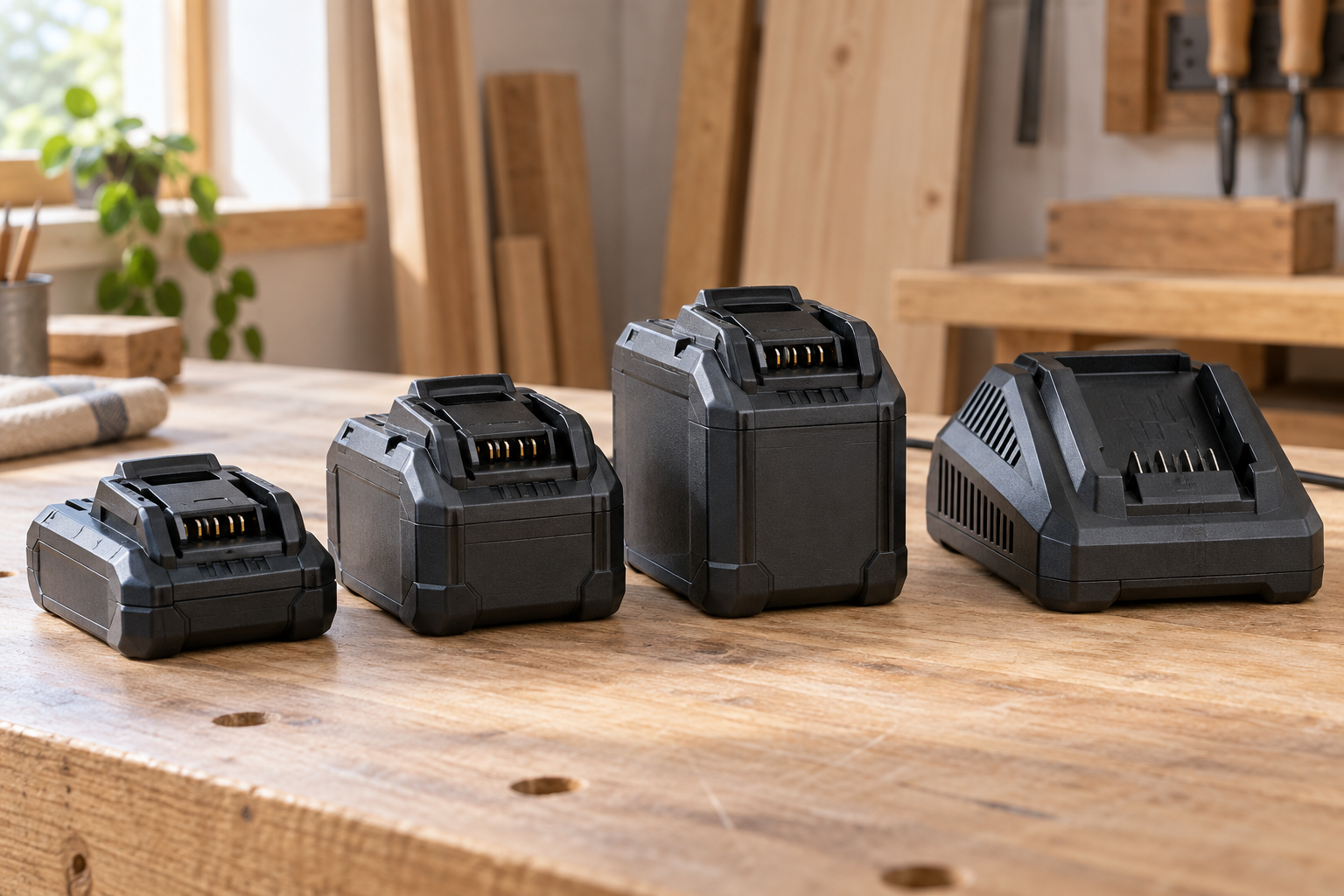
Battery capacity, measured in amp-hours (Ah), mainly affects runtime, while the pack’s ability to deliver current affects performance under load. An older compact battery can make a modern high-draw tool run hotter or trigger its low-voltage protection sooner. A larger pack can add runtime, but also adds weight: moving from a compact 2Ah pack to a 5Ah pack may be noticeable on a drill held overhead or a driver used all day.
There are practical failure modes to watch for. A pack that cuts out during a saw cut may be overheating or unable to sustain the tool’s draw. A loose fit, damaged latch, or worn contacts can cause intermittent power and arcing. If the battery gets unusually hot, smells burnt, swells, leaks, or repeatedly shuts down, stop using it. Do not file rails, bend terminals, or force a pack onto a tool to make it fit.
How common generation changes affect older tools
| Battery change | Likely result on an older tool | What to verify |
|---|---|---|
| Same platform, newer pack, same mounting system | Often works; runtime may improve | Manufacturer compatibility chart and tool restrictions |
| Same brand, different voltage platform | Usually will not fit or operate correctly | Exact voltage and platform marking |
| Same platform, much larger capacity | Usually more runtime, with added weight | Fit, approved battery family, balance and clearance |
| Third-party pack or adapter | May fit but can lose protection or communication features | Tool, charger, warranty, and safety compatibility |
| Older battery on a newer charger | May charge, but not automatically | Charger’s approved battery list |
Chargers and adapters need their own check
Never assume that a charger accepts every battery from the brand. Chargers monitor pack voltage and temperature, and some identify the battery electronically. A charger designed for a newer family may reject an older pack, or an older charger may not support a newer one. Use the compatibility list printed in the manual or on the manufacturer’s support site.
Third-party adapters can connect batteries across brands, but they are a compromise, not a universal solution. An adapter may bypass low-voltage protection, temperature monitoring, or communication between the pack and tool. That can increase the chance of a battery being over-discharged or overheating, especially in high-draw tools. Do not use an adapter to charge a battery unless its maker explicitly approves that exact arrangement. For occasional low-load use, an adapter may be convenient, but a genuine compatible battery is the safer choice for routine work.
Choose the pack for the work
If the existing tool is compatible and used occasionally, a smaller, lower-cost genuine pack can be reasonable. For light drilling, fastening, or household repairs, a compact battery may be easier to handle than a high-capacity one. Compare a compatible compact battery with the manufacturer’s listed fit and capacity before ordering.
For circular saws, grinders, or long, repeated cuts, choose a battery capacity the tool maker recommends for that platform. More amp-hours can reduce interruptions, but do not assume that a larger pack will cure a tool that is overheating or worn out. If you own several tools on one system, buying a battery and charger kit may be cheaper than purchasing each item separately; check that the included charger supports every pack you plan to keep.
When the battery is old, inspect its condition as well as its generation. A pack that has lost runtime, has cracked housing, or no longer latches securely should be replaced rather than adapted. For a replacement, use the exact platform and a pack from the tool maker or a reputable source with clear compatibility information. A battery-and-charger kit for your platform can be a sensible buy if your current charger is old or its compatibility is uncertain.
Test a new combination carefully
After confirming compatibility, inspect the contacts and latch, then install the battery without forcing it. Run the tool briefly with no load. If it behaves normally, try a short, moderate task and check for unexpected heat, cutting out, or a loose connection. Stop immediately if anything seems abnormal. A test cannot replace the manufacturer’s compatibility guidance, but it can catch a damaged pack or worn tool contact before you rely on it for a full day’s work.
Related guides
- Longest Lasting Lawn Mower Battery: AGM vs Lithium vs Flooded Lifespan and Cost per Season
- Duralast Gold Lawn Mower Battery Review: U1 Fit, CCA and When to Pay for AGM
- Greenworks Pro 80V 21-Inch Mower Review: Runtime Math, Push vs Self-Propelled and Yard Fit
- Bosch High Pressure Washer Gun Replacement: Fittings, Adapters and What Fits Your Model