What's inside
As an Amazon Associate I earn from qualifying purchases. This post may contain affiliate links at no extra cost to you.
A cordless platform is a shared battery-and-charger system. Individual tool performance is what happens when a particular drill, saw, or grinder does a particular job. They overlap, but they are not the same buying decision: a platform can be convenient and economical while one tool in it is underpowered, awkward, or poorly suited to your work.
Compare the battery ecosystem for the tools you expect to own, then judge each tool on the job it must do. Battery voltage or a large amp-hour number alone cannot tell you whether a tool will cut quickly, fit into a cabinet, or run long enough to finish the task.
As an Amazon Associate we earn from qualifying purchases at no extra cost to you.


Start with the work, not the platform
List the jobs you do most often and the tools needed for them. Occasional shelf installation might call for a drill and driver. Repeated deck work, framing, or landscaping can justify a larger battery collection and more capable tools. For a one-off job, renting or buying a corded tool may cost less than entering a new battery system.
Set a realistic workload: how many holes, cuts, or fasteners per session, and how often you work away from an outlet? A homeowner drilling a few holes per month has different needs from a contractor running a saw all morning. Buy capacity for the actual work rather than for an imagined full shop.
Compare what the platform includes
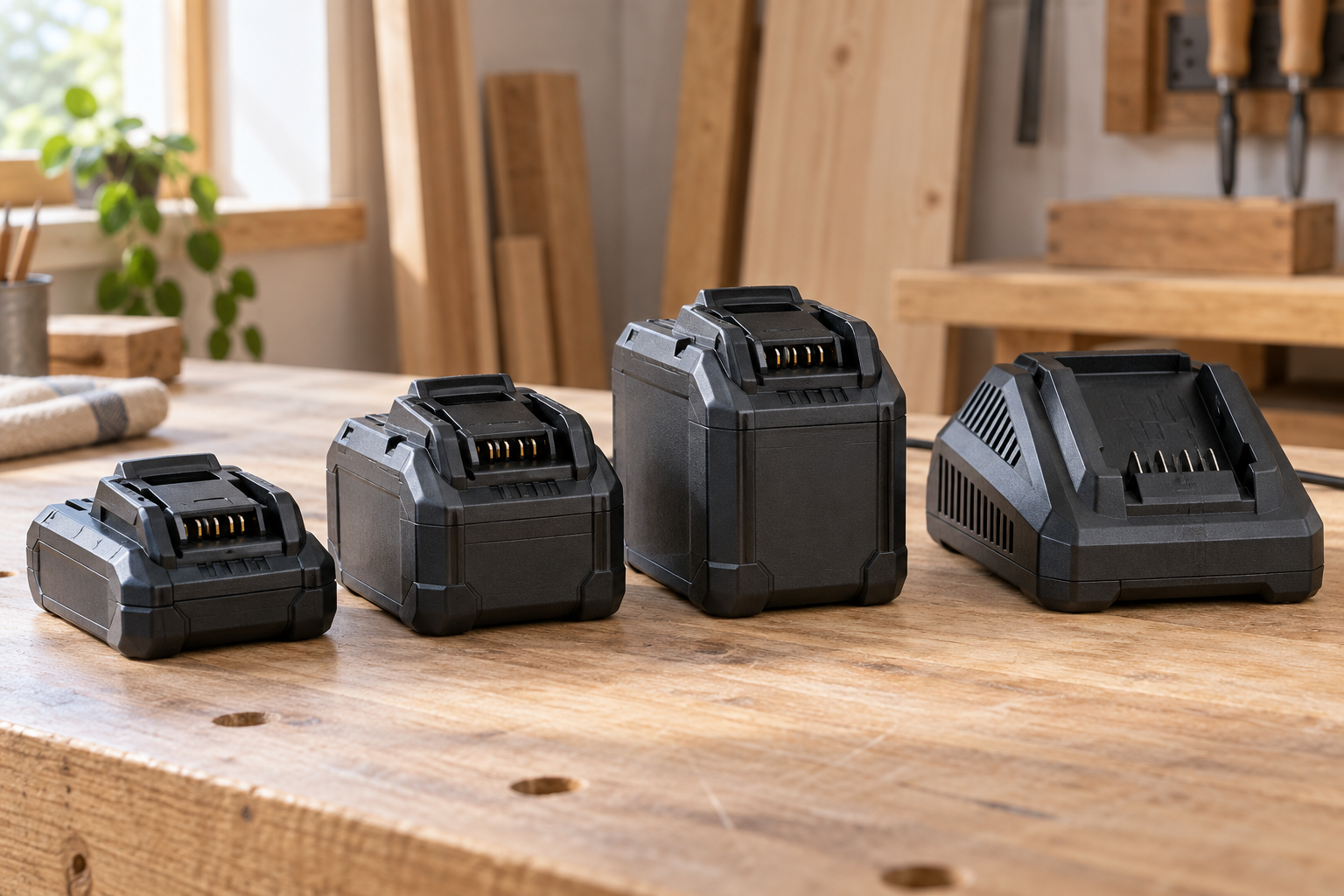
Check which tools use the same battery family, whether batteries are interchangeable across tool sizes, and what the starter kit actually contains. Some brands sell compact and high-output batteries within one family; others have separate systems or exceptions. Confirm compatibility on the manufacturer’s product page rather than assuming that similar-looking packs fit.
Also compare charger speed, battery prices, and kit contents. A kit with two small batteries may be a better start for light work than one with a single expensive large pack. For heavy cutting or grinding, however, a small pack may overheat, limit output, or need frequent changes. If you are choosing your first system, compare cordless tool combo kits by included tools, batteries, and charger—not just the advertised tool count.
| What to compare | Why it matters | What to check |
|---|---|---|
| Battery compatibility | Determines whether future tools can use packs you already own | Exact battery family, tool exceptions, and pack fit |
| Battery capacity | Affects runtime, weight, and sometimes sustained output | Amp-hour rating, pack size, and the job used to estimate runtime |
| Charger | Slow charging can leave a workday waiting on one pack | Charge time for the battery size you plan to use |
| Individual tool | Controls speed, handling, and finish on the actual task | Power, dimensions, weight, controls, and job-specific features |
| Cost to expand | A cheap starter kit can lead to costly additions | Tool-only prices, batteries, chargers, and available kits |
Read battery numbers in context
Amp-hours (Ah) describe battery capacity, not a guaranteed number of cuts or screws. A 5 Ah pack nominally stores more energy than a 2 Ah pack of the same voltage, but actual runtime varies with material, pressure, accessory sharpness, tool efficiency, temperature, and battery condition. A larger pack also adds weight and can make an overhead drill or compact impact driver tiring.
Voltage is not a direct performance score across brands or tool designs. Nor does a higher maximum torque figure mean a drill will always work faster; gearing, motor design, clutch settings, and the bit all matter. For demanding tools, look for tests using a similar task and material, not just peak figures on the box.
Heat is a practical limit. Repeatedly forcing a saw through thick stock with a dull blade can drain a battery quickly and trigger a temperature shutdown. Let a hot pack cool naturally before charging; charging very hot or cold batteries may be delayed by the charger. Keep a second compatible pack if the work cannot wait, rather than expecting a larger battery to solve poor technique or an unsuitable tool.
Judge each tool on its own
For a drill, check chuck capacity, speed range, clutch control, and balance with the battery attached. For a circular saw, compare blade size, cut depth, bevel range, visibility along the cut, and whether it can maintain speed in the material you use. For an impact driver, consider control at low speed and how easily it avoids stripping small fasteners. A compact tool that fits between joists can be more useful than a stronger one that cannot reach the work.
Weight and ergonomics are not minor details when a tool is used for hours. Try the tool with the battery size you would actually use; a bare-tool weight omits the pack. Check trigger response, grip, guard access, and whether the tool feels balanced. If frequent overhead work is involved, a smaller pack may be worth the shorter runtime.
For work where speed and sustained cutting matter, compare cordless circular saws by cut capacity and handling as well as battery family. For occasional short cuts, a lower-cost saw can be entirely adequate with a sharp blade and sensible feed rate.
Calculate the cost of getting equipped
Compare the total cost of the tools and batteries you need over the next few years. A tool-only price looks attractive only if you already own compatible batteries and a charger. If not, include the starter kit. Check whether a tool bundle offers a useful pack size, and whether the charger can handle your largest planned battery.
Mixing brands can make sense when one tool is unusually good for a specific job, but it adds batteries, chargers, and storage. Battery adapters may exist, yet they can introduce fit, protection, warranty, or performance concerns. Do not assume an adapter makes every pack safe or fully compatible; follow both manufacturers’ guidance.
When the cheaper option is fine
A budget kit is often a sensible choice for occasional home repairs, light assembly, or a few seasonal projects. You may not need high-output batteries, brushless motors, or a premium charger if the tools run briefly and cool between tasks. A corded tool can be the better-value choice for a stationary job that needs uninterrupted power.
Pay more when you can identify the benefit: frequent use, longer runtime, tighter access, better control, faster charging, or a tool that keeps working under sustained load. Avoid paying extra for a large platform before you know which tools you will actually use. Compare the complete system and the specific tool against your work; neither battery compatibility nor a headline performance number is a substitute for that check.
Related guides
- Longest Lasting Lawn Mower Battery: AGM vs Lithium vs Flooded Lifespan and Cost per Season
- Duralast Gold Lawn Mower Battery Review: U1 Fit, CCA and When to Pay for AGM
- Greenworks Pro 80V 21-Inch Mower Review: Runtime Math, Push vs Self-Propelled and Yard Fit
- Bosch High Pressure Washer Gun Replacement: Fittings, Adapters and What Fits Your Model