What's inside
As an Amazon Associate I earn from qualifying purchases. This post may contain affiliate links at no extra cost to you.
Choosing a cordless platform is less about finding one excellent drill than about finding a battery system that still makes sense after your fifth or tenth tool. Compact tools—12V, 18V, 20V, and other small-footprint options—can look similar on a shelf, but their batteries, chargers, tool range, weight, and long-term cost differ substantially.
Start With the Work, Not the Battery Voltage
Voltage is a useful starting point, but it does not tell you everything. A compact 12V drill may be easier to control inside a cabinet than an 18V model, while an 18V compact impact driver may handle the same screw-driving tasks with more reserve. Battery capacity, motor design, gearing, and tool size matter just as much.
List the jobs you actually expect to do over the next three years. Typical household and light trade work might include drilling pilot holes, driving cabinet screws, assembling furniture, cutting trim, fastening decking, inflating tires, sanding, or using a compact saw. A platform with only drills and impact drivers may be adequate for occasional repairs but limiting if you later want a light, rotary tool, compact vacuum, or oscillating multitool.
For furniture assembly, shelving, electrical work, and small repairs, a 12V or similarly compact system is often enough. For exterior construction, long screws, hole saws, pruning, or cutting sheet goods, an 18V/20V system gives you more useful headroom. If your work is light and infrequent, the cheaper option is usually fine; extra power does not improve a job that mainly requires careful control.
Compare the Platform, Not Just the Starter Kit
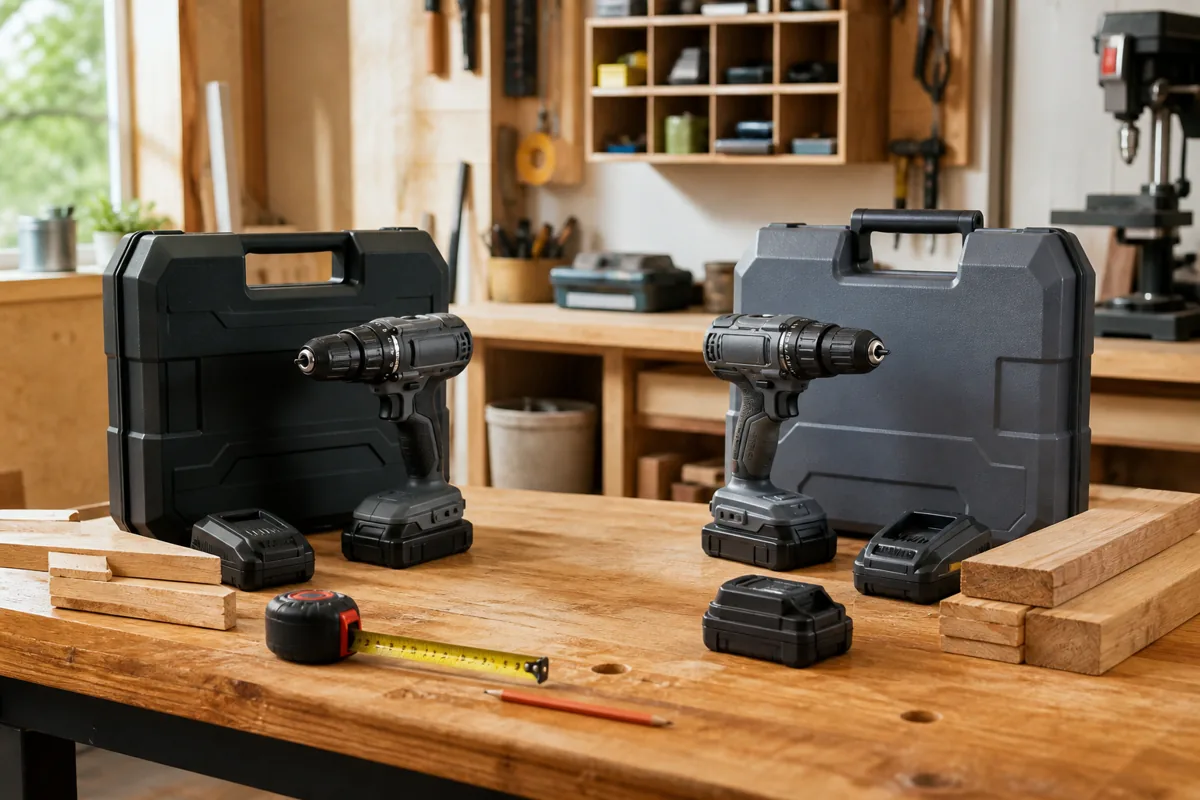
A starter kit price can hide the real cost. Compare what is included: tool, battery capacity, charger, case, and the number of bare tools available later. A kit with two small batteries may be cheaper initially, but a single larger battery can cost enough to erase the difference when you add a saw or vacuum.
| Factor | Compact 12V-class platform | 18V/20V-class platform |
|---|---|---|
| Best fit | Assembly, cabinetry, small repairs, light drilling | General maintenance, construction, cutting, outdoor work |
| Typical advantage | Lower weight and better access in tight spaces | More power and a broader selection of demanding tools |
| Battery burden | Small packs are easy to carry; runtime can be limited | More runtime options; larger packs add weight |
| Common limitation | Fewer high-demand tools and less reserve under load | Tool and battery can be unnecessarily bulky for delicate work |
| Best buying strategy | Choose for comfort and precision | Choose for tool breadth and future expansion |
Do not assume that every tool in a brand’s larger battery family works with its compact batteries. Some platforms use physically different battery mounts, while others offer adapters only for limited tool combinations. An adapter may also change balance, block the tool’s grip, or be unsuitable for high-current tools. Treat each battery family as its own system unless the manufacturer clearly states compatibility.
Calculate Battery and Charger Costs
Battery capacity is normally shown in amp-hours, or Ah. Within the same voltage class, a 2.0Ah pack is generally lighter and runs for less time than a 4.0Ah pack. It does not automatically make the tool more powerful, although some high-output packs can deliver current more effectively under heavy load.
Runtime varies too much by task to promise an exact number of screws or cuts. A drill driving small screws may run for a long time on a compact pack; a circular saw cutting thick material can drain that same pack quickly. For occasional work, two small batteries may be more convenient than one large battery because one can charge while the other is in use. For repeated cutting or grinding, larger packs reduce interruptions but make the tool tiring overhead.
Charger speed matters when you own only one or two batteries. It matters less when you rotate four packs. A charger that runs hot, has no clear status indication, or occupies a crowded bench can be annoying rather than dangerous, but poor storage and extreme temperatures are genuine battery failure risks. Store packs dry and away from heat, and avoid leaving them fully depleted for extended periods.
If you are building around a compact system, compare 12V cordless drill driver kits by battery count and charger, not headline torque alone. If you need broader capability, an 18V/20V cordless combo kit can be the better foundation, provided the included tools match your work.
Check the Tool Ecosystem Carefully
Count the tools you would realistically buy, then separate them into essential, useful, and unlikely categories. A platform may advertise dozens of tools, but several could be versions of the same drill, multiple lights, or specialty items you will never use.
Look for the categories that reveal whether the ecosystem is genuinely broad: compact drills, impact drivers, reciprocating saws, oscillating multitools, compact circular saws, grinders, sanders, inflators, vacuums, and outdoor tools. Also check whether the platform offers tools without batteries. Bare tools are usually the economical way to expand once you own compatible packs.
Some ecosystems are strongest in household tools, while others focus on professional construction or outdoor equipment. Outdoor tools such as trimmers and blowers can consume batteries quickly, so confirm that larger packs are available. A small battery that is comfortable in a drill may be frustrating in a blower, where runtime can fall to minutes under continuous use.
Evaluate Size, Balance, and Failure Modes
Compact tools are useful because they fit where larger tools do not. Check head length, grip circumference, trigger control, and battery position. A short drill can reach between joists or inside a cabinet, but a battery that extends below the handle may still prevent access.
Common buying failures include choosing a heavy kit for occasional indoor work, buying into a platform with no affordable replacement batteries, and assuming a compact tool can perform a high-demand task indefinitely. Another is mixing battery families after a brand changes its connector design. Photograph the battery label and verify the exact family before ordering a bare tool.
For a first purchase, a cordless oscillating multitool is often a practical second tool because it handles plunge cuts, trimming, grout removal, and sanding in places saws cannot. If your work is mostly fastening, spend that money on an extra battery instead. More tools do not compensate for running out of power halfway through a job.
Make the Final Choice
Choose the compact platform when low weight, access, and control dominate, and your work rarely involves thick material or continuous cutting. Choose the larger platform when you want one battery family for drills, saws, outdoor tools, and high-demand accessories.
Before buying, price the starter kit, one replacement battery, a bare drill, and the three tools most likely to follow. That four-item comparison exposes inflated ecosystem costs better than a sale sticker. The best platform is the one whose batteries you can afford, whose tools fit your actual jobs, and whose limitations will not surprise you six months later.
Related guides
- Longest Lasting Lawn Mower Battery: AGM vs Lithium vs Flooded Lifespan and Cost per Season
- Duralast Gold Lawn Mower Battery Review: U1 Fit, CCA and When to Pay for AGM
- Greenworks Pro 80V 21-Inch Mower Review: Runtime Math, Push vs Self-Propelled and Yard Fit
- Bosch High Pressure Washer Gun Replacement: Fittings, Adapters and What Fits Your Model