What's inside
As an Amazon Associate I earn from qualifying purchases. This post may contain affiliate links at no extra cost to you.
Expanding a Hilti Nuron collection is less about buying the most powerful battery for every tool and more about matching battery size to the work. Nuron tools share the same battery platform, but a compact drill, rotary hammer, grinder, and saw place very different demands on a pack. Buying only large batteries can leave you with unnecessary weight, slow charging, and a much higher entry cost.
Start With Your Workload
List the tools you use now and the jobs you expect to add over the next year. Separate them into light, intermittent work and high-drain work. Drilling pilot holes, driving screws, installing fasteners, and cutting trim are usually light-duty applications. Concrete drilling, large-hole coring, grinding, demolition, and extended metal cutting consume considerably more energy.
A practical starting point for a small collection is two batteries rather than one battery per tool. One can be in use while the other charges. If the tools are used by two people at the same time, or the workday involves continuous drilling and cutting, three or four batteries become more useful. The right number depends on charging access and job duration, not simply on how many tools are hanging on the wall.
Choose Battery Size by Tool
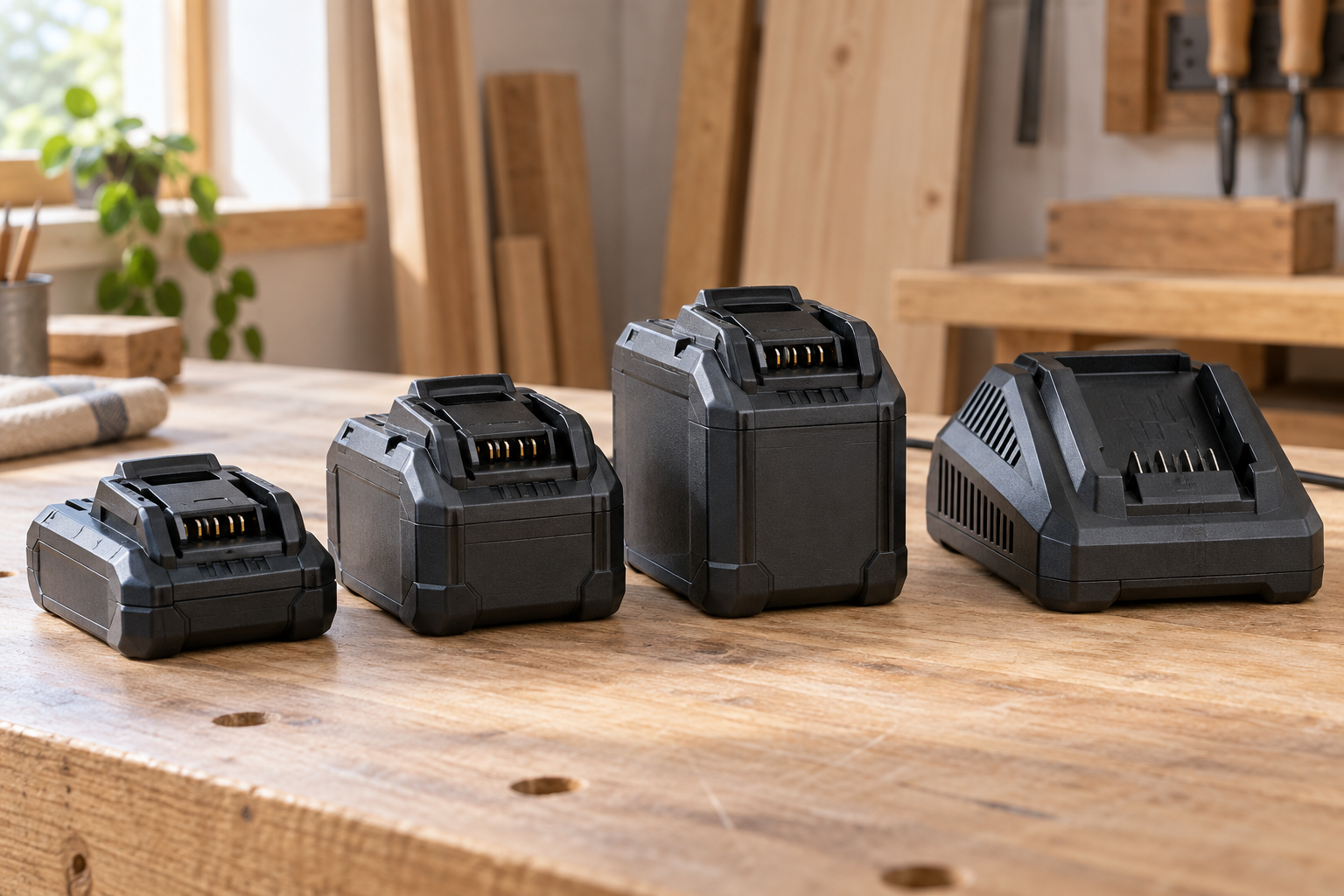
Nuron batteries are available in compact and high-capacity sizes. Exact capacity options vary by market and kit, but the general trade-off is consistent: larger batteries provide longer runtime and better sustained output while adding bulk, cost, and charging time.
| Battery class | Best use | Main advantage | Main drawback |
|---|---|---|---|
| Compact | Drills, drivers, installation tools, light fastening | Lowest weight and best balance | Shorter runtime under heavy load |
| Mid-size | General saws, impact tools, reciprocating saws | Good compromise for most users | Heavier than needed for small fastening jobs |
| High-capacity | Grinders, rotary hammers, demolition, long cuts | Longest runtime and stronger sustained performance | Expensive, heavy, and slower to recharge |
For a first battery purchase, a pair of mid-size packs is often the safest choice. They can run most general-purpose tools without making a drill uncomfortable. Add a compact pack when balance matters, and reserve high-capacity packs for tools that genuinely drain batteries quickly.
For example, a compact battery may be ideal for several dozen screws or routine fixture work, but it can become frustrating on a reciprocating saw. A large pack may keep the saw running longer, yet its extra weight can make overhead drilling tiring. Runtime estimates also change with material, bit size, temperature, and operator technique, so treat advertised runtime as a comparison point rather than a job guarantee.
Buy Tools Bare or in Kits
Once you own enough batteries and a compatible charger, bare tools usually provide the lowest cost per new tool. This is especially true for occasional-use tools such as an angle grinder or oscillating tool. A kit can still be cheaper when it includes a battery size you actually need, particularly if the battery is a high-capacity type that would cost nearly as much on its own.
Before buying a kit, price the individual parts. Compare the kit price with the bare tool, one battery, and the charger. Avoid counting a duplicate charger as a benefit if your existing charger already handles your normal workload. You can browse Hilti Nuron bare tools when expanding a collection that already has adequate batteries.
The cheaper option is fine when a tool will be used for only a few minutes at a time. A bare drill or light-duty driver makes sense for a homeowner who already has two charged packs. It is less sensible to buy a bare heavy-demand tool if your only battery is small and you will immediately need another pack.
Plan Your Charging, Not Just Your Batteries
One charger is enough for light weekend use if you remember to charge batteries after each job. It becomes a bottleneck when several packs are depleted in one day. A simple rule is to add a second charger when charging time regularly overlaps with the next work period.
Do not leave batteries in a hot vehicle or direct sun. Excess heat can reduce service life and may trigger thermal protection during charging or use. Cold batteries also deliver less practical runtime until they warm up. Store packs dry, inspect the contacts, and stop using any battery with a cracked housing, swelling, or damage around the terminals.
A Nuron battery charger is worth adding before buying a third or fourth battery if charging delays are the real problem. More batteries do not solve a slow charging setup when every pack comes home empty at the same time.
Avoid Common Buying Mistakes
Do not buy large batteries for every tool simply because they offer the longest runtime. The weight at the bottom of a drill or above your head can matter more than an extra hour of capacity. Also avoid mixing an undersized battery with a high-demand tool and assuming the tool is defective when it cuts out under load. Thermal and electronic protection can interrupt operation when the pack cannot provide the required current or becomes too hot.
Keep at least one compact battery for installation work and one or two mid-size batteries for general tools. Add high-capacity packs only after you identify a specific task that empties the smaller ones too quickly. For concrete and demolition work, prioritize capacity and a second charging position; for fastening and trim work, prioritize low weight and balance.
Finally, check that every battery, charger, and tool is genuinely part of the Nuron platform before ordering. Older Hilti cordless systems are not automatically compatible just because the tools look similar. When buying used or from a marketplace, confirm the battery platform, inspect photographs of the terminals, and account for uncertain battery history. A measured, task-based collection will cost less and be easier to carry than a shelf full of duplicate packs.
Related guides
- Longest Lasting Lawn Mower Battery: AGM vs Lithium vs Flooded Lifespan and Cost per Season
- Duralast Gold Lawn Mower Battery Review: U1 Fit, CCA and When to Pay for AGM
- Greenworks Pro 80V 21-Inch Mower Review: Runtime Math, Push vs Self-Propelled and Yard Fit
- Bosch High Pressure Washer Gun Replacement: Fittings, Adapters and What Fits Your Model