What's inside
- How the Adapter Actually Connects the Two Systems
- Voltage: Why “18V” and “20V MAX” Are the Same Battery
- The Part That Actually Matters: Where the Protection Lives
- Current Draw and Heat: Which Tools Punish an Adapter
- Warranty and Insurance Realities
- What to Check Before Buying
- Is an Adapter Worth It? Match It to Your Situation
- If You Do Use One: Habits That Protect the Pack
- The Same Logic Applies to Bauer and Craftsman Pairings
- FAQ
- How the Adapter Actually Connects the Two Systems
- Voltage: Why “18V” and “20V MAX” Are the Same Battery
- The Part That Actually Matters: Where the Protection Lives
- Current Draw and Heat: Which Tools Punish an Adapter
- Warranty and Insurance Realities
- What to Check Before Buying
- Is an Adapter Worth It? Match It to Your Situation
- If You Do Use One: Habits That Protect the Pack
- The Same Logic Applies to Bauer and Craftsman Pairings
- FAQ
As an Amazon Associate I earn from qualifying purchases. This post may contain affiliate links at no extra cost to you.
A Makita to DeWalt battery adapter is a pass-through plastic shell that clips a Makita 18V LXT battery into a DeWalt 20V MAX tool’s battery slot — no voltage conversion, just a physical and electrical bridge. It works because both packs are five-cell lithium-ion batteries at the same 18V nominal voltage. What a product listing never explains is the protection gap hiding behind that compatibility, and that gap is what decides whether the adapter is a smart $20–$35 bridge or a slow way to cook a $100-plus battery.
As an Amazon Associate we earn from qualifying purchases at no extra cost to you.

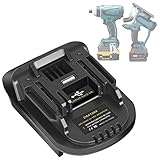


How the Adapter Actually Connects the Two Systems
The adapter is two battery interfaces molded into one block. The top half copies DeWalt’s rail spacing and terminal layout, so it slides into the tool until the latch clicks. The bottom half is a Makita LXT receiver that the battery slides into. Inside, nickel-plated copper contacts and a few inches of wire join positive to positive and negative to negative. On basic units, that is the entire circuit — the data and temperature pins that a genuine Makita tool would read are left unconnected. Better units add a small protection board that cuts output when pack voltage drops below roughly 15V.
A few physical realities worth knowing before you commit:
- The adapter adds roughly 1.5–2 inches of stack height under the tool, shifting balance and sometimes interfering with belt hooks, bit holders, or flush-fit accessories.
- Molding tolerances vary widely between sellers. A loose adapter wobbles under load, and intermittent contact creates arcing that pits terminals on both the adapter and the tool.
- DeWalt itself sells an official adapter (the DCA1820) that runs 20V MAX packs on old 18V XRP NiCad tools — proof that adapters aren’t inherently junk. But that one is engineered by the same brand with proper circuitry. Every cross-brand adapter is third-party.
Voltage: Why “18V” and “20V MAX” Are the Same Battery
The single most important spec is one both brands market differently. Makita labels its packs “18V” (nominal); DeWalt labels the identical five-cell configuration “20V MAX” (peak voltage fresh off the charger). Same cells, same chemistry, same real voltage — which is why no transformer or regulator is needed inside the adapter.
| Battery platform | Label voltage | Nominal voltage | Cells (series) | Fully charged |
|---|---|---|---|---|
| Makita 18V LXT | 18V | 18.0V | 5 | ~21V |
| DeWalt 20V MAX | 20V | 18.0V | 5 | ~20V |
| Craftsman V20 | 20V | 18.0V | 5 | ~20V |
| Bauer 20V (Harbor Freight) | 20V | 18.0V | 5 | ~20V |
| Milwaukee M18 | 18V | 18.0V | 5 | ~20V |
| DeWalt 60V MAX FLEXVOLT | 60V | 54V | 15 | ~60V — never adapt |
One hard rule falls out of this table: a Makita-to-DeWalt adapter is for 20V MAX tools only. DeWalt’s 60V FLEXVOLT tools run on triple the voltage, and no $25 plastic shell bridges that gap safely.
The Part That Actually Matters: Where the Protection Lives
Here’s the asymmetry no listing mentions. DeWalt builds its protection electronics inside the battery pack — a genuine DeWalt pack monitors itself and cuts output at low voltage or overload. DeWalt tools therefore assume the battery will protect itself.
Makita does the opposite. LXT packs rely on communication with the tool or charger (“star protection”) for over-discharge and overheat cutoff. The battery reports; the tool acts. Plug a Makita pack into an adapter that only carries the two power pins, and there is no tool listening and no internal cutoff firing on its own.
The result: a DeWalt tool will happily run a Makita battery down to the point of cell damage — typically anything below ~2.5–3.0V per cell under load. A pack drained that deep loses capacity permanently, may swell, and can refuse a charge or become a safety hazard. This is the single most common way adapter users destroy packs, and it’s entirely avoidable with a cutoff-equipped adapter or disciplined stopping.
Current Draw and Heat: Which Tools Punish an Adapter
The second failure mode is thermal. Cordless tools pull serious amperage, and the adapter — its wire gauge, contact springs, and plastic housing — is the weakest link in the chain.
| Tool type | Typical peak draw | Adapter stress level |
|---|---|---|
| LED work light, inflator | Under 1–5A | Minimal |
| Drill/driver | 20–30A | Moderate |
| Impact driver/wrench | 25–40A | Moderate–high (short bursts) |
| Reciprocating saw | 30–45A | High |
| Circular saw | 30–50A | High, sustained |
| Angle grinder, rotary hammer | 35–60A | Highest — where cheap adapters melt |
Bargain adapters often use 18–20 AWG leads and thin stamped contacts — fine for a work light, marginal under sustained saw or grinder loads. Listings that specify 14 AWG or thicker wire and plated solid-copper contact plates are worth prioritizing. Warning signs in use: the adapter housing getting hot to the touch, a hot-plastic smell, browning or softening around the contacts, or the tool cutting out under load and recovering immediately.
Battery choice matters too. A compact Makita 2.0Ah pack (BL1820B, ~0.8 lb) sags hard under grinder loads and reaches the danger voltage fast. A 5.0Ah BL1850B or 6.0Ah BL1860B (both around 1.4–1.5 lb) holds voltage flatter and gives you more warning before the cutoff point.
Warranty and Insurance Realities
Both brands’ warranties cover defects in materials and workmanship — not damage caused by non-OEM power sources or accessories. If an adapter-fed Makita pack swells, or a DeWalt tool’s electronics fail with an adapter attached, expect any claim to be denied. Most generic adapters also carry no UL or ETL listing, which can complicate things with an insurer in the unlikely event of a fire. For occasional DIY use this is a manageable, informed risk; for a jobsite where tools earn money, native packs are the defensible choice.
What to Check Before Buying
- Correct direction: labeled Makita 18V LXT battery → DeWalt 20V MAX tool. Not a charger, not a 60V tool.
- Low-voltage cutoff: an internal protection board cutting output around 14.5–15V is the single feature most worth paying for.
- Wire and contacts: 14 AWG or thicker leads, plated copper contact plates, firm spring tension.
- Fit: the adapter should slide on with a positive latch click and zero wobble in both directions.
- Realistic price: expect roughly $15–$35. Anything far cheaper usually means thinner wire and no protection board.
Is an Adapter Worth It? Match It to Your Situation
The math is simple: an adapter runs $15–$35, while a single genuine DeWalt 5Ah pack commonly runs $100 or more. Owning three Makita batteries already means the adapter can save you $200–$300 on a DeWalt setup. But kill one 5Ah Makita pack through over-discharge — also a $100-plus replacement — and the entire saving is gone. Breakeven is exactly one damaged battery.
| Your situation | Sensible move |
|---|---|
| Own 3+ Makita packs, DeWalt tool sees occasional weekend use | Adapter is a reasonable bridge — insist on the low-voltage cutoff version |
| DeWalt tool is a daily driver | Buy native DeWalt packs; reliability and warranty outweigh the saving |
| Mainly grinders, circ saws, rotary hammers | Adapters are marginal under sustained draw; use ≥5Ah packs if you adapt at all |
| Just lights, inflators, compact screwdrivers | Lowest-risk use case; even a basic adapter usually holds up |
| Want to charge Makita packs on a DeWalt charger | Stop — adapters are tool-side only; never mate one to a charger |
If You Do Use One: Habits That Protect the Pack
- Stop when power drops. With no cutoff communicating, the tool losing punch is your only warning. Aim to recharge at ~15V resting, never run to stall.
- Charge Makita packs only on Makita chargers (DC18RC, DC18RD, etc.). Charging protocols differ by brand; forcing it is a genuine fire risk.
- Pull the pack after each session and glance at the onboard fuel gauge. Don’t store a depleted pack on the adapter.
- Inspect contacts every month or two — oxidation and arcing raise resistance, which means heat. Retire the adapter at the first sign of discolored or soft plastic.
- Favor short bursts on high-draw tools rather than sustained grinding or rip cuts.
The Same Logic Applies to Bauer and Craftsman Pairings
Everything above generalizes across the 18V/20V class. A Bauer to DeWalt battery adapter (Bauer being Harbor Freight’s 20V house platform) works on identical five-cell hardware — and inherits the same caution, since budget packs generally put much of their protection on the tool side rather than inside the battery. A DeWalt to Craftsman battery adapter is the calmer pairing: both are Stanley Black & Decker platforms with protection electronics inside the pack, so even though the rails don’t interchange natively, an adapter between them isn’t leaving a battery unguarded the way a Makita-pack-on-DeWalt-tool setup does.
FAQ
Can I charge a Makita battery on a DeWalt charger through the adapter?
No. Adapters are for tool discharge only. Chargers use brand-specific communication and pin layouts, and forcing a charge through mismatched pins is a fire risk. Makita packs go on Makita chargers, period.
Will the adapter damage my DeWalt tool?
Usually not — the tool receives correct voltage through correct pins. The risk concentrates on the Makita battery (over-discharge) and the adapter itself (heat under load).
Does it work on DeWalt FLEXVOLT 60V tools?
No. Those tools need ~54V nominal. An 18V pack through an adapter won’t run them and shouldn’t be tried.
How do I know when to stop and recharge?
When the tool noticeably weakens or the Makita pack’s fuel gauge shows one bar. On a multimeter, ~15V resting means recharge now; below ~12.5V means the pack has already taken damage.