As an Amazon Associate I earn from qualifying purchases. This post may contain affiliate links at no extra cost to you.
Most apartments and guest rooms can’t spare the floor space for both a full sofa and a proper bed. A 3 seater sofa bed solves that compromise in one piece of furniture, but the gap between a genuinely comfortable sleeper and a lumpy compromise is wider than most product listings let on. The best options in this category unfold smoothly, offer real back support when seated, and don’t punish you with a visible frame seam at 2 a.m.
What separates a good pick from a regret is mostly about the internal structure — whether the cushioning is continuous from seat to sleeping surface, how many support points the frame distributes your weight across, and whether the mechanism locks firmly enough to stop the piece creeping apart during sleep. Price alone won’t tell you either, because boneless floor couches and traditional frame-based sleepers solve different problems at very different cost tiers. This roundup sorts through the published specs and recurring owner feedback on eight models to help you find the right compromise for your room.
As an Amazon Associate we earn from qualifying purchases at no extra cost to you. Product prices and availability are accurate as of the date shown and are subject to change.




Quick Picks
| Product | Best for | Price |
|---|---|---|
| Boneless Couch 3-in-1 | Small-space versatility | $289.99 |
| Gizoon 63.6″ Convertible | Tight rooms | $349.99 |
| Winzoo 70″ Gray Boneless | Maximum cushioning | $279.99 |
| Winzoo 70″ Black Boneless | Dark interiors | $278.09 |
| FAVSH 81″ L-Shaped | Open-plan layouts | $386.99 |
| 76″ Corduroy w/ Cup Holders | Entertainment setups | $237.49 |
| Erament 78″ Compression Futon | Low-maintenance floors | $298.99 |
| LOOMORA 78.7″ Folding | Frequent overnight guests | $329.99 |
How We Picked
We narrowed the field by prioritizing four things: sleeping surface continuity (does the cushion stay even from seat to back, or does a frame gap ruin it?), weight capacity per section (a 3 seater that sags in the middle within six months fails the core function), mechanism reliability based on recurring complaint patterns in owner reviews, and how well each model actually fits the small-footprint promise it markets — some “compact” sleepers still need nine feet of clearance to unfold fully.
The 8 Best 3 Seater Sofa Bed in 2026
Boneless Couch 3-in-1 Convertible Sleeper Sofa
This corduroy pull-out is aimed at renters and studio dwellers who need one piece to function as seating, lounging, and a real overnight surface without tools or hardware. The boneless design means no metal frame, so the sleeping surface stays continuous — a genuine comfort advantage for back sleepers. Side pockets and a built-in handle make repositioning manageable even for one person.
- Pro: No-assembly delivery saves setup friction and reduces points of mechanical failure.
- Pro: Three included pillows create a head-and-lumbar setup without extra purchases.
- Con: Boneless construction means no internal storage; everything must sit on the surface.
Skip it if you need a traditional framed sofa that doubles as a bed occasionally — this one is built to live on the floor and won’t match a formal living room aesthetic.
Gizoon Convertible Sofa Bed 63.6″
At under 64 inches wide, this is the narrowest option here and the natural fit for hallways, reading nooks, or rooms where a standard 3 seater simply won’t clear a doorway. The three-in-one conversion works in defined steps, and the loveseat-class frame keeps weight moderate for easy rearranging.
- Pro: Compact width fits rooms where every model above or below is too wide.
- Pro: Frame-based design provides firm edge support, useful for getting in and out.
- Con: At full extension, the sleeping surface is short enough that taller sleepers will feel the limit.
Skip it if you regularly sleep two adults on it — the width and length constraints are real.
Winzoo 70″ Gray Boneless Loveseat
Five included pillows is more than any other model in this list, and the oversized designation isn’t marketing fluff — the 70-inch span accommodates three adults seated or one adult stretched out with room to spare. The gray upholstery reads slightly more formal than the corduroy options, making it viable in a living room you don’t want looking like a dorm.
- Pro: Pillow count eliminates the need for separate bedding accessories for solo sleepers.
- Pro: Oversized cushioning masks the body-imprint sag that plagues thinner boneless couches.
- Con: Bulk and weight make this a two-person lift, which complicates cleaning around it.
Skip it if you lack floor space — it needs a generous footprint even in its seated configuration.
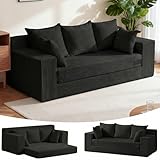
Winzoo 70″ Black Boneless Fold Out Sofa Bed
Functionally identical to the gray version above with the same 70-inch span and five-pillow package, the black colorway is the practical choice for households with pets, kids, or anyone who values a sofa that hides daily wear. Black also grounds the piece visually in rooms with lighter walls or wood tones without competing for attention.
- Pro: Dark fabric resists visible staining far better than beige or gray alternatives.
- Pro: Floor-level design keeps the center of gravity low, reducing tip risk on uneven surfaces.
- Con: Black shows lint and pet hair from certain fabrics more prominently than it shows stains.
Skip it if your space feels dark already — the visual weight of a black floor couch can shrink a room further.
FAVSH 81″ L-Shaped Convertible Sleeper Sectional
This is the only sectional-format entry here, and the L-shape changes the geometry of how a small living room or studio can be divided into zones. The chaise section converts into a full-length sleeping surface while the main seat stays available for daytime use. Beige keeps it neutral enough to work in most contemporary palettes.
- Pro: Zoning ability lets one piece replace both a sofa and a separate bed in an open layout.
- Pro: 81 inches provides the longest total sleeping surface in this comparison.
- Con: The L-shape fixes a directional orientation that’s harder to reverse than a straight sofa.
Skip it if your room is rectangular with a single entry wall — the chaise may block flow or look unbalanced against a flat layout.
76″ Corduroy Boneless Couch with Cup Holders
The lowest price here by a clear margin, and the cup holders plus side pockets signal this is built for people who treat the couch as an entertainment hub — gaming, streaming, or reading sessions that need drinks and devices within reach. Corduroy texture adds a tactile warmth that flat woven fabrics lack.
- Pro: Integrated cup holders remove the need for a side table in tight layouts.
- Pro: Budget price makes it a low-risk first attempt at a boneless floor sleeper.
- Con: Fewer included pillows means extra bedding purchases are likely for solo sleepers.
Skip it if you expect it to support daily full-night use — the lower build cost shows in cushion density over time.
Erament 78″ Compression Futon Floor Couch
Compression packaging is a logistical advantage disguised as a comfort feature: the unit expands on arrival without tools, and the compressed state makes storage or relocation far simpler than rigid-frame alternatives. At 78 inches with three pillows included, it sits in the Goldilocks zone between the compact options and the oversized ones.
- Pro: Compression design means it fits into tight delivery spaces like stairwells or elevators.
- Pro: Corduroy and 78-inch span together offer a middle-of-the-road balance of size and texture.
- Con: Expanded foam can take up to 72 hours to fully recover shape, so immediate use isn’t guaranteed.
Skip it if you need the piece usable the same day it arrives.
LOOMORA 78.7″ Convertible Folding Sofa Bed
Folding mechanisms that lock at multiple angles tend to outlast single-hinge designs for people who genuinely sleep on their sofa bed most nights rather than just occasionally. The 78.7-inch span supports full-height adults without foot hangover, making this the strongest option for hosting guests on a recurring basis.
- Pro: Multi-position folding lets it serve as a lounger, a half-open guest bed, or a flat sleeper.
- Pro: Just over 78 inches handles most adult heights comfortably for overnight use.
- Con: Price sits near the top of this group without a clear feature advantage over the FAVSH.
Skip it if budget is your primary constraint — the Erament or the 76-inch model deliver similar function for less.
Buying Guide
Boneless vs. Frame: Choose Your Failure Mode
A boneless couch distributes your weight across continuous foam, so there’s no central seam or metal bar to push into your back during sleep. The tradeoff is structural: without a frame, edge support suffers, and you can’t sit down at the end of a boneless couch the way you can on a framed sofa without sliding. Frame-based sleepers offer better sitting ergonomics but introduce a gap or bar where the seat meets the back extension. If daily overnight use is your pattern, continuous surface wins. If occasional guest use is your pattern, frame edge support matters more.
Sleeping Length vs. Seating Width
Manufacturers quote width and sometimes length inconsistently, which makes comparison tricky. For solo sleepers under 6 feet, any model at 70 inches or longer provides adequate surface. Above 6 feet, the LOOMORA, FAVSH, or Erament are the realistic candidates. Seating width matters for daytime use — at 63 inches the Gizoon is genuinely a two-plus-one configuration where the third seat is tight, while 78 to 81 inches allows three adults to sit without shoulder contact.
Assembly and Delivery Logistics
Compression shipping (Erament) and no-assembly delivery (Boneless Couch) eliminate the single biggest frustration in this category: discovering that your piece requires a second person, a screwdriver set, and an hour to build when you ordered at 11 p.m. for guests arriving the next morning. If you live above a first-floor apartment without an elevator, compressed packaging is a meaningful practical advantage over pre-assembled frames that must navigate narrow stairwells intact.
Our Verdict
The top pick is the Boneless Couch 3-in-1 Convertible — it balances price, comfort, and convenience better than any other option in this group, and the no-assembly approach removes a common pain point that owner reviews repeatedly flag across every other product category. For budget, the 76-inch corduroy model at under $240 punches above its weight for casual use. If you host overnight guests weekly, the LOOMORA’s multi-position folding and full-length surface make it the better long-term investment despite the higher price.
FAQ
Can you sleep on a 3 seater sofa bed every night?
You can if it’s a boneless or high-density foam model with a continuous surface and adequate length for your height. Traditional frame-based sofa beds tend to show their metal supports after extended nightly use, accelerating foam compression at pressure points. A quality model should handle daily use for several years, but expect to rotate or flip cushion sections to even wear.
How much floor space does a 3 seater sofa bed need when unfolded?
Most 3-seater models at 70 to 81 inches wide need an additional 24 to 34 inches of depth when fully extended for sleeping, compared to roughly 30 to 36 inches for seated use. Always measure your available wall clearance before purchasing, because “small space friendly” marketing doesn’t account for the walk-around space you need to sit down or access the sides.
Do boneless couches lose shape faster than framed ones?
The foam and fabric layers in a boneless design compress more uniformly over time, so it looks and feels flatter without developing the specific sag points that framed sofa beds get at hinge joints. A well-made boneless couch typically stays at 70 to 80 percent of original height for several years of regular use, after which adding a thin mattress topper restores comfort without replacing the piece.
What’s the difference between a fold-out and a pull-out sofa bed?
A pull-out design hides a separate mattress or cushion section under the seat that you slide forward — the back cushion tips down to close the gap. A fold-out (or flip-over) model rotates the back section down to meet the seat, creating a single continuous surface. Fold-outs tend to have fewer mechanical parts and thus fewer failure points, while pull-outs often feel more like a real bed because the hidden section can be independently thicker.