What's inside
As an Amazon Associate I earn from qualifying purchases. This post may contain affiliate links at no extra cost to you.
Build the Kit Around the Work
A lightweight cordless setup for service calls should solve common problems without turning your vehicle into a mobile tool store. The goal is not to own every tool in one battery platform. It is to carry the smallest useful group of tools, batteries, and chargers that can handle the jobs you actually see.
Start by listing your five most common calls. A general maintenance technician may need fasteners removed, covers drilled, terminals tightened, and small parts cut. An appliance technician may use a drill, inspection light, compact driver, and vacuum more often than a saw. A cabinet installer may need a drill, impact driver, trim router, and light.
That list determines the platform. If most of your tools are 12V or compact 18V tools, buying a large high-output battery system adds weight without improving the work.
Choose One Main Battery Platform
One battery ecosystem is usually the best balance of weight, cost, and convenience. Batteries are expensive, and chargers take up space. A single platform also lets you carry fewer spare batteries and swap them between tools during a busy call.
Compact 12V systems are excellent for service work where the fastener sizes are modest and access matters. They generally produce less torque and have shorter runtime, but the tools are easier to carry all day. Compact 18V or 20V systems offer more drilling capacity and a larger tool range, usually at the cost of heavier batteries and bulkier tools. The voltage labels are not directly comparable between brands; nominal 18V and 20V systems typically describe the same general battery class.
| Platform type | Best for | Typical drawback |
|---|---|---|
| 12V compact | Controls, fixtures, appliances, cabinetry, light fastening | Less power for long drilling and large screws |
| Compact 18V/20V | General maintenance and mixed service calls | Heavier tools and batteries |
| High-output 18V/20V | Heavy drilling, cutting, demolition, and extended runtime | More weight, cost, and heat |
| Two platforms | Specialized work where one ecosystem lacks key tools | Extra chargers, batteries, and storage |
For a broad service kit, a compact 18V or 20V platform is often the safest starting point. For light-duty calls, a 12V setup may be noticeably less tiring. Do not choose based only on the largest tool in a catalog. Choose based on the tools you will carry on 80 percent of calls.
The Core Tool Set
A compact drill or drill-driver is the first purchase. Select one with a clutch, two speed ranges, a usable work light, and a short head length. A hammer function is useful for occasional masonry anchors, but it does not replace a rotary hammer for repeated concrete drilling.
An impact driver is useful when you remove many screws, drive structural fasteners, or work with stubborn hardware. It is not automatically better than a drill. Impact drivers are noisy, can damage small screws, and offer less control for delicate work. If your service calls involve electronics, thin sheet metal, or small machine screws, the drill may be the more useful single tool.
Add a compact cordless impact driver when fastening speed matters, not simply because it is common in tool kits.
A compact reciprocating saw earns its place when you regularly cut pipe, damaged fasteners, plastic, or access openings. For occasional cutting, a folding hand saw or multitool may be lighter. An oscillating multitool is especially useful for flush cuts, grout, small drywall openings, and precise access work, although blades are consumables and can cost more than expected.
An LED work light is often more valuable than another high-powered tool. Choose a light with a stable base, a hook or magnet, and at least several hours of practical runtime. A headlamp should be separate from the tool battery because it keeps both hands free and does not require carrying a large pack on your head.
Battery and Charger Planning
For a small service setup, start with three batteries: two compact packs and one larger pack. The compact batteries keep the drill or light easy to handle. The larger battery is reserved for saws, grinders, vacuums, or long drilling sessions.
Battery capacity is normally expressed in amp-hours. A 2.0Ah pack is lighter and charges quickly; a 4.0Ah or 5.0Ah pack gives roughly twice the stored energy but adds noticeable weight. Runtime varies with load, temperature, and tool efficiency, so do not treat the rating as an exact work-hour figure.
A practical rule is to carry enough capacity for one full call plus a reserve. If a drill uses a 2.0Ah battery during a typical day, two compact batteries may be enough. If a saw drains a 4.0Ah pack in one heavy job, carry a second large pack rather than expecting a small battery to perform the same work.
Use the charger that matches the platform and keep it in the vehicle if calls can run long. A dual-port charger is convenient, but it may not charge both batteries at the fastest rate. A fast charger can shorten downtime while adding cost and heat. For occasional service work, the cheaper standard charger is fine if you charge batteries overnight and arrive with full packs.
Avoid Battery Mistakes That Cause Downtime
Do not leave lithium-ion batteries in a freezing truck overnight or in a hot vehicle for days. Extreme temperatures reduce performance and shorten battery life. Bring batteries indoors when practical, and allow a cold battery to warm before charging.
Never mix chargers between brands or force an incompatible battery onto a tool. Battery adapters can be useful in limited situations, but they add bulk and may remove electronic protections. They also make warranty and troubleshooting questions harder. For a professional kit, native batteries are the less complicated choice.
Keep battery contacts covered from metal debris. A loose wrench or collection of screws in a tool bag can short exposed terminals. Store batteries in a case, compartment, or protective cap rather than loose in a pocket with hardware.
Buy in Stages and Control the Weight
Starter kits are often cheaper than buying a bare tool and battery separately, but kit contents vary. Check whether the batteries are compact or high-capacity, whether the charger is included, and whether the tools are full-size versions. A kit with two oversized batteries may look like a bargain and still be a poor service-call choice.
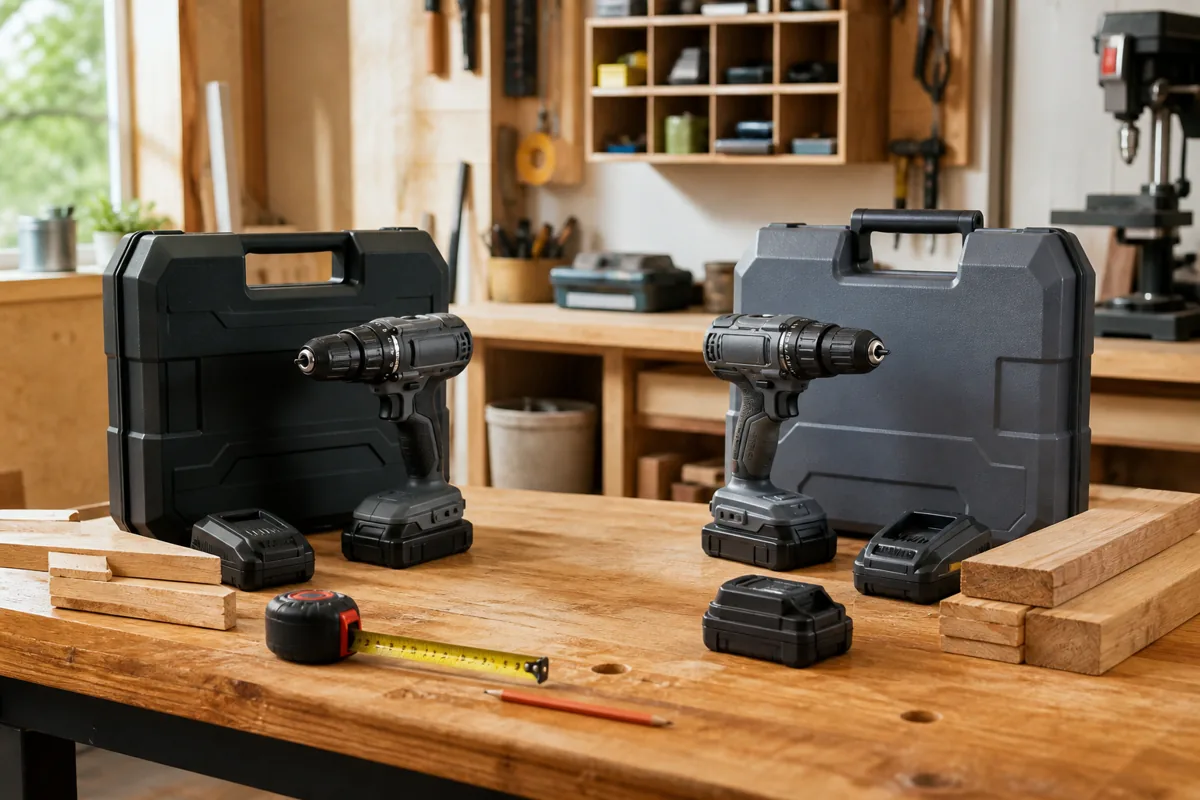
For a first purchase, consider a compact cordless drill-driver kit, then add tools individually as actual jobs require them. A bare tool is cheaper only when you already own compatible batteries. Otherwise, the battery and charger can erase the apparent savings.
Use a small tool bag with separate battery pockets. Keep one battery installed only when traveling a short distance; otherwise remove it to prevent accidental activation. Carry bits, driver tips, blades, and sockets in labeled cases. A missing bit can waste more time than a slightly slower tool.
Before adding a grinder, rotary hammer, vacuum, or circular saw, ask how often it prevents a second trip. If the answer is once every few months, the cheaper corded tool, rental, or hand tool may be the better choice. Lightweight service setups work because they stay focused: enough cordless capability to finish common calls, without carrying the weight of every possible emergency.
Related guides
- Longest Lasting Lawn Mower Battery: AGM vs Lithium vs Flooded Lifespan and Cost per Season
- Duralast Gold Lawn Mower Battery Review: U1 Fit, CCA and When to Pay for AGM
- Greenworks Pro 80V 21-Inch Mower Review: Runtime Math, Push vs Self-Propelled and Yard Fit
- Bosch High Pressure Washer Gun Replacement: Fittings, Adapters and What Fits Your Model