What's inside
As an Amazon Associate I earn from qualifying purchases. This post may contain affiliate links at no extra cost to you.
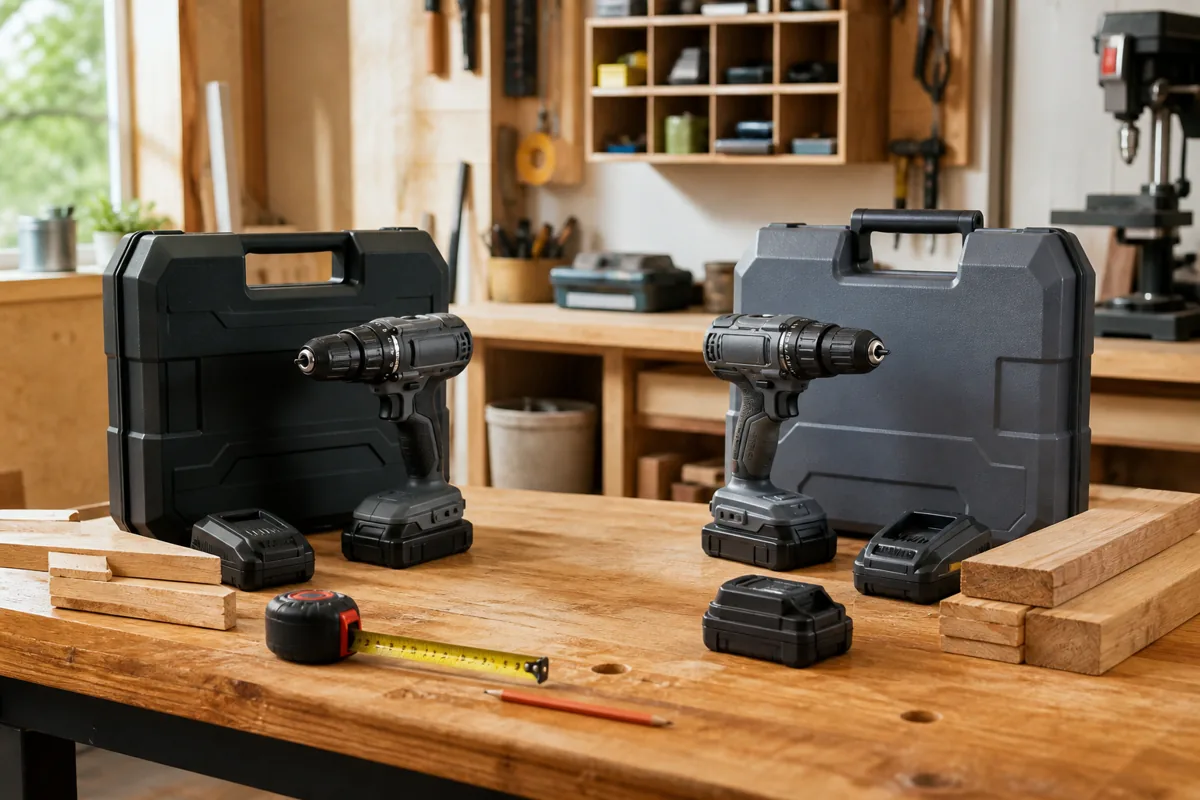
A small workshop rarely needs the biggest tools in a battery lineup. For cabinet hardware, furniture assembly, shelves and routine repairs, a compact drill-driver and a careful choice of bits will do most jobs. Add an impact driver, oscillating multitool or compact saw only when the work calls for it. Buying into one battery platform can save money later, but only if you choose a system with the tools and batteries you actually need.
As an Amazon Associate we earn from qualifying purchases at no extra cost to you.



Start with the drill-driver
A cordless drill-driver is the most useful first purchase. It drills holes and drives screws, and its adjustable clutch helps prevent stripped heads and damaged work. For a small shop, a compact 12-volt drill is often enough for pilot holes, hinges and furniture assembly. A 18- or 20-volt model is a better fit for frequent drilling in hardwood, larger bits or longer work sessions, but it is bulkier.
Check the tool’s weight with a battery attached, not just the bare-tool figure. A heavy drill becomes tiring during overhead work or when fitting dozens of cabinet screws. A two-speed gearbox is useful: the low range gives better control for driving, while the high range suits small drill bits. If you mostly assemble flat-pack furniture and hang hardware, a basic cordless drill-driver kit is a sensible starting point; the cheapest kit is fine if it includes a decent clutch, charger and a battery you can replace or supplement.
When an impact driver helps—and when it doesn’t
An impact driver is useful for driving long screws into framing, installing deck hardware or working through a large assembly job. Its repeated rotational impacts help turn fasteners without forcing your wrist to resist as much twisting. It is not automatically better for every screw: impacts can snap small screws, damage soft wood and make delicate work harder to control. Use a drill-driver for cabinet hinges, small hardware and jobs where you need a clean, slow start.
If you buy one, keep the bit straight and use impact-rated driver bits. Stop as soon as the screw head seats; an impact driver can bury a screw in seconds. A drill-driver and impact-driver combo kit is often cheaper than buying both separately, but it may include batteries that are too small for sustained work. Compare the kit’s battery capacity and charger, not just the number of tools.
Choose tools by the work
| Tool | Best suited to | Main trade-off |
|---|---|---|
| Drill-driver | Pilot holes, general drilling and controlled screw driving | Slower than an impact driver on many long screws |
| Impact driver | Long fasteners and repetitive assembly | Less control on small or delicate fasteners |
| Oscillating multitool | Flush cuts, trimming and sanding tight corners | Blades wear quickly, and it is noisy for its size |
| Compact circular saw | Straight cuts in sheet goods and boards | Needs a guide for accurate cuts; not ideal for small parts |
For occasional trim work, an oscillating multitool can save a trip to a hand saw, but it is not a replacement for a proper saw. Blades are a recurring cost: cutting nails or abrasive material can dull a blade quickly. A cordless oscillating multitool makes sense if you regularly need flush cuts or work in corners; for one repair a year, a handsaw or rental may be better value.
Batteries and platforms matter
Before choosing a brand, look at its cordless range in your market. A platform is valuable when it covers your likely next tools—perhaps a drill, impact driver and work light—not because the brand has the largest catalogue. Batteries generally do not cross between brands, and adapters can compromise fit, protection or warranty coverage. Treat an adapter as a workaround, not a sound basis for a new tool collection.
For light repairs, a 2.0- or 2.5-amp-hour battery keeps a compact tool manageable. A larger 4.0- or 5.0-Ah pack can run longer but adds weight and may feel awkward on a drill used at arm’s length. Battery capacity is not a direct measure of power; the tool and battery design also matter. One small pack is enough to start, but two let you keep working while the other charges. Check whether a kit includes a charger and whether that charger supports the battery sizes you may buy later.
Bits, setup and common failures
Good bits often improve results more than a more powerful tool. Use the correct drive type and size—such as a well-fitting Phillips or square-drive bit—and replace worn tips before they cam out. For hardwood, drill a pilot hole sized to the screw’s core rather than forcing the screw and risking a split. Clamp the work securely, keep fingers out of the bit’s path and remove the battery before changing accessories.
Two common mistakes are using a drill’s high gear to drive large screws and running a battery until the tool slows dramatically. Choose low gear for demanding driving, let the tool work without leaning heavily on it, and recharge when performance drops. If the drill chuck loosens or a bit wobbles, stop and reseat it; a crooked bit can enlarge a hole or damage the work.
A practical buying order
Buy a drill-driver kit first, then use it long enough to see what slows your work down. Add an impact driver if you routinely drive long screws or assemble in volume. Choose an oscillating multitool for repeated flush-cutting and tight-access repairs, not as a general-purpose saw. For straight cuts, a circular saw and guide are more predictable than trying to steer a compact saw freehand. This staged approach avoids paying for tools that spend most of their time on a shelf, while still giving you a battery platform that can grow with the workshop.
Related guides
- Longest Lasting Lawn Mower Battery: AGM vs Lithium vs Flooded Lifespan and Cost per Season
- Duralast Gold Lawn Mower Battery Review: U1 Fit, CCA and When to Pay for AGM
- Greenworks Pro 80V 21-Inch Mower Review: Runtime Math, Push vs Self-Propelled and Yard Fit
- Bosch High Pressure Washer Gun Replacement: Fittings, Adapters and What Fits Your Model