What's inside
As an Amazon Associate I earn from qualifying purchases. This post may contain affiliate links at no extra cost to you.
The short answer
A cordless trim router is the better tool for clean, repeatable laminate work. It makes controlled edge cuts, trims laminate flush with a substrate, and produces a more professional result when paired with the right bit. A cordless oscillating tool is slower and less precise, but it is cheaper to own if you already have one, and it works well for small repairs, tight corners, door jambs, and places where a router will not fit.
For installing a laminate countertop, trimming a large sheet, or making more than a few edge cuts, buy or borrow a cordless trim router. For one short backsplash cut or a small flooring repair, the oscillating tool may be good enough.
As an Amazon Associate we earn from qualifying purchases at no extra cost to you.



What each tool does
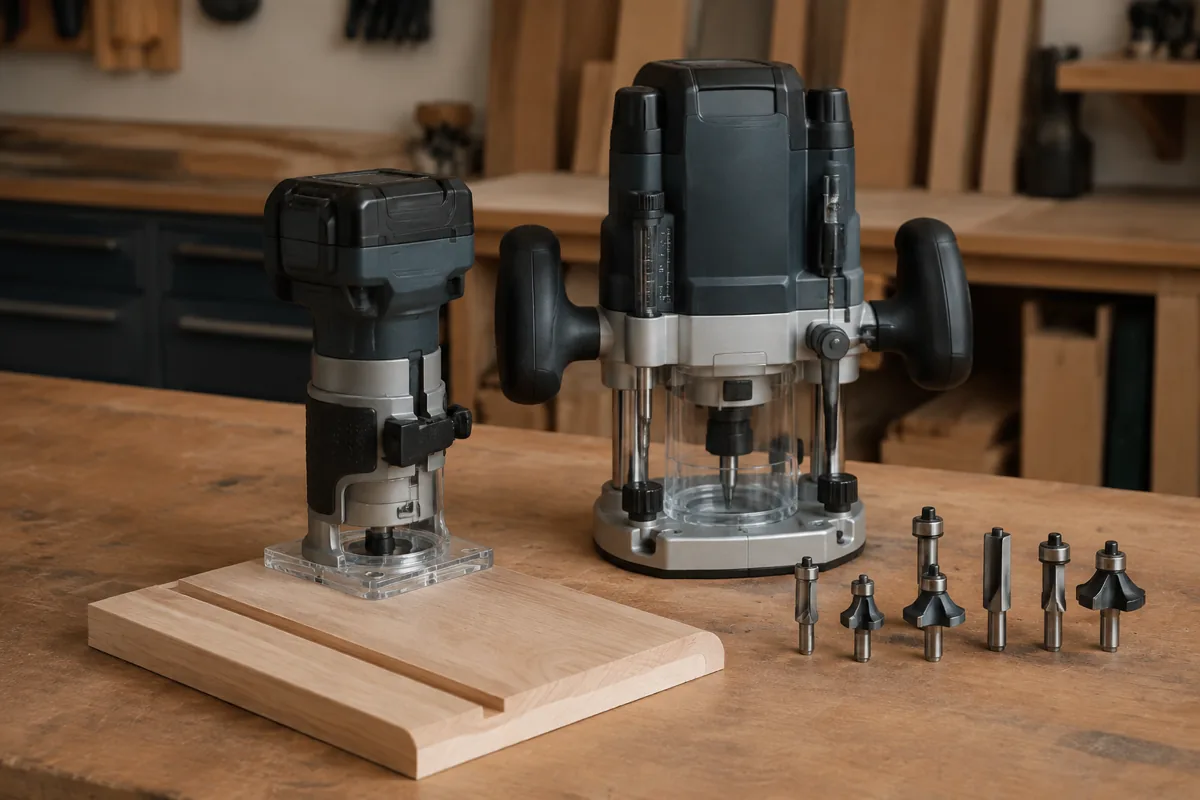
A trim router spins a bit at roughly 20,000 to 30,000 rpm. With a flush-trim bit, its bearing follows the edge of the substrate while the carbide cutter removes excess laminate. The base gives you a flat reference, so the cut can stay consistent along a long edge.
An oscillating tool moves its blade through a short arc, commonly around 2 to 4 degrees. It does not remove material continuously like a router. Instead, a fine-tooth or carbide-grit blade scrapes and cuts a narrow kerf. That makes it useful in corners and against finished surfaces, but it also makes long, straight laminate cuts slow and difficult to keep perfectly even.
| Job | Cordless trim router | Cordless oscillating tool |
|---|---|---|
| Flush-trimming countertop laminate | Best choice; fast and consistent | Possible, but slow and wavy |
| Cutting a small notch or corner | Good with a template or guide | Very good in tight spaces |
| Trimming laminate flooring around jambs | Usually awkward | Best choice |
| Dust control | Usually better with a vacuum port | Often poor; fine dust spreads around the cut |
| Learning curve | Moderate; bit direction matters | Low, but blade control still matters |
Where the trim router wins
The router is the right choice when the visible edge matters. A flush-trim bit can remove a 1/16-inch to 1/8-inch overhang in a single controlled pass, depending on the laminate and substrate. Use a sharp, carbide-tipped bit and let the tool feed at a steady pace. Forcing it overheats the edge and can chip the decorative surface.
Run the router so the bit’s rotation pushes the tool against the work rather than pulling it away. On a typical outside edge, this means moving left to right when the work is positioned in front of you, but the correct direction changes on inside corners and some edge orientations. Make a test cut on scrap before touching the finished panel.
A compact router also handles bevels and roundovers. A small 1/8-inch or 1/4-inch roundover can soften a sharp laminate edge, while a bearing-guided flush-trim bit can follow a template for sink openings. For a sink cutout, drill the starting hole, support the laminate fully, and use several shallow passes rather than trying to remove everything at once.
Cordless operation is useful here because a cord is easy to catch on a countertop or workpiece. The trade-off is runtime. A small battery may last long enough for several edge-trimming jobs, but a large cutout can consume more power than expected. Keep a charged spare battery available, especially with compact 18V or 20V platforms.
Where the oscillating tool wins
An oscillating tool is better around obstacles. It can undercut a door casing so laminate flooring slides underneath, trim a narrow strip beside a wall, or cut a small notch around a pipe. Its slim blade reaches places where a router base cannot sit flat.
It is also the safer choice for a minor repair when removing only a few inches of damaged laminate. A carbide-grit blade can cut laminate and adhesive, while a fine-tooth bi-metal blade is better for thin laminate over wood. Use short strokes and let the blade work. Pressing hard increases heat, bends the blade, and can leave a dark melted edge.
The main failure mode is an uneven cut. The blade can wander, especially when cutting a long line freehand. Mark the cut clearly, apply painter’s tape over the decorative surface, and use a straightedge if the cut will be visible. Even then, expect more hand-finishing with a file or sanding block.
Batteries, chargers, and platforms
These tools make the most sense when they share batteries with tools you already own. If you have a cordless drill, impact driver, or saw in a platform, staying within that system usually saves more than choosing a theoretically better tool from another brand. You avoid another charger and another battery type.
For occasional laminate work, a compact battery is easier to handle and adds less weight to a trim router. For repeated routing, a higher-capacity pack—roughly 4.0Ah or more in an 18V/20V system—reduces battery changes, though it makes the tool bulkier. An oscillating tool is less demanding on the battery during short cuts, but long cuts through dense laminate can still drain a small pack quickly.
If you are starting from zero, compare the cost of the tool, battery, and charger rather than the bare-tool price. A cordless oscillating tool kit is often the cheaper entry point because it includes a battery and charger and can also sand, scrape, and cut wood. A trim router is more specialized, but the matching flush-trim router bit is essential; the bare tool alone cannot do the job.
A practical workflow
For countertop laminate, leave a small overhang rather than trying to cut it perfectly with a saw. Bond the laminate securely, then trim it with the router in two light passes if necessary. Keep the base flat and clear chips frequently. Finish the edge with a fine file, working toward the laminate face so you do not lift the top layer.
For flooring, use the oscillating tool to undercut jambs and make short relief cuts. For a straight exposed edge, use a guide and a router only if the panel is firmly supported and the tool can sit flat. Never cut a loose laminate sheet while holding it in your hand; vibration can grab the sheet and damage both the edge and the operator’s control.
Which one should you buy?
Choose the trim router if you expect to trim countertops, shelving, edge banding, or multiple laminate panels. It costs more once you add a battery, charger, and quality bits, but it saves time and produces cleaner edges.
Choose the oscillating tool if your laminate work is occasional, involves flooring and trim, or includes many awkward corners. The cheaper option is fine when the cut will be hidden under trim or a cabinet. It is not a substitute for a router when a long, visible edge needs to look factory-straight.
FAQ
Which one should you buy?
Related guides
- Longest Lasting Lawn Mower Battery: AGM vs Lithium vs Flooded Lifespan and Cost per Season
- Duralast Gold Lawn Mower Battery Review: U1 Fit, CCA and When to Pay for AGM
- Greenworks Pro 80V 21-Inch Mower Review: Runtime Math, Push vs Self-Propelled and Yard Fit
- Bosch High Pressure Washer Gun Replacement: Fittings, Adapters and What Fits Your Model