What's inside
As an Amazon Associate I earn from qualifying purchases. This post may contain affiliate links at no extra cost to you.
Battery compatibility is not determined by the logo on a cordless tool. It is determined by the battery platform, voltage, physical mounting system, electrical contacts, and the tool’s control electronics. Two tools from the same brand can use completely different batteries, even when both are marketed as part of the same cordless system.
In most cases, batteries only share across tools within the same voltage class and platform. A compact 12-volt tool normally cannot accept an 18- or 20-volt battery, and a high-power 36- or 40-volt tool generally cannot run from a smaller pack. Trying to force compatibility can damage the tool, battery, or charger.
Voltage classes and nominal ratings
Manufacturers use voltage numbers as a quick way to separate tool families. The number printed on the tool may be a nominal voltage, while the battery’s fully charged voltage is higher. For example, a lithium-ion pack described as 18 volts is commonly around 20 volts immediately after charging, then settles near 18 volts during use. This is why “18V” and “20V MAX” tools can have similar electrical characteristics, but their batteries are not automatically interchangeable.
Common cordless classes include compact 10.8V/12V systems, 18V/20V systems, and larger 36V, 40V, or dual-battery outdoor platforms. The marketing number alone does not prove compatibility. A 12V battery from one brand will not fit a different brand’s 12V tool, and even two product lines from the same manufacturer may use different rails, latches, and electronic communication.
| Tool class | Typical work | Battery-sharing expectation | Main trade-off |
|---|---|---|---|
| 10.8V/12V | Drilling, driving, light cutting, small repairs | Usually shares only within its compact platform | Light and convenient, but less runtime and peak power |
| 18V/20V | General construction, woodworking, renovation | Often broad sharing within one brand platform | Best balance, but heavier than compact tools |
| 36V/40V | Lawn equipment, large saws, blowers, demanding outdoor work | Usually limited to the high-voltage outdoor range | More power and runtime, with larger packs and higher cost |
Why the same brand does not mean compatible
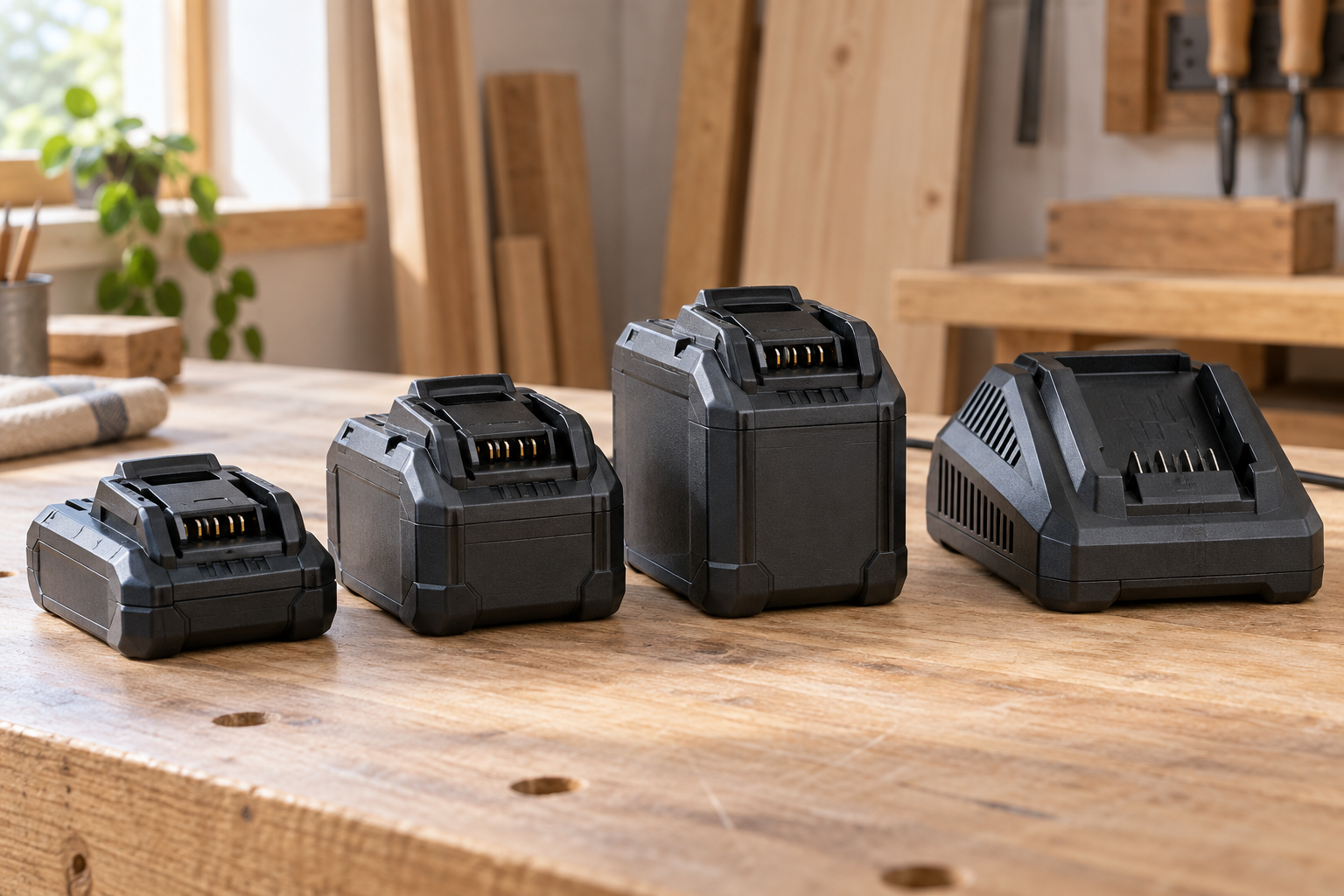
A brand may sell several battery families for different tool sizes. Compact packs use smaller housings and contacts. Full-size packs need thicker terminals and often include more sophisticated battery-management communication. High-voltage tools may use two batteries in series or a dedicated high-voltage pack.
The battery and tool can also exchange data. The tool may check pack temperature, cell voltage, current limits, and remaining charge before allowing the motor to start. A battery with the correct nominal voltage can still be rejected because the data connection or authentication system is different.
Physical fit is not a safety test. If a battery slides into a tool with excessive force, requires filing, or has loose contacts, stop. A poor connection can create resistance and heat under load. At several dozen amps, even a small amount of contact resistance can melt plastic, pit terminals, or trigger intermittent shutdowns.
What can usually share batteries
Tools explicitly listed in the same battery platform normally share packs. This commonly includes drills, impact drivers, circular saws, reciprocating saws, sanders, lights, radios, and compact vacuums in an 18V/20V family. The battery may be physically identical across those tools, although runtime and performance will vary significantly.
A 2.0Ah battery is often a sensible choice for a drill, impact driver, or inspection light. A 4.0Ah or 5.0Ah pack provides longer runtime for saws and grinders, but adds weight. High-output packs can reduce voltage sag during heavy cutting, though they cost more and are not necessary for occasional light work.
For a broad selection of compatible tools, compare 18V and 20V cordless tool platforms before buying your first tool. The platform matters more than the individual drill when you expect to add tools later.
Adapters and mixed platforms
Battery adapters exist, but they are not a universal solution. Some adapters only change the mechanical mounting and pass the battery’s voltage directly to the tool. Others omit temperature or communication connections. The tool may run, but its low-voltage cutoff, overload protection, or battery gauge may no longer work correctly.
Never use an adapter to put a higher-voltage battery on a lower-voltage tool. A nominal 20V pack on a 12V tool can overheat the motor and control board. Even an adapter advertised as compatible may void the warranty. Adapters are most defensible when moving a battery between closely related platforms at the same nominal voltage, and only when the adapter maker clearly lists both the battery and tool families.
Do not charge an adapted battery in a charger made for the other platform. Use the charger designed for that exact battery family. Chargers regulate current and voltage, monitor temperature, and often communicate with the pack. A generic power supply or incorrect charger can cause overheating, swelling, venting, or fire.
How to check before buying
Start with the battery part number or platform name, not just the brand. Check the tool’s manual and the manufacturer’s compatibility chart. Look for an exact statement that the tool accepts the battery series you own. Product listings that say “compatible with [brand] batteries” without naming the platform deserve caution.
Inspect the battery mount, but treat it as confirmation rather than proof. Check the number and arrangement of terminals, latch position, and whether the pack is slide-on or stem-style. Also confirm whether the tool requires one battery or two, and whether both batteries must be from the same series and capacity.
For a small collection, buying the bare tool can be cheaper if you already own several suitable batteries and a charger. If you are starting from zero, a kit with one battery and a charger is often better value. For occasional DIY work, a basic 2.0Ah kit is usually enough; spending more on premium high-output packs makes sense for repeated sawing, grinding, or outdoor equipment use.
A practical starting point is to choose a cordless tool starter kit with a battery and charger, then add bare tools from that same platform. If you need outdoor equipment, keep it separate unless the manufacturer explicitly includes those tools in the same battery family; large outdoor packs are often heavier and substantially more expensive.
Failure modes to avoid
Common mistakes include assuming 18V and 20V labels guarantee interchangeability, using a physically modified battery, mixing old nickel-cadmium chargers with lithium-ion packs, and buying third-party packs with unknown protection circuitry. A battery that becomes unusually hot, swells, smells sweet or solvent-like, or shuts down repeatedly should be removed from service and recycled through an approved battery program.
When compatibility is uncertain, the cheapest safe option is usually a manufacturer-approved battery or a different bare tool within your existing platform. The cost of one correct battery is small compared with replacing a burned-out tool, and far smaller than dealing with a damaged lithium-ion pack.
Related guides
- Longest Lasting Lawn Mower Battery: AGM vs Lithium vs Flooded Lifespan and Cost per Season
- Duralast Gold Lawn Mower Battery Review: U1 Fit, CCA and When to Pay for AGM
- Greenworks Pro 80V 21-Inch Mower Review: Runtime Math, Push vs Self-Propelled and Yard Fit
- Bosch High Pressure Washer Gun Replacement: Fittings, Adapters and What Fits Your Model