What's inside
As an Amazon Associate I earn from qualifying purchases. This post may contain affiliate links at no extra cost to you.
Choosing one cordless battery platform for several tools can save money and reduce clutter, but only if the tools have similar power and usage demands. A compact drill battery may be excellent for driving screws and useless for a high-draw saw. The best decision is not always “buy every tool from one brand.” It is to identify which tools you use together, how hard they work, and whether sharing batteries creates a real advantage.
Start With the Tools You Use Most
Make a list of the cordless tools you expect to buy over the next three to five years. Separate them into three groups: everyday tools, occasional tools, and specialty tools. Your everyday group should determine the battery ecosystem. A drill, impact driver, work light, and compact reciprocating saw often make a sensible core. A grinder, circular saw, blower, or chainsaw may need larger batteries even if they carry the same brand logo.
Look at actual work rather than tool labels. A drill used for cabinet hardware may run for weeks on a small battery. The same drill used to bore dozens of 1-inch holes through framing lumber will consume considerably more energy. Similarly, a compact impact driver can share small packs effectively, while a high-torque impact wrench may justify its own larger batteries.
If you are building a basic home kit, compare cordless drill and impact driver combo kits first. Kits usually cost less than buying two bare tools and a charger separately, but check the included battery sizes before deciding.
Understand Voltage and Battery Size
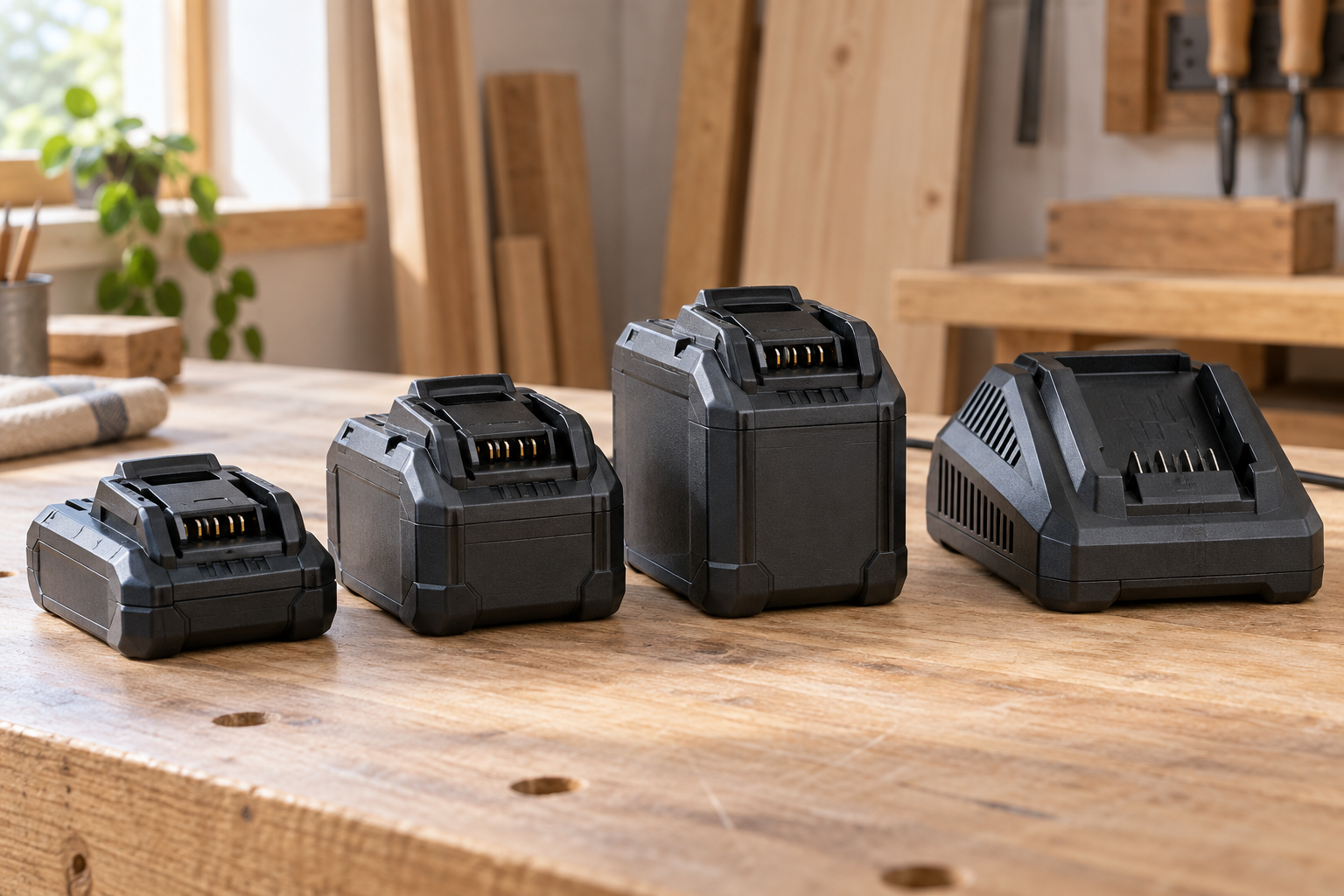
Voltage classes are useful, but they do not tell the whole story. Within one platform, a 2.0Ah battery and a 6.0Ah battery may power the same tool, yet they deliver different runtime, weight, and peak performance. Amp-hours are roughly a measure of stored capacity: a 4.0Ah pack should last about twice as long as a 2.0Ah pack under comparable conditions, though heat, tool design, and battery age affect the result.
| Battery type | Best use | Main advantage | Main drawback |
|---|---|---|---|
| Compact 1.5–2.0Ah | Drills, drivers, lights, finish work | Low weight and good balance | Short runtime on saws and grinders |
| Mid-size 3.0–5.0Ah | General construction and remodeling | Good compromise of runtime and weight | Heavier and slower to charge |
| Large 6.0–12.0Ah | Saws, blowers, grinders, outdoor equipment | Long runtime and stronger sustained output | Expensive, bulky, and tiring in handheld tools |
Do not put a large battery on every tool simply because it lasts longer. A 6.0Ah pack can make a drill awkward overhead, while a 2.0Ah pack may trigger thermal protection in a saw before the cut is finished. For most homeowners, two compact packs and two mid-size packs are more useful than one very large battery.
Check Compatibility Before Buying
Battery compatibility is usually limited to a brand’s specific voltage platform and product family. A battery that fits physically may not be electrically approved for every tool. Some brands also have separate professional and consumer lines that look similar but do not share packs. Confirm compatibility on the manufacturer’s documentation, not just a marketplace listing.
Older and newer batteries within a platform may also behave differently. A tool can run on an older pack but deliver less power, shorter runtime, or more frequent shutdowns. Brushless tools commonly make better use of modern high-output batteries, but that does not mean every premium battery is a sensible purchase for light DIY work.
Chargers are part of the platform cost. A fast charger can be useful when you have one battery and a full day of work, but it may add little value if you own four packs and rotate them. Charging times vary, but a heavily depleted large pack can take well over an hour on a standard charger. Keep batteries indoors, allow hot packs to cool before charging, and replace packs that are swollen, cracked, or unusually hot.
Match Platform Size to the Job
For light maintenance, furniture assembly, shelving, and occasional drilling, a compact 12V-class system is often enough. These tools are smaller and easier to control. They are a poor choice for repeated framing, long screws, masonry drilling, or cutting thick material.
An 18V or 20V-class platform is the practical middle ground for most homeowners and remodelers. It covers drills, impact drivers, circular saws, reciprocating saws, oscillating tools, sanders, and many outdoor tools. A typical 18V or 20V cordless battery platform gives you the broadest selection, but tool availability varies by brand and region.
High-output systems make sense for demanding work: cutting structural lumber all day, grinding metal, running large blowers, or using cordless outdoor equipment for extended periods. They cost more and add weight. If you use a grinder for five minutes to sharpen a mower blade, buying into the largest system is hard to justify. If you grind or cut steel weekly, the extra battery capacity and cooling performance can pay for itself in fewer interruptions.
Compare Total Cost, Not Sticker Price
Calculate the price of the tools, batteries, chargers, and replacements you will actually need. A cheap bare tool is not cheap if it requires a new charger and two batteries. Conversely, a discounted kit can be a poor deal when it includes batteries too small for your main tool.
Brand ecosystems also differ in tool depth. Before committing, search for the less common tools you may need later, such as a rotary tool, inflator, compact router, or cordless vacuum. If only the basic drill and driver are available, sharing batteries will not help with future purchases.
When two platforms meet your needs, choose based on ergonomics, warranty support, local availability, and battery prices. A tool that feels uncomfortable can waste more time than a slightly slower charger. For occasional work, the cheaper platform is often fine if it has the tools you need and genuine replacement batteries remain available.
When Not to Share Batteries
Use separate platforms when the voltage requirements are fundamentally different, the tool selection does not overlap, or one category dominates your work. For example, a homeowner may reasonably use one platform for indoor tools and a separate system for lawn equipment if the outdoor lineup is stronger and the batteries stay dedicated to those machines.
Do not buy duplicate tools just to force battery commonality. A corded grinder, corded shop vacuum, or corded circular saw can be the better choice for stationary or long-duration work. Cordless tools win when mobility matters; they are not automatically cheaper or more capable.
The practical target is a platform with enough tools to cover your real projects, two or more battery sizes for different jobs, and a charger that matches your work pace. Start with the most-used tools, verify compatibility, and treat battery weight and replacement cost as seriously as advertised power.
Related guides
- Longest Lasting Lawn Mower Battery: AGM vs Lithium vs Flooded Lifespan and Cost per Season
- Duralast Gold Lawn Mower Battery Review: U1 Fit, CCA and When to Pay for AGM
- Greenworks Pro 80V 21-Inch Mower Review: Runtime Math, Push vs Self-Propelled and Yard Fit
- Bosch High Pressure Washer Gun Replacement: Fittings, Adapters and What Fits Your Model