What's inside
As an Amazon Associate I earn from qualifying purchases. This post may contain affiliate links at no extra cost to you.
The best Makita multi tool for most users doing flush cuts and grout removal is the 18V LXT brushless model (XMT03Z/DTM51Z), while the 12V CXT model (TM30DZ) is the better pick if you prioritize low weight and one-handed control for light trim and detail work.
Both platforms use Starlock-compatible interfaces and share the same oscillation principle, but they differ significantly in power delivery, SPM range, vibration damping, and which makita multi tool kit options make financial sense. This comparison breaks down where each one wins.
As an Amazon Associate we earn from qualifying purchases at no extra cost to you.

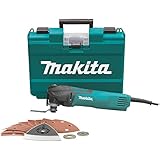


18V LXT vs 12V CXT: At a Glance
Makita currently splits its cordless oscillating tools across two battery systems. LXT is the 18V flagship platform with the largest battery and accessory ecosystem. CXT is the compact 12V platform designed for lower weight and tighter spaces. You cannot swap batteries between them, so the choice locks you into a system.
| Specification | Makita 18V LXT Brushless XMT03Z | Makita 18V LXT StarlockMax DTM51Z | Makita 12V CXT TM30DZ |
|---|---|---|---|
| Voltage Platform | 18V LXT | 18V LXT | 12V CXT (10.8V nominal) |
| Motor Type | Brushless | Brushless | Brushed |
| Oscillation Angle | 3.2 degrees (1.6 deg each side) | 3.6 degrees | 3.2 degrees |
| SPM Range (no load) | 10,000 – 20,000 SPM | 6,000 – 20,000 SPM | 6,000 – 20,000 SPM |
| Speed Dial Settings | 5-stage dial + variable trigger | 5-stage dial + variable trigger | 5-stage dial + variable trigger |
| Tool Weight (bare tool) | 2.1 kg / 4.7 lbs | 2.3 kg / 5.1 lbs | 1.1 kg / 2.4 lbs |
| Overall Length | 316 mm / 12.4 in | 340 mm / 13.4 in | 277 mm / 10.9 in |
| Blade Interface | Starlock / StarlockPlus / StarlockMax compatible with adapter | StarlockMax (tool-less, also accepts Starlock/Plus) | Starlock (tool-less) |
| Vibration Control | Anti-vibration housing, AVT counterweight | AVT with larger counterbalancer | Rubber dampened head, no AVT |
| LED Work Light | Yes | Yes | Yes |
| Typical Runtime on Full Battery | ~35-45 mins continuous at 15k SPM with 3.0Ah BL1830B | ~30-40 mins with 3.0Ah battery under load | ~25-30 mins with 2.0Ah BL1021B |
SPM Range and Real Cutting Control
Strokes per minute (SPM) is not just about top speed. The usable low end matters more for flush cuts and grout removal.
Why the Low End Matters
The 18V DTM51Z and 12V TM30DZ both dial down to 6,000 SPM, while the older XMT03Z bottoms out at 10,000 SPM. For flush-cutting door jambs or undercutting baseboard, 10,000+ SPM is often too aggressive – the blade chatters on the wood surface and burns the edge before you can control the feed. At 6,000-8,000 SPM you get a slower, more controllable bite that lets you ride the floor with a bi-metal or Japanese-tooth blade without gouging.
For grout removal, the same logic applies. Grout blades are carbide-grit or diamond-grit and generate intense friction heat. Running at 18,000-20,000 SPM clears grout faster but overheats the carbide particles and the tool’s head. Most pros run grout at 10,000-14,000 SPM on the LXT or CXT, dipping to 6,000-8,000 SPM for corners and near tile edges to avoid chipping glaze.
Power Under Load
This is where the 18V LXT separates itself. The 18V brushless motors maintain SPM under pressure. When you plunge a 32mm wide wood blade into oak jamb or press a diamond grout blade into sanded grout, the CXT will audibly bog down and drop 1,500-2,500 SPM unless you ease off. The LXT holds speed with less throttle input, which translates to straighter flush cuts and less tendency to walk out of a grout line. If your work is 80% pine, MDF, drywall, and occasional tile, the CXT keeps up. If you regularly cut hardwood, nails, or 15+ linear feet of grout, the LXT saves time and blade life.
Starlock Blade Fit: What Actually Fits What
Makita has transitioned to Starlock across both lines, but not all Starlock is equal.
- Starlock: Standard 35mm mount. Fits all three tools listed above.
- StarlockPlus: Adds deeper drive ribs for higher torque transfer. Fits XMT03Z (with OIS adapter), DTM51Z natively, and TM30DZ.
- StarlockMax: Largest 45mm mount for heavy-duty blades (wide plunge, carbide grout, heavy scraper). Only the DTM51Z accepts StarlockMax natively. The XMT03Z needs the Makita StarlockMax adapter, and the TM30DZ cannot use StarlockMax at all.
For flush cuts, this matters because the best flush-cut blades – 65mm wide bi-metal with Japanese teeth and 32mm precision wood blades – are now StarlockMax on Makita and Bosch. On the DTM51Z you snap them in tool-less. On the XMT03Z you can still use them, but with the adapter you add a small amount of stack height that slightly reduces plunge depth. On the CXT, you are limited to Starlock and StarlockPlus widths, typically max 32-35mm, which is fine for detail but slower for long jamb cuts.
For grout removal, carbide and diamond grout blades in the 70mm segmented shape and 30mm rigid grout rakes are available in all three Starlock sizes. The CXT handles the smaller Starlock grout blades well, but the wider StarlockMax grout blades that clear joints in one pass require the 18V DTM51Z.
Tool-Less Change and Dust
Both the DTM51Z and TM30DZ have a true tool-less lever clamp. The XMT03Z uses a hex bolt/adapter system that requires a wrench for some blade types. In dusty grout work, that bolt clogs with silica dust and becomes harder to tighten. A tool-less Starlock clamp wipes clean and maintains clamping force longer. If you switch between wood, grout, and scraping frequently, the lever system is a practical durability advantage.
Vibration Control and Fatigue on Flush Cuts
Oscillating tools vibrate by design. Makita’s AVT (Anti-Vibration Technology) on the 18V LXT models uses an internal counterweight that moves opposite the drive head. It does not eliminate vibration, but it lowers the 3-axis vibration value from around 11-13 m/s² on non-AVT tools to 7.5-9.5 m/s² on the LXT AVT models under the same blade and material.
The 12V TM30DZ has no AVT. It relies on rubber overmold and its lighter reciprocating mass. At low SPM it feels smoother because there is less mass moving. At high SPM for extended grout removal, it transmits more high-frequency buzz to the hand than the AVT-equipped LXT. In practice:
- For 2-4 flush cuts to install a floor transition, both are comfortable. The CXT’s 1.1 kg weight feels less tiring overhead or one-handed.
- For 20+ minutes of continuous grout or undercutting jambs in a whole room, the LXT’s AVT results in noticeably less tingling and better control, even though the tool is heavier overall.
Tip for flush cuts: let the blade do the work. Excess pressure increases vibration more than SPM does. Use a sharp blade, set SPM to 8,000-12,000, and guide the tool with the baseplate flat to the floor. A dull blade is the single biggest cause of vibration and wandering cuts.
Which Makita Multi Tool Kit Should You Buy?
A makita multi tool kit almost always costs less than buying the bare tool plus batteries and charger separately. Kits are denoted differently by platform:
- LXT kits (e.g., XMT03T, DTM51RTX): Often include one or two 18V 3.0Ah or 5.0Ah BL1850B/BL1860B batteries, a DC18RC charger, and a hard case. The RTX kits add a Starlock blade set.
- CXT kits (e.g., TM30DSAJ): Typically include two 12V 2.0Ah BL1021B batteries and a DC10SA charger in a compact case. The 4.0Ah CXT batteries (BL1041B) double runtime but add weight.
If you already own Makita LXT batteries from a drill, impact driver, or circular saw, the bare tool DTM51Z or XMT03Z is the most economical entry and keeps you on one charger. If you own no Makita batteries, compare kit pricing on the general market: CXT kits are generally in a lower price tier than LXT kits due to smaller batteries, while LXT kits cost more upfront but share batteries with over 300 LXT tools.
Decision Matrix: Pick by Your Situation
| Your Situation | Recommended Platform | Why |
|---|---|---|
| Homeowner: occasional flush cuts, trim, outlet cutouts, light grout repair | 12V CXT TM30DZ kit | Lighter, easier to control one-handed, lower investment if you don’t need LXT power |
| Flooring installer: daily jamb undercuts, subfloor and nail-embedded wood | 18V LXT DTM51Z | StarlockMax accepts wide flush blades, holds SPM in hardwood, lowest vibration for long runs |
| Tile-focused remodels: 10+ feet of grout removal per job | 18V LXT DTM51Z or XMT03Z | Higher torque maintains speed in grout, compatible with wider diamond grout blades |
| Already invested in 18V LXT batteries | 18V LXT bare tool | No need for second charger system, better runtime with 5.0Ah/6.0Ah batteries |
| Need the most compact tool for cabinet, boat, or RV work | 12V CXT TM30DZ | 277mm length and 1.1kg weight fits inside cabinets and overhead without fatigue |
| Want the lowest total cost for first Makita Cordless purchase | 12V CXT kit | General market price is typically lower than LXT kits; 2.0Ah batteries are inexpensive to replace |
Durability and Ownership Realities
Oscillating tools are hard on themselves. The head gets hot, dust infiltrates the clamp, and blades dull quickly. Here is what actually wears first:
- Clamp and tool-less lever: Grout dust is abrasive. After grout jobs, blow out the Starlock mount with dry compressed air and wipe the clamp faces. A single grain of grout trapped under a blade causes slippage and damages the drive ribs.
- Blade wear: Bi-metal wood blades lose teeth after 10-20 jamb cuts in hardwood or if they hit a nail. Carbide grout blades glaze over – you will feel the tool skating instead of cutting. Have at least two wood blades and one spare grout blade per room-sized job.
- Battery heat: Continuous grout removal at 18,000-20,000 SPM heats both the tool and battery. If the battery cuts out, let it cool 15 minutes before recharging. Using a 5.0Ah or 6.0Ah LXT battery instead of a compact 2.0Ah or 3.0Ah runs cooler because the larger pack shares the current draw.
- Common mistakes: Running at max SPM for every cut, pushing the blade sideways to steer a flush cut, and reusing a dull blade. All three increase vibration, burn marks, and motor load. Drop SPM, use a fresh blade, and keep the blade perpendicular to the cut line.
Runtime Calculation: Planning a Grout Job
Runtime helps you decide how many batteries to keep charged. As a rule of thumb, an oscillating tool draws about 120-180W under moderate load.
Energy per battery: 18V x 3.0Ah = 54Wh. Usable at ~85% efficiency = ~46Wh. At 150W average draw, theoretical runtime is 46 / 150 = 0.30 hours, or about 18 minutes of true loaded cutting. Because you pause to reposition and inspect, that stretches to roughly 35-40 minutes of on-off work time, which matches the table above.
For the CXT 12V 2.0Ah: 12V x 2.0Ah = 24Wh, usable ~20Wh, so about 8 minutes of continuous loaded cutting or 25-30 minutes of intermittent work. For a 50 square foot tile area needing grout replacement, budget one fully charged 5.0Ah LXT battery or two 2.0Ah CXT batteries, plus spares.
Bottom Line
Choose the 18V LXT DTM51Z if you want full StarlockMax blade access, the widest low-to-high SPM control, and AVT for longer flush-cut and grout sessions. Choose the lighter 12V CXT TM30DZ if most of your cuts are short, detailed, or overhead and you value compact size and a smaller kit cost over raw power. If you already live in LXT, adding the LXT bare tool keeps your makita multi tool on one battery system; if you are starting fresh and weight matters more than wide blades, the CXT kit is the practical, fatigue-friendly choice.
Frequently Asked Questions
Can I use Bosch Starlock blades on a Makita multi tool? Yes. Starlock is an open standard. Bosch, Makita, and other Starlock blades are cross-compatible within the same Starlock size. A Starlock blade fits any Starlock, Plus, or Max mount. A StarlockMax blade only fits a StarlockMax tool like the DTM51Z.
Do I need a special adapter to use Starlock blades on the older XMT03Z? The XMT03Z accepts OIS-style blades with its included adapter and can use Starlock/Plus/Max blades with the Starlock adapter. The clamp still uses a bolt for some adapters, so blade changes are slower than the tool-less lever on the DTM51Z and TM30DZ.
Which is better for grout removal, CXT or LXT? Both cut grout, but LXT holds SPM better when the diamond blade is buried in the joint and supports wider grout blades that clear faster. CXT works well for spot repairs and short runs where control and low weight help prevent tile chipping.