What's inside
As an Amazon Associate I earn from qualifying purchases. This post may contain affiliate links at no extra cost to you.
The Jet DC-1100 dust collector is a 1.5 HP, 1100 CFM single-stage machine that suits most one-car-garage and basement shops running one machine at a time through short duct runs — but its 5-micron felt bag and roughly 12-foot effective reach make it a poor fit for whole-shop central ducting or fine-dust-conscious users without a filter upgrade.
As an Amazon Associate we earn from qualifying purchases at no extra cost to you.


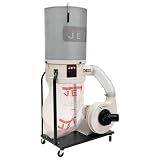

Jet DC-1100 at a Glance
The DC-1100 (often listed as the JET DC-1100VX with vortex cone) is a portable canister-style or bag-style collector on a wheeled base. It pulls air through a single 6-inch inlet — commonly split into dual 4-inch ports via a Y-fitting — and exhausts through a filter bag or cartridge above a collection bag. It’s aimed squarely at the serious hobbyist: bigger than a shop vac or wall-mount unit, smaller than a 3 HP cyclone.
| Specification | Jet DC-1100VX-5M / CK |
|---|---|
| Motor | 1.5 HP, 110V/220V (prewired varies by version) |
| Rated airflow | ~1100 CFM (manufacturer rating, unrestricted) |
| Static pressure | ~10–12 in. wg (claimed max) |
| Inlet | 6 in., typically shipped with a Y to two 4 in. ports |
| Filtration | 5-micron canister (VX-5M) or 30-micron bag (CK), depending on model |
| Collection capacity | ~5.3 cu ft bag / ~20-gallon drum equivalent |
| Footprint | ~31 × 26 in., ~67 in. tall |
| Weight | ~130–150 lbs |
| Noise | ~80–85 dB at the machine |
What 1100 CFM Actually Gets You
Manufacturer CFM ratings are measured with no duct attached — real-world airflow drops fast once you add hose, bends, and a machine port. A realistic planning number for the Jet 1100 CFM dust collector is 500–700 CFM at the tool through a short, well-run 4-inch flex hose, which is enough for a table saw, jointer, planer up to about 13 inches, bandsaw, or drum sander used one at a time.
Where it falls short: tools that need high velocity in small ports (router tables, random orbital sanders) do better on a shop vac or dedicated extractor, and long trunk-line duct layouts eat the DC-1100’s static pressure quickly.
Ducting Math: Will It Reach Your Layout?
A useful rule for this class of collector: every foot of corrugated flex hose costs roughly the same static pressure as 3 feet of smooth rigid pipe, and each 90-degree elbow acts like 6–8 feet of straight pipe.
Worked example — a garage shop with the collector in one corner:
- 10 ft of 4-in. flex hose to a jointer ≈ equivalent of 30 ft of rigid pipe
- 2 × 90° elbows ≈ 14 ft equivalent
- Total ≈ 44 ft equivalent length — comfortably within the DC-1100’s usable range
Now a basement with a central 6-inch main, three drops, and 35 ft of pipe plus wyes: you’re easily at 80–100+ ft equivalent, and airflow at the far machine can fall below the 350–400 CFM needed for effective chip capture. That’s the dividing line — this jet dc 1100 dust collector rewards point-to-point or short-run layouts, not whole-shop systems.
Filtration Reality Check
Filtration is where buying decisions matter most. The older DC-1100CK shipped with a 30-micron bag that traps chips but blows fine dust back into the room. The VX-5M’s 5-micron canister is meaningfully better, but neither is a 1-micron or HEPA solution. Planing MDF, sanding, and drum sanding generate the sub-10-micron dust that hangs in the air — many owners pair the collector with an ambient air cleaner or upgrade to a 1-micron aftermarket canister (common in the $150–250 range).
Decision Matrix: Is the DC-1100 Right for You?
| Your situation | Recommendation |
|---|---|
| 1-car garage, mobile tools, connect one hose at a time | Strong fit — DC-1100VX canister version |
| Basement shop, 2–3 fixed machines within ~15 ft | Good fit with rigid 6-in. main + blast gates |
| Whole-shop central ducting, 4+ drops, long runs | Step up to a 2–3 HP cyclone |
| Heavy sanding/MDF work, dust-sensitive household | Add 1-micron canister + ambient filter, or consider cyclone + HEPA |
| Fine benchwork only (sanding, routing, miter saw) | Overkill — a shop vac or small extractor is better suited |
| 220V not available | Verify the version; some DC-1100 models run on 110V circuits |
Ownership and Maintenance Notes
- Bag changes: the ~5 cu ft lower bag fills fast when planing — a heavy planing session can fill it in under an hour. Many owners vent into a 30–55 gallon drum with a trash-can separator lid to cut bag changes.
- Canister cleaning: the VX canister has internal flapper paddles; crank them every session or the pleats cake and CFM drops noticeably. A caked filter is the most common reason owners think the motor weakened.
- Impeller: it’s steel and survives stray offcuts well, but never run the hose near screws or knots on the floor — a hard strike can chip the housing.
- Gasket leaks: the band clamps and lid gasket weep fine dust over time; a wrap of foil HVAC tape on joints is a cheap fix.
- Noise: at ~80+ dB it shares space poorly; remote switches or wall-mounted controls are a popular add-on.
Buying Options in 2026
New DC-1100VX units typically sell in the $500–700 range depending on filter configuration, while used single-bag DC-1100s circulate widely on the used market in the $150–350 range. On used units, check for a sagging impeller (rattle at startup), a crushed or mildewed bag, and whether the motor is the original. Comparable alternatives at this size include 1.5 HP collectors from Grizzly, Shop Fox, and Laguna — compare on filter rating and canister cleaning mechanism rather than the CFM headline, which is measured the same optimistic way across brands.
FAQ
Can the DC-1100 run two machines at once?
Not effectively. With both 4-inch ports open, airflow splits and neither tool gets enough velocity for good chip capture. Use blast gates and open only one line at a time.
Is the DC-1100 enough for a 13-inch planer?
Yes — planers produce heavy chips that are easy to capture at 400–600 CFM through a short 4 or 5-inch hose. Keep the run under ~10 ft of flex hose.
Should I hard-pipe my shop around it?
Only for short layouts. If your farthest machine is more than ~15–20 duct-feet away, the static pressure loss undermines the point — a cyclone is the better foundation for permanent ductwork.