What's inside
As an Amazon Associate I earn from qualifying purchases. This post may contain affiliate links at no extra cost to you.
The best unique attachments for oscillating tool are task-specific blades, sanding accessories, grout removers, scrapers, polishing pads, and dust-control adapters chosen around the material, tool interface, and amount of work—not simply the largest accessory kit.
As an Amazon Associate we earn from qualifying purchases at no extra cost to you.



Choose by the job first
Oscillating tools are unusually versatile because the blade moves through a short arc, but that motion also creates heat, vibration, and rapid wear when an attachment is mismatched. A carbide grout blade is excellent in cementitious joints but unnecessarily aggressive on delicate tile edges; a flexible scraper can remove adhesive without cutting the substrate but may buckle against cured mortar.
| Task | Attachment to look for | Useful specifications | Main trade-off |
|---|---|---|---|
| Remove grout | Carbide-grit grout blade | 1/16–1/8 in. joint width; carbide coating or teeth | Fast removal, but can chip tile or gouge soft substrate |
| Detail sanding | Triangular hook-and-loop sanding pad | 2.5–3.5 in. point; 60–240 grit sheets | Reaches corners, though paper at the tip wears quickly |
| Scraping | Rigid or flexible scraper blade | 1.25–2.5 in. blade; high-carbon steel or bimetal | Rigid blades cut cured residue; flexible blades follow surfaces |
| Polishing | Hook-and-loop backing pad with foam or felt interface | 2.5–3 in. pad; approximately 800–3,000 grit system | More controlled than a rotary polisher, but slow on large areas |
| Flush cutting | Bi-metal, carbide-tooth, or fine-tooth plunge blade | 1–2.5 in. cutting width; 14–32 teeth per inch | Fine teeth make cleaner cuts but remove material more slowly |
| Dust collection | Brand-specific sanding or cutting dust shroud | Usually 1.25–1.5 in. vacuum port; tool-specific collar | Cleaner work area, but reduces visibility and may limit blade access |
Best specialty attachments by situation
For replacing bathroom or kitchen grout
A carbide-grit grout-removal blade is the specialist choice. Narrow versions suit approximately 1/16-inch joints, while wider versions remove material from 1/8-inch or larger joints with fewer passes. Carbide teeth or grit last longer than plain steel when working on abrasive cement grout. Diamond-grit versions generally cost more but can be useful for especially hard grout and controlled restoration work.
Use the existing joint as your guide and avoid forcing the blade into the tile corners. Start at a low or medium speed, make shallow passes, and leave a thin layer for hand removal if the joint is close to glazed tile. These attachments are a poor choice for epoxy grout unless the manufacturer specifically rates them for it; epoxy can load the abrasive and produce substantial heat.
For detailed sanding in corners and profiles
A triangular sanding pad with hook-and-loop sheets is the most useful unusual attachment for furniture repair, stair parts, window trim, and small painted areas. A 60- or 80-grit sheet removes finish quickly, 120 grit blends scratches, and 180–240 grit prepares many surfaces for paint or clear finish.
The pointed tip is also the first part to wear. Rotate the pad periodically, keep the tool moving, and do not press hard enough to flatten the point. A dust-extraction pad or perforated sanding sheet can reduce airborne dust, but the holes must align with the pad and vacuum adapter to work effectively.
For adhesive, caulk, and flooring residue
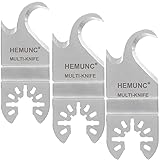
Scraper attachments divide into flexible and rigid types. A flexible stainless-steel blade is better for labels, vinyl residue, silicone remnants, and material that needs to be lifted without digging into the surface. A rigid high-carbon-steel blade is more effective against dried construction adhesive, paint drips, and carpet tack-strip residue.
For brittle adhesive, hold the blade at a shallow angle and let oscillation separate the residue. For soft adhesive, a lower speed helps prevent smearing. Scrapers are consumables: a rounded edge requires more pressure, which increases vibration and makes surface damage more likely. Lightly filing a damaged edge may restore it, but replace a blade once it becomes bent or develops a sharp burr.
For small flush cuts and plunge cuts
Fine-tooth bi-metal blades are versatile for nails, screws, wood, plastic, and thin metal. They are a good general-purpose choice when the material is uncertain. High-carbon steel blades are usually cheaper and cut clean wood efficiently, but they dull quickly if they contact hidden fasteners.
Carbide-tooth blades are the specialist upgrade for repeated nail cutting, cement board, abrasive composite, or dirty reclaimed wood. They commonly cost more than bi-metal blades, yet the longer service life can lower cost per cut when fasteners are frequent.
Match blade width to access. A 1-inch blade is easier to control in a confined opening; a 2-1/2-inch blade covers more material but creates more drag. Use a shorter exposed length whenever possible to reduce flex and wandering.
For polishing and surface restoration
Oscillating-tool polishing systems normally combine a backing pad with foam, felt, microfiber, or abrasive discs. They are suited to small, flat areas such as stone edges, painted trim, stainless-steel details, and localized scratches—not for polishing an entire vehicle panel or countertop.
Use the lowest effective speed and a small amount of compound. Excess compound can saturate the pad and make it slide. Check compatibility before polishing coated, anodized, or soft plastic surfaces, because an abrasive pad can remove more material than expected. A foam interface provides more forgiveness; a felt pad cuts more aggressively but transfers heat and pressure more directly.
Dust collection: worthwhile or restrictive?
A dust shroud is most valuable during detail sanding, drywall work, and masonry-related cutting. Look for a collar designed for your tool’s mounting area and a vacuum port compatible with your hose—commonly 1-1/4 or 1-1/2 inches. Universal shrouds can work across brands, but they may cover the sightline or interfere with plunge depth.
Dust extraction is not a substitute for suitable respiratory and eye protection. Empty the vacuum before airflow drops, inspect the shroud for cracks, and clean the tool’s ventilation openings after dusty work. A clogged filter can make a nominally effective shroud perform poorly.
Compatibility matters more than brand matching
Many modern oscillating tools use an open universal interface, but mounting patterns and retaining systems are not identical. Fein Starlock, Starlock Plus, and Starlock Max accessories require the corresponding receiver; a standard open-interface blade may not fit a Starlock-only tool. Bosch, Makita, DeWalt, Milwaukee, Ryobi, and other manufacturers sell tools and accessories with varying interface support.
Before buying, check three details:
- Mounting system: confirm whether the tool accepts universal, OIS-style, Starlock, Starlock Plus, or Starlock Max accessories.
- Clearance: verify that a dust shroud, sanding pad, or offset blade does not contact the housing or battery.
- Intended material: confirm the blade is rated for wood, metal, grout, masonry, plastic, or mixed materials as needed.
A practical buying matrix
| Your situation | Best starting choice | Why | What to avoid |
|---|---|---|---|
| Occasional homeowner, tight budget | Universal-interface kit with sanding pad, scraper, wood blade, and bi-metal blade | Covers the most common repairs without buying specialist consumables first | Large kits dominated by duplicate low-grade wood blades |
| Frequent remodeler | Separate carbide grout blade, bi-metal blade, rigid scraper, and dust shroud | Task-specific designs reduce downtime and improve control | Using one general-purpose blade for grout, nails, and wood |
| Fine-furniture or trim work | Triangular sanding system with 120–240 grit sheets and a narrow fine-tooth blade | Prioritizes clean edges and controlled detail work | Coarse carbide blades near finished surfaces |
| Heavy renovation or reclaimed wood | Carbide-tooth cutting blade plus rigid scraper | Handles embedded fasteners and hardened residue better | Cheap high-carbon blades against unknown metal |
| Small indoor workspace | Perforated sanding pad and compatible extraction shroud | Reduces cleanup and airborne dust | Oversized shrouds that block the cutting line |
Ownership costs and maintenance
Accessory price alone does not determine value. Suppose a $12 bi-metal blade lasts through 20 nail cuts while a $30 carbide-tooth blade lasts through 75. The approximate consumable cost is $0.60 per cut for the bi-metal blade versus $0.40 for the carbide blade. The carbide option is the better value in repeated fastener work, but the cheaper blade may be sensible for a one-time repair.
Keep blades dry, brush dust from sanding pads, and remove resin buildup before it hardens. Let a hot blade cool naturally rather than quenching it, which can distort some materials. Replace accessories when cutting becomes slow despite reasonable pressure, when teeth are missing, or when a sanding pad no longer holds sheets securely. Excess pressure is the most common mistake: it slows the tool, heats the accessory, and transfers vibration to the operator.
Bottom line
Choose a carbide grout attachment for joint removal, a triangular hook-and-loop pad for detail sanding, a scraper matched to the residue, a bi-metal or carbide-tooth blade for cutting, and a properly fitted shroud when dust is the priority. The most useful combination is not the biggest assortment; it is a small set whose interface, width, abrasive type, and durability match the materials and frequency of your work.