What's inside
- Best Bulb Planting Auger Drill Bits for Gardens
- Quick size guide: match the bit to the bulb
- Which diameter is best?
- Length matters, but longer is not always better
- Soil-type performance: choose for resistance
- Drill requirements and a useful runtime calculation
- Decision matrix: pick by garden and experience
- Features worth paying for
- Ownership, wear, and maintenance
- Best Bulb Planting Auger Drill Bits for Gardens
- Quick size guide: match the bit to the bulb
- Which diameter is best?
- Length matters, but longer is not always better
- Soil-type performance: choose for resistance
- Drill requirements and a useful runtime calculation
- Decision matrix: pick by garden and experience
- Features worth paying for
- Ownership, wear, and maintenance
As an Amazon Associate I earn from qualifying purchases. This post may contain affiliate links at no extra cost to you.
Best Bulb Planting Auger Drill Bits for Gardens
The best bulb planting auger drill bits for most gardens are 2 to 3 inches in diameter and 7 to 12 inches long: choose the smaller end for crocuses and small bulbs, a 2.5-inch bit for tulips and daffodils, and a 3-inch bit for large alliums, lilies, and loose soil where wider planting holes are useful.
An auger saves time by drilling a planting hole rather than forcing a trowel through every section of ground, but the right size depends on more than the bulb itself. Diameter affects clearance around the bulb, length determines whether you can reach the required depth comfortably, and soil resistance determines how much torque your drill needs. The best choice is therefore a match between bulb size, soil condition, planting frequency, and drill capability.
As an Amazon Associate we earn from qualifying purchases at no extra cost to you.
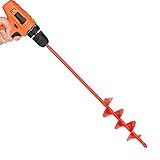


Quick size guide: match the bit to the bulb
| Bulb or planting job | Recommended diameter | Useful length | Typical hole depth | Suitable drill power |
|---|---|---|---|---|
| Crocus, snowdrop, small bulbs | 1.5–2 inches | 6–8 inches | 3–5 inches | 12V or compact 18V drill |
| Tulip, daffodil, hyacinth | 2–2.5 inches | 8–10 inches | 6–8 inches | 18V drill, 35–45 Nm torque |
| Large allium, lily, ornamental onion | 2.5–3 inches | 10–12 inches | 8–10 inches | 18V or 20V drill, 45 Nm or more |
| Naturalizing many bulbs in loose soil | 2–3 inches | 8–12 inches | Varies by bulb | 18V drill with adjustable clutch |
| Heavy clay or compacted beds | 1.5–2.5 inches | 6–10 inches | Shallow passes recommended | 18V or 20V high-torque drill |
These dimensions are working ranges, not substitutes for the planting instructions supplied with a particular bulb. A common rule is to plant a bulb at approximately two to three times its own height, measured from the bulb base to the soil surface. Some bulbs have different requirements, so check the variety before drilling dozens of holes.
Which diameter is best?
1.5- to 2-inch augers: control and low power demand
Small augers are the easiest for a compact cordless drill to turn. They suit small bulbs, containers, raised beds, and tightly planted borders where a large hole would disturb nearby roots. Their narrow flights also remove less soil, making them useful when you want the bulb to fit snugly.
The limitation is clearance. A 1.5-inch hole may be too tight for a large tulip or daffodil, especially if the soil contains clods. The bit can also clog more quickly in damp clay because there is less space between the auger and the hole wall.
2- to 2.5-inch augers: the most versatile choice
For most home gardeners, a 2- to 2.5-inch diameter is the best compromise. It accommodates common tulips, daffodils, crocuses planted generously, and many ornamental bulbs without demanding as much torque as a wide bit.
This size is also easier to control when planting at an angle near an edging or between established plants. If you want one general-purpose bit rather than a set, a 2.5-inch model around 10 inches long is a practical starting point for ordinary garden beds.
2.5- to 3-inch augers: speed and room for large bulbs
Wide augers remove more soil per rotation and create a roomier hole. That helps with large bulbs, loose backfill, and situations where you want to add a small amount of compost or grit around the bulb. They can also reduce the number of passes needed in soft soil.
The trade-off is torque. A 3-inch auger has substantially more cutting area than a 2-inch model, so it places a heavier load on the drill and the operator’s wrists. Wide bits are less forgiving of buried stones and may grab suddenly when the cutting edge catches a root.
Length matters, but longer is not always better
A long bit makes deep holes possible without repeatedly enlarging the opening, but excessive length increases leverage and makes the drill harder to control. For bulbs planted 3 to 6 inches deep, a 6- to 8-inch auger is usually sufficient. An 8- to 10-inch bit covers most tulip and daffodil work, while 10- to 12-inch versions are useful for deep planting or when the surrounding foliage makes access awkward.
Do not confuse total bit length with usable drilling depth. The chuck, shank, and tapered tip occupy part of the stated length. A bit advertised as 12 inches may provide closer to 9 or 10 inches of effective cylindrical hole depth. Mark the desired depth on the flight or shank with outdoor-safe tape before beginning.
Soil-type performance: choose for resistance
- Loose loam: Nearly any garden auger works. A medium-pitch, 2- to 2.5-inch bit gives clean holes without excessive torque.
- Sandy soil: Soil may collapse as the bit is removed. Choose a slightly wider bit, drill slowly, and place the bulb immediately after making each hole.
- Wet soil: Auger flights can pack with mud. Wait until the soil is damp but crumbly, rather than saturated, and clean the flights frequently.
- Clay: Use a narrower bit and short drilling passes. A 3-inch auger can stall or twist the drill in hard clay. Pre-moistening the bed the day before often works better than drilling immediately after heavy rain.
- Root-filled beds: A bulb auger is not a root cutter. Stop when you meet substantial roots, since tearing them can damage existing plants and overload the drill.
- Rocky ground: Do not force the auger through stones. Dig out large obstructions with a hand tool; a standard planting auger is intended for soil, not masonry or hard aggregate.
Drill requirements and a useful runtime calculation
Diameter, soil, and drilling speed determine the load. A compact 12V drill may handle small holes in loose soil, but an 18V or 20V cordless drill is a safer general choice for 2.5- to 3-inch augers. Select low gear, use the side handle if supplied, and keep both hands on the tool when the soil is firm.
As a planning example, suppose you are planting 120 tulip bulbs with a 2.5-inch auger. If each hole takes 8 seconds to drill, the trigger-on time is:
120 holes × 8 seconds = 960 seconds, or 16 minutes of drilling.
That does not mean a battery will last only 16 minutes. Slower starts, moving between holes, lifting soil, and clearing the bit add time and load. Allow roughly 30 to 45 minutes of active garden work for this job. A healthy 18V battery in the 2.0 to 4.0 Ah range will often be adequate in loose soil, while hard clay, a wide auger, or an aging battery may justify a spare.
Decision matrix: pick by garden and experience
| Your situation | Best bit choice | Why |
|---|---|---|
| Occasional planting, small budget | 2-inch × 8-inch steel auger | Low cost, broad bulb compatibility, modest drill demand |
| First-time user | 2-inch or 2.5-inch × 8-inch bit | Easier to control than a wide, extra-long auger |
| Large flower border | 2.5-inch × 10-inch bit | Good balance of speed, clearance, and depth |
| Containers and raised beds | 1.5- to 2-inch × 6-inch bit | Reduces disturbance and works with smaller drills |
| Heavy clay | 1.5- to 2-inch × 6- to 8-inch bit | Lower torque demand and easier short-pass drilling |
| Frequent professional-style planting | 2.5- to 3-inch × 10- to 12-inch bit with side handle | Faster coverage, provided the drill has sufficient torque |
Features worth paying for
Prioritize a standard hex shank that fits your drill chuck securely and reduces slipping under load. A sharpened point helps the bit start accurately, while a continuous spiral flight clears soil more consistently than a shallow decorative spiral. Thick steel at the cutting edge improves longevity, but it does not make the bit suitable for rocks.
A bit with a painted or corrosion-resistant finish is easier to clean after damp soil use. Look for a balanced shaft with minimal wobble; an uneven bit enlarges the hole, increases vibration, and places unnecessary stress on the chuck.
Ownership, wear, and maintenance
The cutting tip usually wears first, followed by the leading edge of the flight. In sandy soil, abrasive grit gradually dulls the edge; in clay, packed soil can bend or distort thin metal. Stop using a bit if the shaft is visibly bent, since wobble can become hazardous at high speed.
- Remove soil immediately after use with a stiff nylon brush or wooden stick.
- Do not strike the bit against concrete to clear packed clay.
- Dry it fully, then apply a light protective oil film before storage.
- Inspect the hex shank and chuck for rounding, which can cause slipping.
- Use low speed and steady pressure; forcing the bit creates more heat and wear than controlled drilling.
For most gardeners, the best bulb planting auger drill bit is a 2.5-inch model about 10 inches long, paired with an 18V drill and used in crumbly soil. Choose 2 inches or less when power and control matter most, and move to 3 inches only when large bulbs, loose soil, or high planting volume justify the extra torque.