What's inside
- Milwaukee M18 FUEL 2746-20: Key Specifications
- Milwaukee 18 Gauge Brad Nailer Price
- Performance Review: How Well Does the Milwaukee 2746-20 Work?
- Battery Compatibility: Which Milwaukee Batteries Work?
- Pros and Cons
- Warranty and After-Sales Support
- Is the Milwaukee 18 Gauge Brad Nailer Worth Buying?
- Frequently Asked Questions
- Final Verdict
As an Amazon Associate I earn from qualifying purchases. This post may contain affiliate links at no extra cost to you.
The Milwaukee M18 FUEL 18 Gauge Brad Nailer (2746-20) is worth considering if you want a cordless finish nailer for trim installation, cabinet work, and other detailed woodworking without dragging around an air compressor and hose. Its brushless motor, nitrogen air-spring mechanism, adjustable nail depth, and selectable firing modes make it a practical option for both professional carpenters and serious DIYers.
The main drawback is the upfront cost. The 2746-20 is commonly sold as a bare tool, meaning you need a compatible Milwaukee M18 battery and charger if you do not already own them. It also costs more than many basic pneumatic brad nailers.
Verdict: The Milwaukee 18 gauge brad nailer is a strong choice for frequent trim and finish work, especially for people already invested in the M18 battery platform. Occasional users with no compatible batteries should compare the complete ownership cost against a pneumatic nailer and compressor before buying.
Milwaukee M18 FUEL 2746-20: Key Specifications
Product reviewed: North American model 2746-20. Research date: October 22, 2026.
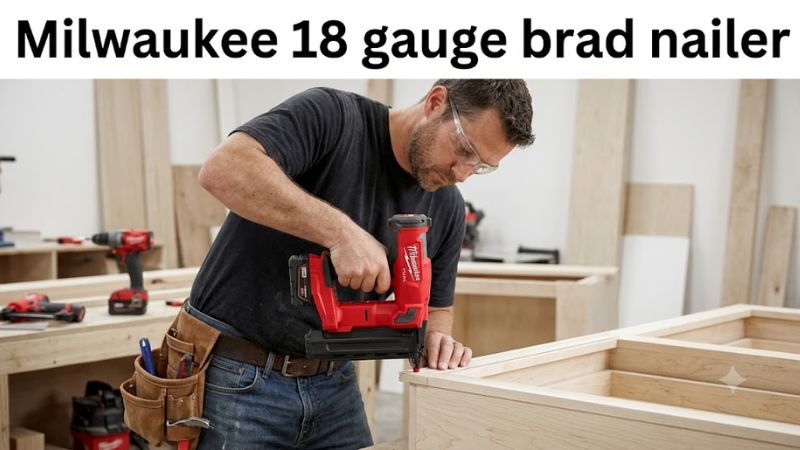
| Specification | Details |
| Brand | Milwaukee |
| Product | M18 FUEL 18 Gauge Brad Nailer |
| Model number | 2746-20 |
| Power source | Cordless battery |
| Battery platform | Milwaukee M18 |
| Motor | POWERSTATE brushless |
| Fastener type | 18-gauge brad nails |
| Compatible nail length | 5/8–2-1/8 inches |
| Firing modes | Sequential and contact actuation |
| Depth adjustment | Tool-free |
| Jam clearing | Tool-free jam-clearing latch |
| Additional features | LED work light, adjustable belt hook |
| Battery and charger | Not included with the 2746-20 bare tool |
| Nitrogen air spring | Yes |
| Compressor or gas cartridge | Neither is required for normal operation |
Specifications are based on Milwaukee’s official product information and operator’s manual. Confirm the packaging and regional product listing before purchasing, particularly when comparing bare-tool and kit configurations.
Milwaukee 18 Gauge Brad Nailer Price
The right price depends on whether you are buying the bare tool or a kit with a battery and charger.
| Configuration | Price reference | What you get |
| 2746-20 bare tool | $329 | Nailer only; battery and charger sold separately |
| 2746-21CT kit | Verify current retailer price | Nailer, one M18 CP2.0 battery, M18/M12 multi-voltage charger, reversible belt hook, and contractor bag |
US pricing research checked October 22, 2026. The $329 bare-tool price was listed by Home Depot; it is a retailer listing, not a guaranteed current checkout price. Kit contents are based on Milwaukee’s official product information.
Is the bare tool worth $329?
At that price, the 2746-20 makes the most sense for someone who already owns compatible M18 batteries and a charger. Existing batteries reduce the additional cost of adding the nailer to your workshop.
If you are starting from scratch, compare the price of the kit with the combined cost of the bare tool, battery, and charger. A kit may provide better value, although the included 2.0Ah battery is not necessarily the best choice for every workload.
Prices, promotions, inventory, and package contents can change. Check the exact model number and included accessories before paying.
Performance Review: How Well Does the Milwaukee 2746-20 Work?
Milwaukee designed this nailer for finish carpentry where consistent nail placement, portability, and clean results matter more than the lowest purchase price.
The performance assessment below draws on the manufacturer’s documentation and published independent field reviews. It is not a claim that LOA Power Tools personally tested the tool.
1. Driving power and nail depth
The 2746-20 combines a POWERSTATE brushless motor with a nitrogen air-spring mechanism. According to Milwaukee, this system drives brads into both hardwoods and softwoods without the ramp-up delay associated with some cordless nailer designs.
An independent Tool Box Buzz review reported consistent nail depth and clean holes during work with oak, maple, poplar, cedar, plywood, spruce, and laminated veneer lumber. Its findings support the nailer’s suitability for varied trim materials, but they should not be interpreted as a guarantee of identical results in every wood species or board.
Practical takeaway: The tool is a compelling option for baseboards, casing, decorative trim, and cabinet projects that require repeatable fastening. Test nail depth on a scrap of the actual material before starting visible work.
2. Nail size and applications
The nailer accepts 18-gauge brad nails measuring 5/8 to 2-1/8 inches long. These relatively slender fasteners are useful for attaching narrow trim, securing small molding, and holding components while adhesive cures when the project calls for that method.
Typical applications include:
- Baseboards and door or window casing.
- Crown molding and decorative trim.
- Cabinet face-frame details and light woodworking.
- Small furniture projects and other finish-carpentry jobs.
An 18-gauge brad nailer is not a replacement for a framing nailer or a heavier finish nailer when a project requires larger fasteners or greater structural holding capacity. Select the fastener and joint according to the project’s design rather than relying on nail length alone.
3. Firing speed and operating modes
Milwaukee’s product literature advertises a firing rate of up to three nails per second. That is a manufacturer-stated maximum, not a guarantee of sustained production under every material, battery, or operating condition.
The two firing modes serve different purposes:
- Sequential actuation: Better suited to deliberate, controlled placement where accuracy matters.
- Contact actuation: Useful for faster repetitive fastening when the work and operating conditions permit it.
Use the firing mode appropriate to the task, maintain control of the tool, and follow the operator’s manual. Do not prioritize speed over accurate placement or safe handling.
4. Ergonomics and access to tight spaces
Milwaukee highlights the nailer’s compact nose area, LED work light, and adjustable belt hook. Independent reviews also describe improved visibility around the nose and reduced recoil compared with an earlier version of the design.
These features are useful when working near corners, around cabinet details, or along trim edges. However, cordless nailers remain bulkier than many pneumatic nailers because the motor and battery are integrated into the tool.
The weight also changes with the battery installed. If you regularly work overhead or install trim throughout a large house, consider the complete tool-and-battery weight rather than evaluating the bare tool alone.
5. Jams, maintenance, and dry-fire protection
The tool has a tool-free jam-clearing latch and depth adjustment. These features simplify routine adjustments and clearing an accessible fastener jam when performed according to the manual.
The kit version, 2746-21CT, also lists dry-fire lockout, which helps prevent firing when the magazine is empty. Verify the exact features and package associated with the model you purchase.
The nitrogen air-spring system eliminates the need for disposable gas cartridges during normal operation. It does not mean the tool is maintenance-free or that its internal mechanism should be dismantled by the owner. Milwaukee’s service documentation directs repair of the combined compressed-air system and electronics through an authorized repair process.
Battery Compatibility: Which Milwaukee Batteries Work?
The 2746-20 uses Milwaukee’s M18 battery platform, rather than the M12 platform. Milwaukee lists REDLITHIUM batteries as its power source and does not include a battery with the bare tool.
Before buying, check the following:
- Battery platform: Use a compatible Milwaukee M18 battery, not an M12 battery or a pack from another voltage family.
- Battery capacity: The amp-hour (Ah) rating describes capacity, not the tool’s nail-driving force. A larger pack may be useful for longer work sessions but adds weight.
- Charger: Use a Milwaukee charger specified for the battery pack. The M18/M12 multi-voltage charger is included in the 2746-21CT kit.
- Runtime: Actual nails per charge depend on battery condition and capacity, material, nail length, firing frequency, and operating conditions. No single runtime figure should be assumed for every setup.
If you already own compatible M18 tools, the shared battery platform is a major advantage. If you own only M12 tools, account for the cost of entering the M18 system.
Pros and Cons
| Pros | Cons |
| No compressor or air hose required | Relatively high initial cost |
| Brushless motor and nitrogen air-spring mechanism | Heavier than many pneumatic nailers |
| Accepts 18-gauge brads from 5/8 to 2-1/8 inches | Bare tool does not include a battery or charger |
| Tool-free depth adjustment | Nail depth still needs to be checked for each material |
| Sequential and contact firing modes | Not designed to replace framing or heavy finish nailers |
| Tool-free jam-clearing latch | Internal repairs may require authorized service |
| Compatible with the Milwaukee M18 battery platform | Best value depends on whether you already own M18 batteries |
Warranty and After-Sales Support
Milwaukee’s US and Canadian warranty information lists a five-year limited warranty for qualifying air nailers and staplers, subject to the applicable terms and exclusions. Confirm the coverage for the exact product, purchase region, and seller before buying. Keep your receipt or invoice to help establish the purchase date.
For a used or discounted tool, check its condition, serial or date code, and proof of purchase. A low price is less attractive if the tool has a damaged nose assembly, inconsistent firing, or an uncertain service history.
Because the nailer combines electronics and a compressed-nitrogen mechanism, do not assume that internal repairs are as simple as replacing a part in a conventional pneumatic nailer. Consult Milwaukee’s service guidance for faults that cannot be resolved through the operator’s manual.
Is the Milwaukee 18 Gauge Brad Nailer Worth Buying?
The 2746-20 is worth buying when its cordless convenience and finish-carpentry capabilities justify the price.
Buy it if…
- You regularly install trim, casing, or cabinet details.
- You already own Milwaukee M18 batteries and a compatible charger.
- You want to work without an air compressor, hose, or gas cartridges.
- You value selectable firing modes and tool-free adjustments.
Skip it if…
- You only need a nailer for an occasional small DIY project.
- Your priority is the lowest upfront cost.
- You already have a suitable pneumatic nailer and compressor.
- Your work requires framing nails or heavier structural fastening.
Alternatives worth considering
The best alternative depends on whether you prioritize cordless convenience, lower initial cost, or a different fastener type.
- A pneumatic 18-gauge brad nailer: Worth comparing if you already own a compressor. The nailer itself can cost less, but you must account for the compressor, hose, fittings, and setup.
- A different cordless 18-gauge nailer: Compare nail-length range, tool-and-battery weight, jam clearing, firing modes, warranty, and the battery system you already own. Do not assume all cordless nailers deliver equivalent results simply because they accept the same gauge.
- A 16-gauge finish nailer: Consider this category when your work requires a thicker finish fastener. It is not a direct substitute for the smaller brads used in delicate trim applications.
For most existing M18 users who perform finish carpentry regularly, the 2746-20 is the most straightforward choice among these options. For a first-time DIY buyer, the total cost of the cordless setup deserves more scrutiny.
Frequently Asked Questions
1. What size nails does the Milwaukee 18 gauge brad nailer use?
The Milwaukee 2746-20 accepts 18-gauge brad nails from 5/8 inch to 2-1/8 inches long. Choose the length based on the material thickness, fastening requirements, and the manufacturer’s guidance for the project.
2. Does the Milwaukee 2746-20 come with a battery and charger?
No, the 2746-20 is the bare-tool model and does not include a battery or charger. The separate 2746-21CT kit includes one M18 CP2.0 battery, an M18/M12 multi-voltage charger, a reversible belt hook, and a contractor bag.
3. Can the Milwaukee M18 brad nailer replace a pneumatic nailer?
Yes, it can replace a pneumatic brad nailer for many finish-carpentry jobs, provided the required fastener type and length are supported. It offers cordless convenience without a compressor or hose, but the higher purchase cost, tool weight, and battery requirements may make pneumatic equipment more economical for some workshops.
4. Is the Milwaukee 2746-20 suitable for hardwood?
Yes, Milwaukee specifies the nailer for driving brads into both hardwoods and softwoods. Independent testing has also reported consistent fastening in several wood species, including oak and maple. Results still depend on the wood, nail length, material thickness, and depth setting, so test on scrap before fastening finished surfaces.
Final Verdict
The Milwaukee M18 FUEL 18 Gauge Brad Nailer 2746-20 is a worthwhile cordless finish-carpentry tool for regular users, particularly those who already own Milwaukee M18 batteries. Its brushless motor, nitrogen air-spring mechanism, supported nail range, and adjustable firing options make it a practical choice for trim, cabinetry, and detailed woodworking.
The $329 US bare-tool listing provides a useful price reference, but it is not necessarily the best deal for someone who also needs a battery and charger. Compare the full kit price, warranty, and cost of ownership before making a decision.
For frequent professional use, the convenience may justify the expense. For occasional home repairs, a less expensive pneumatic nailer or another suitable cordless option may offer better value.